

Cleaning removes food scraps, grease, dirt and other residues from food contact surfaces, while sanitising reduces the microorganisms left on those cleaned surfaces to a level that does not compromise food safety. A food contact surface is any part of equipment, a utensil or a work area that directly touches food. Cleaning must come before sanitising because food residue and leftover detergent interfere with sanitiser performance. A professional provider cleans and sanitises food equipment in six steps: pre-clean, wash, rinse, sanitise, final rinse where required, and dry and store. Sanitising uses heat, a food-contact chemical sanitiser or a sanitising dishwasher cycle, and verification combines visual inspection, chemical-strength checks, temperature and time checks, and where needed ATP or swab testing. Australian food businesses must keep food-contact surfaces clean and sanitary under Standard 3.2.2 of the Food Standards Code. Sydney kitchens that cannot deliver documented, repeatable results in-house hire a commercial kitchen cleaning service such as Westlink Commercial Cleaning, which is fully insured, uses police-checked crews and offers a free site assessment.
What Is the Difference Between Cleaning and Sanitising Food Contact Surfaces?
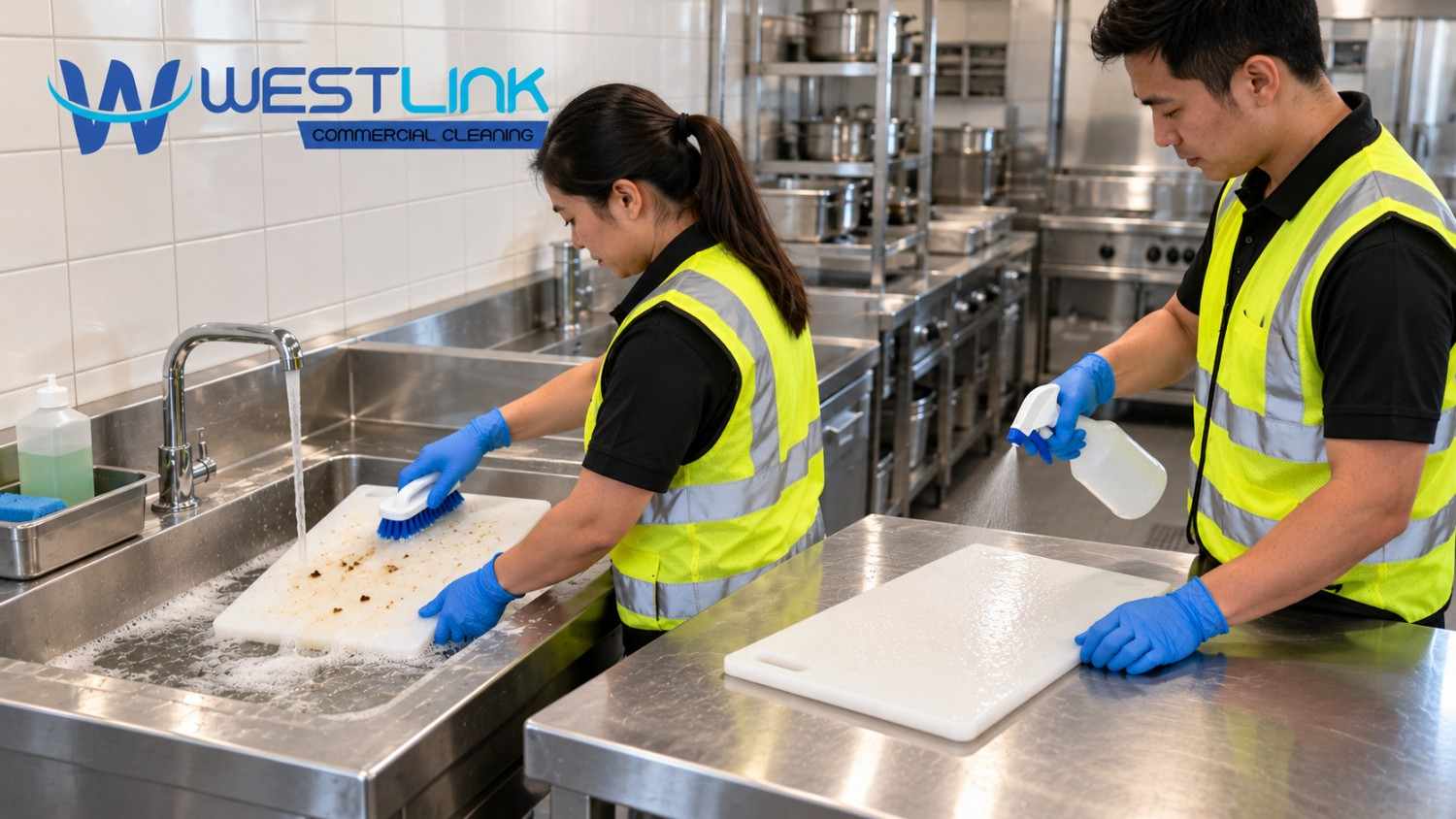
The difference between cleaning and sanitising is the type of contamination each process controls: cleaning physically removes soil, and sanitising reduces the microorganisms that remain on a previously cleaned surface. Neither step replaces the other. The professional performs both on every food-contact surface it services in Sydney commercial kitchens.
| Point of comparison | Cleaning | Sanitising |
| Main purpose | Removes food residue, grease, dirt and other soil | Reduces remaining microorganisms to a safe level |
| Typical method | Detergent, water and physical action such as scrubbing | Heat, a suitable chemical sanitiser or an approved combination of methods |
| Visible result | The surface looks and feels clean. | The surface may look unchanged despite reduced microbial contamination. |
| Position in the process | Comes first | Follows effective cleaning and, usually, a rinse |
| Key control | Complete soil and detergent removal | Correct treatment, concentration, coverage, temperature and contact time |
| Check | Visual inspection and, where useful, residue testing | Chemical-strength testing, or temperature and time monitoring |
Sanitising also differs from sterilising, which aims to destroy all microorganisms, including resistant spores. Routine food contact surfaces need to be clean and sanitary, not sterile. FSANZ explains this distinction in its guidance on cleaning and sanitising surfaces and utensils.
What Counts as a Food Contact Surface in a Commercial Kitchen?
A food contact surface is any part of equipment, a utensil or a work area that directly touches food during preparation, processing, storage or service. Contamination on these surfaces transfers to the next food they touch, so professionals treat each one as a priority area. Common examples include:
- Chopping boards, knives, food preparation benches and serving tongs.
- Meat slicer blades, food processor bowls, blender jugs and mixer attachments.
- Reusable trays, containers, dispensing nozzles and food-contact conveyor belts.
- Probe thermometers that touch food during temperature checks.
Edges, seals, joints, cutting grooves and removable parts trap residues even when the main surface appears clean. Professional technicians dismantle removable parts where the manufacturer allows it, and they flag scratched or damaged utensils for repair or replacement because damaged surfaces cannot be cleaned effectively.
Why Must Food Contact Surfaces Be Cleaned Before Sanitising?
Food contact surfaces must be cleaned before sanitising because food residues and leftover detergent interfere with sanitiser performance. Grease and protein deposits shield microorganisms from the treatment, and some residues react with or weaken sanitising chemicals.
A meat slicer shows the problem clearly. Spraying sanitiser on a blade coated with fat does not remove the fat or ensure that the treatment reaches every part of the blade. A trained technician removes the residue first, washes and rinses the accessible components, then applies the sanitising method specified for that equipment.
The order matters most when a kitchen moves between raw food and ready-to-eat food. Raw poultry can carry Campylobacter or Salmonella, and a contaminated knife or board reused for salad ingredients can transfer those microorganisms to food that receives no further cooking.
Cleaning also controls allergen cross-contact, a job sanitising does not do. A sanitiser may reduce microbes without removing proteins from milk, egg, peanut or other allergens, so kitchens with allergen risks need an effective cleaning process and, sometimes, allergen-specific verification. The UK Food Standards Agency’s review of allergen cleaning discusses this distinction.
How Professionals Clean and Sanitise Food Equipment in 6 Steps?
The professional procedure for cleaning and sanitising food equipment is to pre-clean, wash, rinse, sanitise, complete any required final rinse, and dry hygienically. This six-step sequence follows FSANZ guidance, and the equipment instructions and sanitiser label set the specific conditions. (Steps may vary from company to company; Westlink Commercial Cleaning follows the below six steps.)
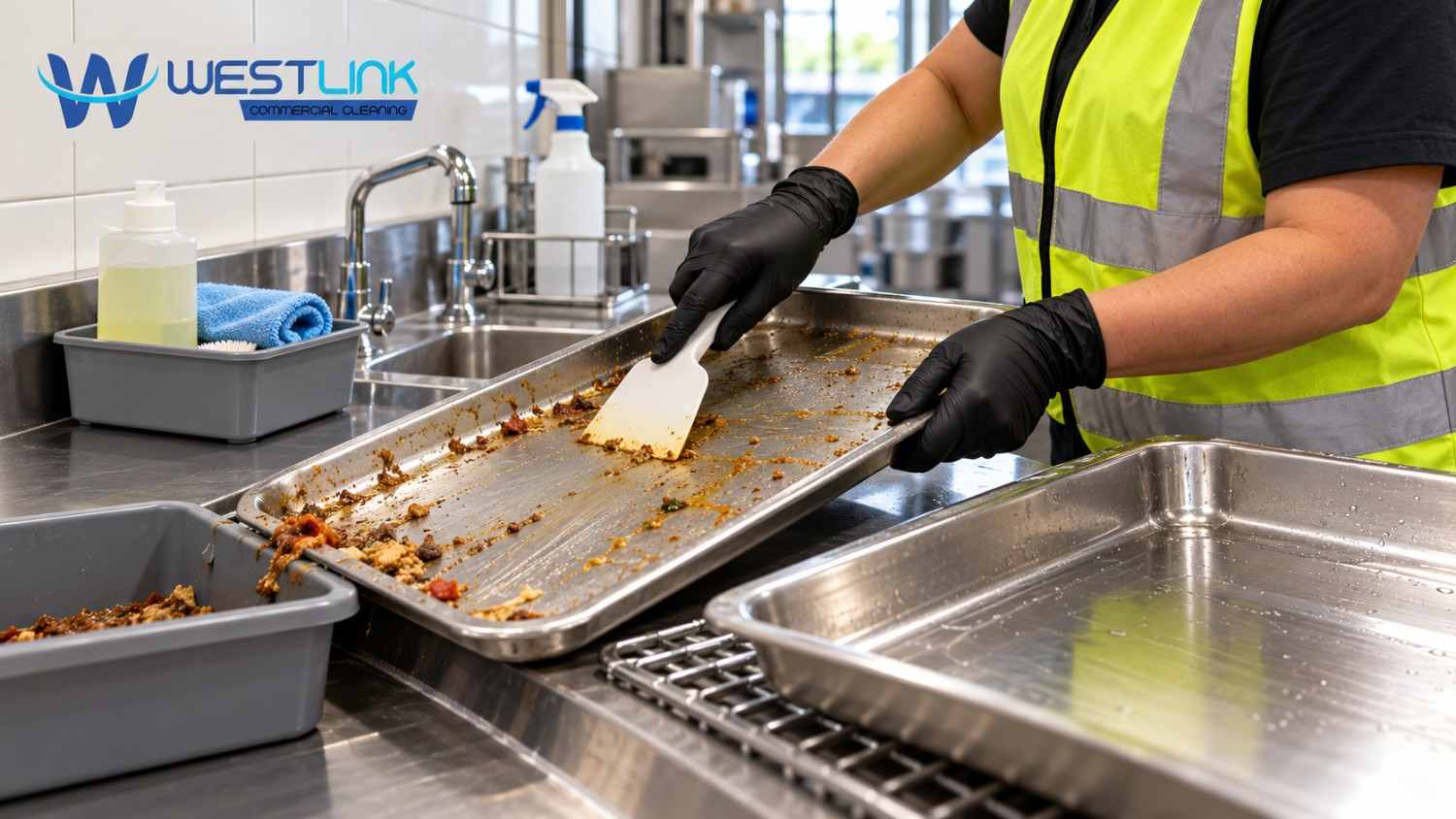
- Pre-clean. Pre-cleaning removes loose material before detergent is applied. Technicians scrape or wipe away food scraps, dispose of waste safely and dismantle equipment such as slicers and mixers according to the manufacturer’s instructions.
- Wash. Washing uses a suitable detergent, water and mechanical action to detach food soils from the surface. Technicians scrub cutting grooves, joins and other difficult areas, and they use the water temperature and detergent concentration recommended for the product and equipment.
- Rinse. Rinsing carries away loosened residues and cleaning chemicals before sanitisation. If grease, particles or detergent film remain, the technician repeats the wash step instead of moving on to sanitising.
- Sanitise. Sanitising treats the cleaned surface with heat, a commercial product labelled for food contact surfaces, or a suitable sanitising dishwasher cycle. The technician follows the specified dilution, contact time, temperature and surface coverage because a quick spray-and-wipe does not meet the required contact time.
- Final rinse. A final rinse is required only when the sanitiser instructions call for it. Some food-contact sanitisers work without a post-sanitising rinse under stated conditions, while others need clean water to remove residues, and “food grade” does not automatically mean “no rinse.”
- Dry and store. Hygienic drying and storage preserve the result of cleaning and sanitising. Technicians air-dry equipment where practical, or use clean single-use towels, and they place sanitised items in clean storage areas.
If a surface still carries residue after washing, the procedure returns to the cleaning stage. If the sanitising concentration, temperature or contact time was wrong, the technician corrects the process and sanitises again.
How to Sanitise Food Contact Surfaces in a Commercial Kitchen: Heat, Dishwasher and Chemical Methods
Commercial kitchens sanitise food contact surfaces with heat, a suitable chemical sanitiser, or a properly operated dishwasher with a sanitising cycle. The correct method depends on the material, the equipment design, the food safety risk and the manufacturer’s instructions.
Heat sanitisation. Heat sanitisation uses sufficiently hot water for a sufficient duration to reduce microorganisms. FSANZ gives immersion at 77°C for 30 seconds as an example method for suitable items. This is guidance, not a universal legal time-and-temperature setting for every process, and staff need suitable equipment and scald precautions.
Dishwasher sanitisation. A commercial dishwasher achieves sanitisation through heat or chemical dosing, depending on its design. Operators load utensils so water reaches every surface, run the manufacturer-designated sanitising programme, and maintain the machine, filters and spray arms.
Chemical sanitisation. Chemical sanitisation applies a food-contact-suitable antimicrobial product under its specified use conditions. Active ingredients include chlorine compounds, quaternary ammonium compounds, iodine compounds and peracetic acid, and the product instructions, not the chemical name, determine suitability. Before use, a technician confirms:
- The product suits the exact food-contact surface.
- Whether it is ready to use or needs dilution.
- The required concentration, contact time, temperature and complete coverage.
- Whether a final rinse is necessary and how long the prepared solution stays usable.
- The safe handling, labelling and storage instructions.
Technicians use test strips or another recommended method to monitor chemical strength, and they never mix sanitisers with other chemicals because incompatible products can release hazardous substances. The NSW Food Authority’s chemical sanitiser guidance lists practical product-selection and application checks.
Combined detergent-sanitiser products. A combined detergent-sanitiser supports a validated procedure only when its label and operating method establish that both functions are achieved. A product name alone does not prove that a heavily soiled surface is cleaned and sanitised in one application, so the supplier’s instructions on separate cleaning, rinsing or reapplication apply.
How Does a Professional Provider Verify That Sanitising Worked?
A professional provider verifies sanitising by checking both visible cleanliness and whether the sanitising process met its required conditions. No single routine test proves the absence of every pathogen or allergen, so professionals combine several checks:
- Visual and tactile inspection detects food particles, grease and damaged surfaces, but it cannot confirm microbiological safety.
- Sanitiser test strips and dosing checks confirm that a chemical solution has the intended concentration, though they do not measure the microorganisms left on a surface.
- Temperature and contact-time checks confirm the key settings for heat or chemical procedures.
- ATP or protein-residue testing indicates remaining biological material, but it does not identify specific pathogens or prove a surface is free of allergens.
- Targeted microbiological or allergen swabs serve risk-based verification programmes, especially in food processing operations.
When a check fails, the technician recleans the surface, repeats the approved sanitising process, replaces the exhausted solution, or reports equipment faults. The professional records the problem and the correction.
What Do Australian Food Safety Standards Require of Commercial Kitchens?
Australian food businesses must keep food contact surfaces and eating and drinking utensils in a clean and sanitary condition under Standard 3.2.2 of the Australia New Zealand Food Standards Code. The standard requires a visibly clean surface with microorganisms reduced enough to protect the food and its consumers, and it does not impose one identical sanitising recipe on every business. See the FSANZ cleaning and sanitising guidance.
Some food service, catering and retail businesses that handle unpackaged, potentially hazardous, ready-to-eat food also fall under Standard 3.2.2A. Category one businesses must substantiate specified food safety controls, including cleaning and sanitising, with records or another acceptable demonstration to the regulator. Where records are required, the minimum retention period is three months. Requirements vary by business category and activity, so check the FSANZ evidence-tool guidance and your state or territory regulator.
These provisions apply in Australia only. Businesses elsewhere must follow the food safety rules, approved products and manufacturer directions of their own jurisdiction.
When Should a Commercial Kitchen Hire a Professional Cleaning and Sanitising Provider?
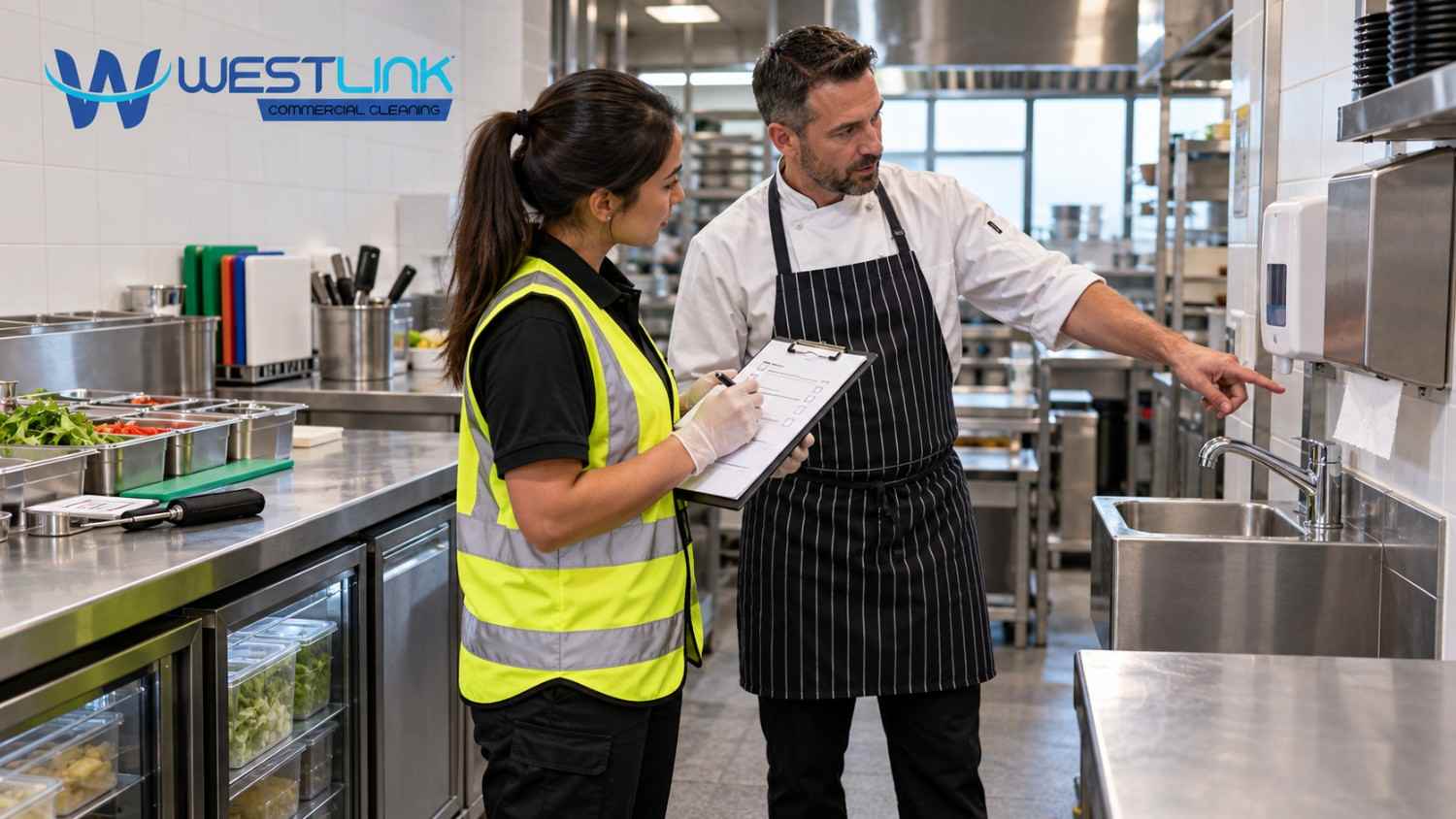
A commercial kitchen should hire a professional cleaning and sanitising provider when in-house routines cannot deliver documented, repeatable results across every shift. Common triggers include:
- Audit preparation: An upcoming council, state or third-party audit requires evidence of cleaning and sanitising.
- Heavy equipment: Slicers, mixers and conveyors need dismantling and treatment beyond routine wipe-downs.
- Staff turnover: Inconsistent training across shifts causes skipped steps or wrong sanitiser dilution.
- Failed checks: ATP, swab or inspection results show that current methods leave residue.
- Allergen risk: The kitchen needs cleaning procedures built to control allergen cross-contact.
In-house staff still handle between-task cleaning and sanitising, such as clearing a bench after raw meat preparation. A provider adds scheduled deep cleaning, documented verification and trained technicians on top of that daily work.
Frequently Asked Questions
Is cleaning enough to remove bacteria from food contact surfaces?
Cleaning removes soil and some microorganisms, but it does not reliably achieve the microbial reduction that sanitising delivers. Food contact surfaces that must be clean and sanitary need cleaning followed by an effective sanitising method.
What are food-grade sanitisers used for in a kitchen?
Food-grade sanitisers reduce microorganisms on cleaned surfaces that may contact food. They apply to approved worktops, utensils and equipment parts under their label conditions. “Food grade” does not mean a chemical is edible or that rinsing is never required.
Can detergent sanitise a food preparation surface?
Ordinary detergent primarily removes grease and food soil, and it is not automatically a sanitiser. A combined product sanitises only when its instructions support that function and the complete procedure is followed.
What is the difference between sanitising and disinfecting?
Sanitising is the food-hygiene term for reducing microorganisms on cleaned surfaces to a level appropriate for safe food contact. Disinfecting describes antimicrobial treatments in other settings and may carry different product claims, so choose a product labelled for food contact surfaces, whichever term it uses.
Does sanitising remove food allergens?
Sanitising does not reliably remove allergenic food proteins. Effective cleaning removes the residues that carry allergens, and kitchens with allergen risks need an allergen-control procedure with verification where necessary.
How often must a kitchen sanitise food contact surfaces?
Sanitising frequency depends on when a surface may contaminate food. Kitchens clean and sanitise after risky task changes, after contamination incidents, and at the intervals set in their food safety procedure.
How much does professional commercial kitchen cleaning cost?
Commercial Kitchen Cleaning by Westlink Commercial Cleaning
Westlink Commercial Cleaning cleans and sanitises commercial kitchens across Sydney, so your food contact surfaces stay compliant, audit-ready, and safe. We clean first, sanitise second, and document every visit in [report format].
Our kitchen cleaning services
- Food contact surface cleaning and sanitising: benches, slicers, mixers, utensils, and storage
- Scheduled deep cleaning: nightly, weekly, or monthly, to suit your kitchen
- Pre-audit cleaning: ready for council or third-party inspections
Related services
- Kitchen exhaust and canopy degreasing
- Floor, drain, and wall cleaning
- Cold room and freezer cleaning
- Dining area and front-of-house cleaning
- Washroom and general commercial cleaning
Why Westlink commercial cleaning? 13 years of experience, ISO certification Standards, and trained technicians who follow the six-step process: pre-clean, wash, rinse, sanitise, final rinse where required, and dry.
Book a free site assessment: +61 450 256 844 | info@westlinkcommercialcleaning.com.au