

AS 1851 requires monthly inspection of kitchen exhaust filters, hoods, plenum chambers, and grease gutters, and a full clean of the hood, plenum, and exhaust duct at least every 12 months. Cooking intensity shortens those intervals: solid-fuel kitchens clean monthly, and heavy frying and wok cooking move cleaning to monthly-to-quarterly cycles. From 13 February 2026, NSW building owners must maintain fire safety measures to AS 1851, which turns a commercial kitchen exhaust schedule into a compliance obligation enforced through the fire safety schedule, the Annual Fire Safety Statement, insurance conditions, and food-safety law. This guide sets out the frequencies AS 1851 prescribes, the grease thresholds that override the calendar, and the documentation Sydney venues need at every service.
Exhaust maintenance is one part of keeping a commercial kitchen clean. Our commercial kitchen cleaning services cover food-preparation areas, cooking equipment, floors and other grease-prone surfaces, helping Sydney venues coordinate their wider cleaning needs alongside a dedicated exhaust maintenance schedule.
What Does AS 1851 Require for Kitchen Exhaust Systems?
AS 1851-2012: Routine service of fire protection systems and equipment sets out requirements for inspecting, testing and maintaining fire protection systems and equipment. For kitchen operators, the practical task is to identify the requirements that apply to their exhaust system, arrange the relevant inspections and cleaning, and retain records of the work completed.
AS 1851 requires monthly inspection of grease filters, hoods, plenum chambers, and grease gutters, plus a clean of the hood and plenum and an inspection and clean of the exhaust duct at least every 12 months. The 12-monthly clean is the floor for a standard system, not the target for a busy one, and solid-fuel cooking runs on a shorter schedule again.
AS 1851, titled Routine Service of Fire Protection Systems and Equipment, is the Australian Standard that governs the inspection, testing, and preventive maintenance of fire protection systems. Standards Australia publishes the standard, and its kitchen exhaust provisions treat the exhaust system as a fire risk: grease that accumulates inside the canopy, the filters, and the ductwork becomes fuel that feeds duct fires reaching temperatures around 1,000 degrees Celsius. The standard answers the frequency question with a two-part routine: a monthly inspection and a 12-monthly clean.
What the monthly inspection covers
If an inspection identifies filters that need professional degreasing, our commercial kitchen filter cleaning service provides a dedicated option for managing grease buildup on the filter units. Filter cleaning should sit alongside checks of the hood, plenum and ductwork because cleaning the removable filters alone does not address deposits elsewhere in the system.
The monthly routine checks the grease filters, the hood, the plenum chamber, and the grease gutters for excessive accumulation. The plenum chamber is the space between the filters and the duct entrance, and the grease gutters are the collection channels running along the hood’s lower edge. The monthly check also verifies that every filter sits secured and undamaged, because a warped or missing filter lets grease-laden vapour bypass filtration and deposit directly into the ductwork. A monthly inspection that finds heavy accumulation triggers a clean ahead of the annual schedule; inspections shorten intervals, and they never extend them.
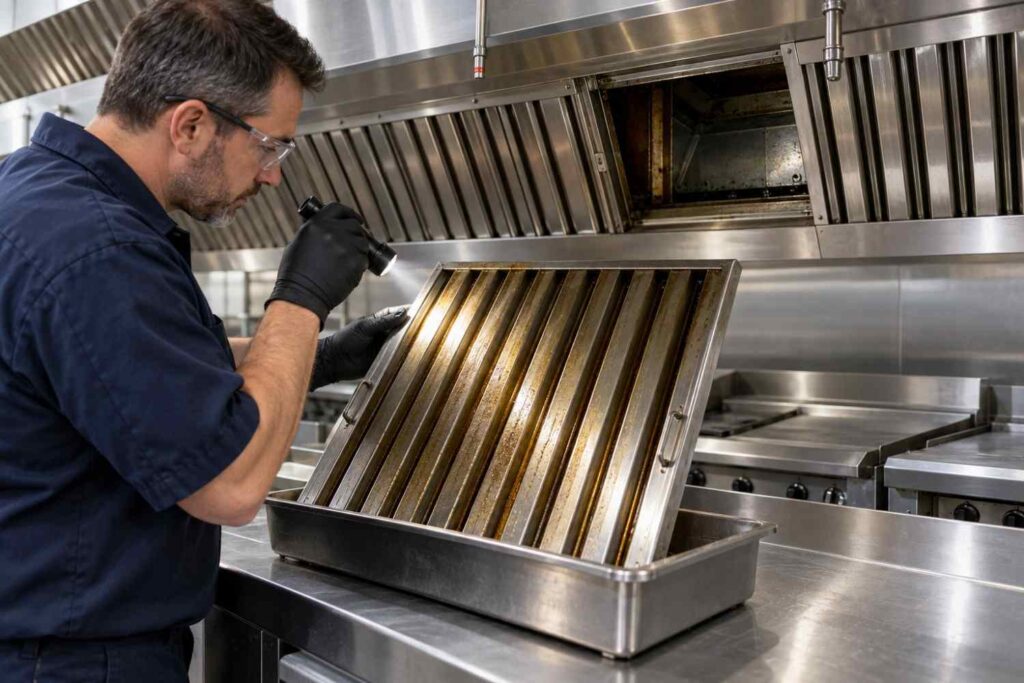
What the 12-monthly clean covers?
The 12-monthly routine includes cleaning the hood and plenum, inspecting the exhaust duct for accumulated grease, and cleaning the duct as required. Our commercial kitchen canopy cleaning service addresses grease buildup around the canopy, filters, plenum and grease gutters. Kitchens with heavy frying, chargrilling or high cooking volumes may need shorter cleaning intervals, with the wider system assessed according to its condition and applicable maintenance requirements.
Why solid-fuel kitchens run shorter schedules
Solid-fuel cooking introduces soot and other combustible deposits alongside grease, making regular inspection particularly important. The AIRAH Commercial Kitchen Exhaust Management Best Practice Guide recommends weekly inspection of solid-fuel combustion chambers and monthly inspection of systems serving solid-fuel cooking. It also recommends scraping and cleaning combustion chambers weekly. Inspection intervals and cleaning intervals are distinct, with system cleaning informed by the deposits found and the applicable maintenance requirements.
How Does Cooking Type Change the Cleaning Frequency?
Cooking intensity sets the cleaning frequency: solid-fuel and heavy-fry kitchens clean monthly to quarterly, standard restaurants clean quarterly to six-monthly, and light-use venues such as cafes and aged-care kitchens clean at least annually, with grease measurements deciding the final date. The frequency moves with the cooking method because the grease load follows the cooking method.
AS 1851’s 12-monthly baseline flexes with the volume and type of cooking the kitchen performs. Deep frying, chargrilling, and wok cooking aerosolise fats at high rates, while cafe-style preparation and reheating produce a fraction of that load. The table below maps cooking categories to inspection starting points and working cleaning frequencies, drawn from the AIRAH guide and from the ranges specialist exhaust cleaners apply across Sydney venues.
Table 1. Kitchen exhaust cleaning frequency by cooking category, combining AIRAH inspection starting points with working cleaning frequencies used across Sydney venues.
| Cooking category | Typical venues | Inspection starting point | Working cleaning frequency |
|---|---|---|---|
| Solid fuel | Charcoal chicken, wood-fired pizza, flame grills | Combustion chambers weekly; system monthly | Fortnightly to monthly |
| Heavy / high volume | Fast food, deep-fryer kitchens, burger venues | Quarterly | Monthly to quarterly |
| Wok and high turnover | Asian kitchens, stir-fry and noodle venues | Quarterly | Monthly to quarterly |
| Moderate | A la carte restaurants, bistros, clubs | Semi-annually | Quarterly to six-monthly |
| Light | Cafes, school canteens, aged care | Annually | Annually at minimum |
The inspection column reflects the AIRAH Commercial Kitchen Exhaust Management Best Practice Guide, and the frequency column reflects industry practice for Sydney venues. Inspection frequency is not cleaning frequency: an inspection that finds accumulation pulls the clean forward, and no inspection result pushes the clean back. A venue that sits between two categories adopts the shorter interval because grease load does not average out across a compliance period.
Which grease measurements override the calendar?
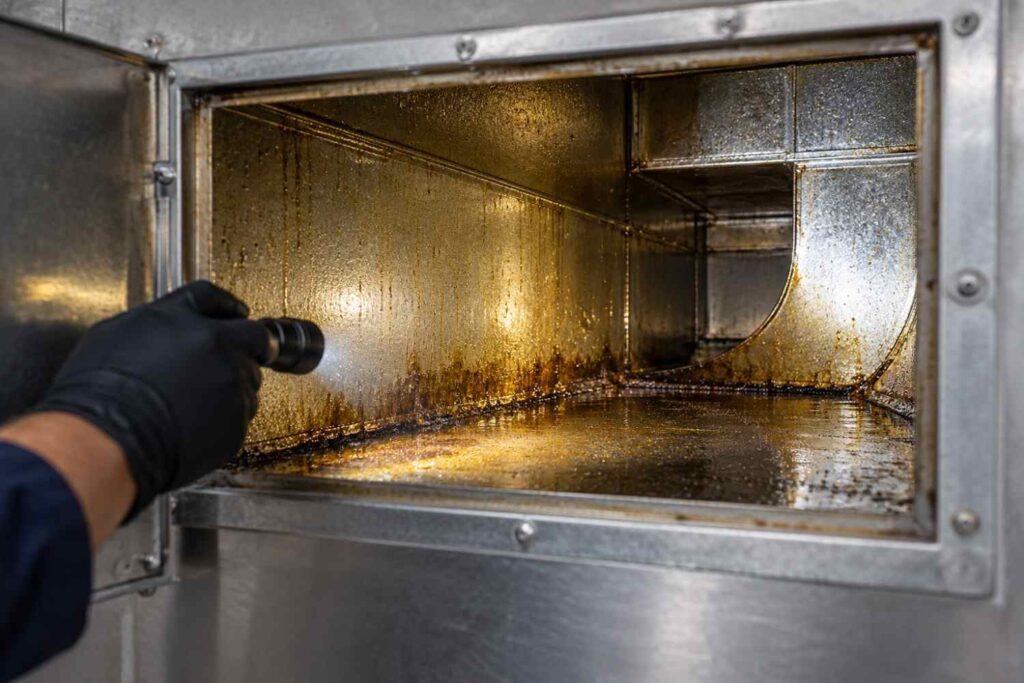
The AIRAH grease-thickness guidance identifies a mean grease thickness of 0.2 millimetres across the system as the threshold for complete-system cleaning. A single-point reading of 2 millimetres indicates a need for urgent localised cleaning, with the extent of contamination and the location’s fire risk considered. A competent cleaning crew measures grease film at representative locations: hood base, filter tracks, the first duct bend, horizontal runs, the fan inlet, and the roof discharge because a clean-looking canopy tells an operator nothing about the duct behind the wall. Measurement-based scheduling sets the next clean from the kitchen’s actual grease accumulation rate, and menu changes, new equipment, and seasonal peaks all shift that rate in both directions.
Is Kitchen Exhaust Cleaning Legally Required for Sydney Venues?
Yes. From 13 February 2026, NSW building owners must maintain fire safety measures to AS 1851, and where the kitchen exhaust system appears in the building’s fire safety schedule, its cleaning schedule becomes a legal obligation enforced through the Annual Fire Safety Statement. Work health and safety duties, insurance conditions, and food-safety law apply to every commercial kitchen regardless of the schedule.
How the fire safety schedule decides your obligation
The fire safety schedule is the document, issued with a building’s development consent, that lists the fire safety measures installed on the premises and the standard each measure must be maintained to. The Environmental Planning and Assessment (Development Certification and Fire Safety) Amendment Regulation 2025 requires building owners, other than single dwellings, to maintain those measures to AS 1851, with the deferred fire safety provisions commencing on 13 February 2026. Kitchen exhaust systems appear on some schedules and not others, because a consent authority or certifier lists the system where grease build-up presents a fire risk to the building. A listed exhaust system must be serviced to AS 1851 and certified each year, and an unlisted system still carries duties under the Work Health and Safety Act 2011, insurer requirements, and the Food Act 2003 (NSW).
What the Annual Fire Safety Statement requires
The Annual Fire Safety Statement certifies to the local council and Fire and Rescue NSW that each measure on the fire safety schedule has been assessed and maintained to its nominated standard. Building owners lodge the statement annually; council systems now cross-check lodgements against the schedule, and a kitchen exhaust listed on the schedule needs service records that support the certification. A missed exhaust clean surfaces at statement time as either a false certification or a late lodgement, and both carry consequences: council penalty notices, fire safety orders from Fire and Rescue NSW under the Environmental Planning and Assessment Act 1979, and insurer scrutiny of the claim file after any fire event.
What Does a Compliant AS 1851 Kitchen Exhaust Clean Cover?
Our kitchen exhaust cleaning service in Sydney explains the cleaning scope for canopies, filters, accessible ductwork and exhaust fans. Confirm access arrangements and reporting requirements when booking so the agreed scope identifies the areas to be cleaned and any sections that cannot be reached safely. A compliant clean covers the entire exhaust pathway: the canopy and grease gutters, the baffle filters, the plenum chamber, the horizontal and vertical ductwork, the exhaust fan, and the roof-level discharge point, with access panels opened so the duct is cleaned and not just assessed. Anything short of the full pathway is a hood polish, not an AS 1851 service.
The exhaust pathway runs from the canopy above the cooking line to the discharge point above the roof, and every component accumulates grease at a different rate. Baffle filters capture the heaviest load first; the plenum chamber and the first horizontal duct run collect the vapour that passes through; horizontal runs collect more than vertical risers because gravity settles grease along the duct floor; and the fan impeller and housing collect what survives the journey. A service that polishes the visible canopy but leaves the duct loaded fails AS 1851, because the standard requires the whole system to be assessed and cleaned. The roof-mounted exhaust fan needs its own attention, since grease on the impeller unbalances the fan and loads the motor. The kitchen exhaust fan cleaning guide on this site covers that component in detail.
The service report is part of the clean, because the report is what an assessor, an insurer, or a council inspector examines. A compliant report for a Sydney venue names six things:
- The date of service and the crew that performed the work
- Every component cleaned and the method used
- Every section that was not accessible, with the reason recorded
- Before-and-after photographs taken at each access point
- Grease-film thickness measurements at representative points, where taken
- The recommended date of the next service
The inaccessible-section clause matters most in older Sydney buildings, where duct runs sometimes lack the access panels the standard expects, and the first compliant clean often doubles as a scoping report for access-panel installation.
What Happens When a Venue Misses the Required Frequency?
Missing the required frequency exposes a venue on four fronts: grease fires that spread through the ductwork at temperatures near 1,000 degrees Celsius, insurance claims declined under cleaning-condition clauses, fire safety orders and penalty notices from Fire and Rescue NSW and council, and food-safety enforcement from council inspectors. Each front opens from the same evidence file: the missing service records.
Grease inside an exhaust system is fuel stacked above an ignition source. A flare-up under a loaded hood ignites the filter film, the fire enters the duct, and a duct fire reaches temperatures around 1,000 degrees Celsius, hot enough to travel through horizontal runs, exploit gaps in fire-rated shafts where maintenance has lapsed, and exit through the roof discharge into the building’s upper levels. Solid-fuel and heavy-fry kitchens carry the highest ignition probability, which is the reason their cleaning schedules run shortest in Table 1.
Insurers write kitchen exhaust maintenance into policy conditions, and a fire loss investigation requests the cleaning history first. Policies exclude or decline fire claims where the exhaust system was not cleaned and documented to an acceptable standard, and an insurer that pays a third-party claim can recover the loss from the venue operator or the landlord. A cleaning log with dated reports, photographs, and grease readings is the evidence that keeps a claim alive.
Regulatory exposure follows the same trail. Fire and Rescue NSW issues fire safety orders under the Environmental Planning and Assessment Act 1979 that require rectification within a stated period, councils issue penalty notices for late or false Annual Fire Safety Statements, and council environmental health officers enforce cleanliness of food premises under the Food Act 2003 (NSW) and the Food Standards Code, where grease accumulation on fixtures and equipment draws improvement notices, penalty infringement notices, or prohibition orders in serious cases. Emergency rectification cleans carried out under an order deadline cost materially more than scheduled cleans, because they run at short notice with additional documentation requirements.
How Should a Sydney Venue Set Its Cleaning Schedule?
A defensible schedule starts from the cooking category, tightens to the shortest interval the usage and grease measurements support, aligns with the fire safety schedule and the insurer’s evidence requirements, and documents every service so the Annual Fire Safety Statement and any claim file stand up to scrutiny. Six steps produce that schedule.
- Classify the kitchen’s cooking category as solid fuel, heavy fry, wok, moderate, or light from the menu and the equipment list.
- Set the starting frequency from Table 1, adopting the shortest interval the venue’s usage supports rather than the longest the table allows.
- Measure grease film at every service hood base, filter tracks, duct bends, horizontal runs, fan inlet and let the 0.2 mm mean threshold and the 2 mm single-point threshold pull the next clean forward.
- Check the building’s fire safety schedule, confirm whether the exhaust system is a listed measure, and align the cleaning cycle with the Annual Fire Safety Statement lodgement date.
- Confirm the insurer’s cleaning-evidence requirements in writing, because policy conditions define the documentation that survives a claim.
- File every service report, photograph set, and grease reading with the venue’s compliance records, and review the schedule after menu changes, equipment upgrades, and seasonal peaks.
Westlink Commercial Cleaning performs AS 1851-aligned kitchen exhaust cleaning across Sydney venues with before-and-after photographic reports and grease measurements at every service, which is the documentation layer this schedule depends on. The Kitchen Exhaust Cleaning Sydney service page sets out the full service scope, the reporting format, and the venues covered across the Sydney metropolitan area.
Kitchen Exhaust Cleaning Frequency: Frequently Asked Questions
The five questions below complete the query network around kitchen exhaust cleaning frequency in Sydney. Each answer stands alone for direct extraction.
Is kitchen exhaust cleaning legally required in NSW?
Kitchen exhaust cleaning is legally required in NSW where the exhaust system is listed in the building’s fire safety schedule, because the schedule binds the owner to maintain listed measures to AS 1851. Every commercial kitchen also carries work health and safety duties, insurance conditions, and Food Act 2003 cleanliness obligations regardless of the schedule.
Does AS 1851 apply to cafes or only to restaurants?
AS 1851 applies to every commercial kitchen exhaust system, from a charcoal restaurant to a cafe warming oven, because the standard governs the system rather than the venue type. The cooking category sets the frequency: a light-use cafe cleans at least annually, while a heavy-fry restaurant cleans monthly to quarterly.
What is the difference between AS 1851 and the AIRAH guide?
AS 1851 prescribes time-based service monthly inspections and at least 12-monthly cleaning and proves compliance through records, while the AIRAH Best Practice Guide measures actual grease accumulation and adjusts the cleaning frequency to measured risk. Sydney venues use both: AS 1851 for the legal baseline, the AIRAH thresholds for the working schedule.
Can venue staff clean the exhaust system themselves?
Venue staff clean the removable grease filters as a routine kitchen task. The How to Clean Kitchen Hood Filters guide on this site covers that process, while the plenum, ductwork, and fan require a competent cleaning crew with access equipment and the reporting format AS 1851 documentation demands. The system-level clean stays with the specialist.
Does a clean-looking canopy mean the system is compliant?
A clean-looking canopy does not establish compliance, because the heaviest grease accumulates where no one sees it: the plenum chamber, the horizontal duct runs, and the fan. AS 1851 requires the whole pathway inspected and cleaned, the service report must name any section left untouched, and compliance is a documented system state rather than a surface appearance.