

Deep cleaning a commercial flat-top griddle removes accumulated grease and food deposits with tools, chemicals, and temperatures that the manufacturer approves for the specific cooking plate material. Deep cleaning removes carbonised grease, plate-edge residue, and grease-trough buildup that routine scraping leaves behind. Commercial griddle cleaning requires a compatible scraper, cleaning pad, brush, approved cleaner, protective equipment, and a grease collection container. Plate material determines which scrapers, chemicals, and abrasives are safe on a commercial griddle. Commercial griddle deep cleaning follows eight steps that separate debris removal, chemical cleaning, component cleaning, and surface protection. Thick carbon buildup on a commercial griddle comes off with a combination of approved mechanical cleaning and approved chemical degreasing. A griddle brick cleans only commercial plates whose manufacturers permit abrasive stone cleaning. Incompatible abrasives, excessive force, unsuitable chemicals, abrupt temperature changes, and neglected grease drawers cause most commercial griddle damage. Commercial griddle cleaning frequency depends on cooking volume, residue accumulation, plate material, and manufacturer requirements. Commercial griddle carbon buildup is prevented by removing grease and food residue before repeated heating cycles harden the deposits. Seasoning restoration rebuilds the protective oil layer on carbon steel and cast iron griddle plates. Commercial griddle cleaning problems are diagnosed by residue type, plate material, and visible surface damage. A qualified service technician should inspect a commercial griddle when approved cleaning does not resolve a problem or when physical damage is visible, and Sydney Kitchens can book commercial kitchen cleaning for professional deep cleaning.
What Is the Proper Way to Deep Clean a Commercial Flat-Top Griddle?
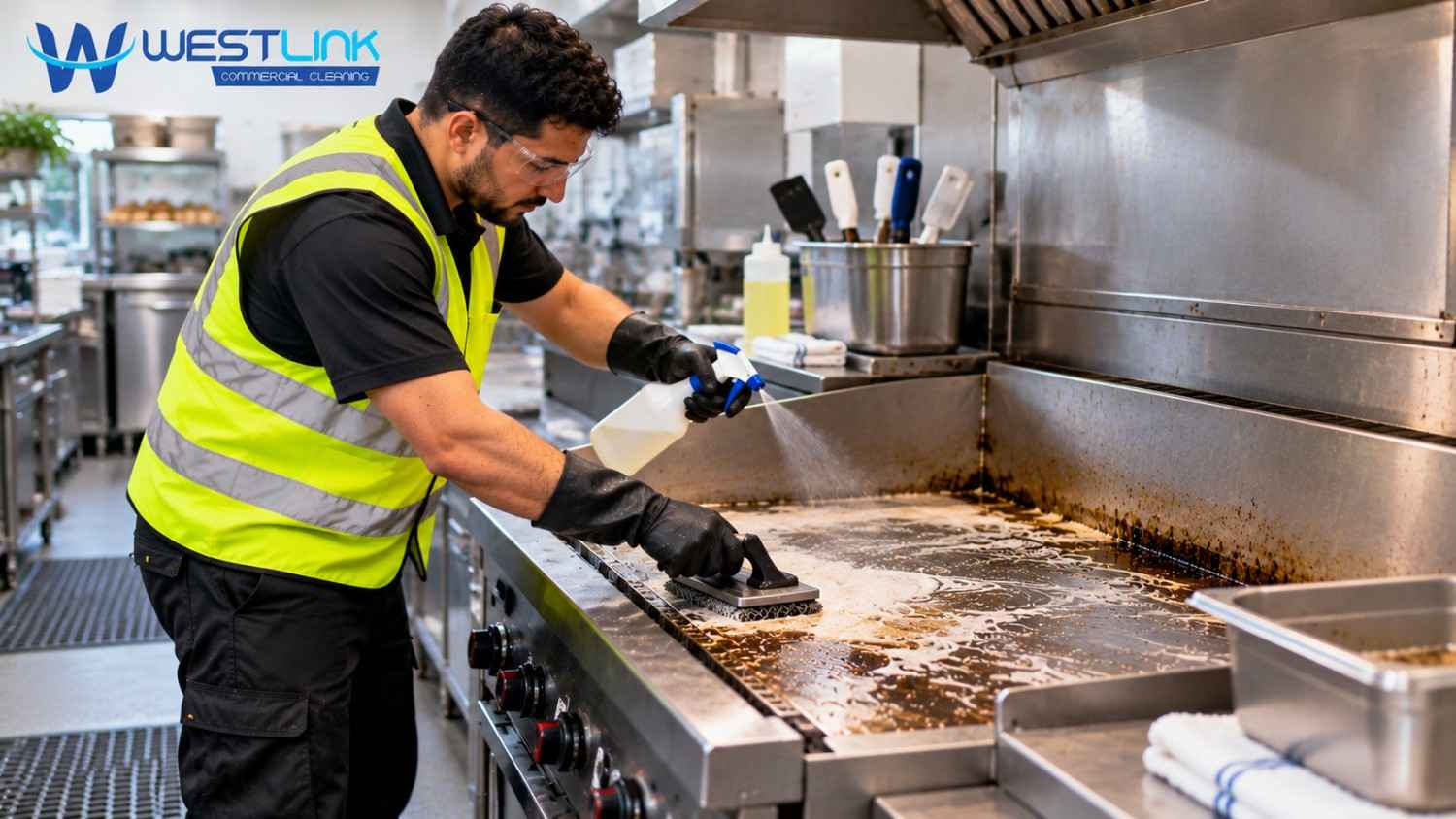
Deep cleaning a commercial flat-top griddle removes accumulated grease and food deposits with tools, chemicals, and temperatures that the manufacturer approves for the specific cooking plate material. The procedure cleans the food-contact surface without damaging the plate finish or the protective seasoning.
The core rule is to match the cleaning method to the plate. Standard steel plates may tolerate manufacturer-approved griddle bricks, while polished chrome and composite plates generally require non-abrasive methods. Stronger chemicals and harder scraping do not make a deep clean more effective. Both can score steel plates, scratch chrome, strip seasoning, and damage speciality surfaces.
A commercial griddle deep clean follows eight stages:
- Identify the plate material and read the manufacturer’s cleaning instructions.
- Turn off the heat and let the plate reach the specified cleaning temperature.
- Scrape loose food particles with a compatible commercial griddle scraper.
- Loosen hardened grease and carbon with an approved pad, brush, or cleaner.
- Apply the manufacturer-approved griddle cleaner for the labelled contact time.
- Scrub the plate with the tool permitted for that surface.
- Remove cleaning chemicals and loosened deposits following the product’s rinse instructions, then clean the grease trough, grease drawer, backsplash, and accessible exterior surfaces.
- Dry, inspect, and condition the plate according to its material.
Why Does a Commercial Flat-Top Griddle Need Deep Cleaning?
Deep cleaning removes carbonised grease, plate-edge residue, and grease-trough buildup that routine scraping leaves behind. Fat, cooking oil, proteins, sugars, and starches accumulate on a griddle plate through repeated heating cycles. Continued heat exposure hardens, oxidises, and carbonises some of those deposits.
Carbon Buildup Reduces Cooking Consistency
Thick carbon deposits block direct contact between food and the griddle plate. Accumulated residue produces uneven browning, inconsistent cooking results, and flavour transfer between food batches. Removing the deposits restores consistent plate contact.
Accumulated Grease Raises Maintenance and Fire Risk
Grease collects in the drainage channel, grease trough, and removable grease drawer of a commercial griddle. Obstructed drains, overflowing waste containers, and combustible deposits near heated equipment result when staff skip removal. Regular cleaning of these components is part of commercial kitchen fire prevention and housekeeping.
Improper Cleaning Shortens Equipment Service Life
Abrasive tools permanently damage the finish of chrome-plated griddles. Moisture left on steel surfaces encourages corrosion. Correct cleaning practices protect plate integrity and reduce avoidable repair costs and downtime.
Which Tools and Supplies Does Commercial Griddle Cleaning Require?
Commercial griddle cleaning requires a compatible scraper, cleaning pad, brush, approved cleaner, protective equipment, and a grease collection container. The manufacturer’s approved equipment and chemical list determine the final selection.
| Tool or supply | Cleaning purpose |
| Commercial griddle scraper | Removes loose food particles and surface deposits |
| Griddle brick or screen | Removes stubborn buildup on compatible steel plates |
| Non-abrasive cleaning pad | Cleans delicate finishes and approved specialty surfaces |
| Palmetto brush | Loosens deposits on compatible chrome plates |
| Manufacturer-approved griddle cleaner | Breaks down hardened grease and food residue |
| Commercial griddle squeegee | Directs loosened debris toward the grease trough |
| Surface thermometer | Verifies the plate’s cleaning temperature |
| Heat-resistant and chemical-resistant PPE | Protects staff from thermal and chemical hazards |
| Clean wiping cloths | Remove residual moisture and cleaning solution |
| Grease collection container | Holds removable grease waste for safe handling |
Cleaning products must also match the plate’s surface temperature. Hot-surface formulations work at specified heated conditions, while other cleaners require a cooled plate. A product labelled as a commercial degreaser does not automatically suit every griddle finish.
How Does Plate Material Change the Cleaning Method?
Plate material determines which scrapers, chemicals, and abrasives are safe on a commercial griddle. Steel, stainless steel, polished chrome, cast iron, and composite plates each carry different maintenance requirements.
| Plate material | Recommended approach | Key restriction |
| Standard mild or carbon steel | Approved scraper, griddle cleaner, and permitted abrasive treatment | Avoid gouging and restore seasoning as directed |
| Stainless steel | Manufacturer-compatible scraper, detergent, and cleaning pad | Do not assume every stainless surface permits griddle bricks |
| Polished chrome or chrome-plated steel | Approved chrome scraper, palmetto brush, and non-abrasive cleaner | Avoid griddle bricks, steel wool, and abrasive screens |
| Cast iron | Approved residue removal, careful drying, and seasoning maintenance | Avoid unnecessary removal of protective seasoning |
| Composite plate | Manufacturer-specified scraper, mild detergent, and approved non-abrasive pad | Avoid griddle bricks unless explicitly permitted |
| Proprietary coated surface | Coating-specific tools and cleaning solution | Avoid metal scraping and aggressive chemicals unless authorized |
Standard Steel Commercial Griddles
Standard steel commercial griddles often allow controlled mechanical removal of carbon deposits. Depending on the model, a griddle brick, cleaning screen, or approved scrubbing pad removes hardened residue. Cleaning direction, applied pressure, and surface temperature must follow the manufacturer’s instructions. After cleaning, many standard steel griddles need a thin coating of cooking oil or a specified reseasoning procedure to prevent corrosion.
Stainless Steel Commercial Griddles
Stainless steel griddles need a cleaning solution and tools matched to the plate’s construction and finish. A solid stainless plate and a composite plate with a stainless outer layer can require different methods. Use a manufacturer-approved scraper for loose debris, apply the specified detergent or griddle cleaner, and clean with an approved pad or brush. Where the manual directs, clean along the surface grain to reduce visible abrasion. Stainless steel does not withstand every abrasive or highly alkaline cleaner, and improper treatment causes scratches, staining, and corrosion.
Chrome-Plated Commercial Griddles
Chrome-plated commercial griddles require non-abrasive cleaning to preserve the polished chromium finish. Manufacturers such as Vulcan recommend specialized scraper tools and palmetto brushes for certain chrome griddle models. Griddle bricks and abrasive scouring pads scratch chrome and should not be used. Even an approved scraper damages the plate when used at an incorrect angle or with excessive force.
The cleaning sequence for models that permit it has four parts: remove food debris with a chrome-safe scraper, loosen residue with a palmetto brush, clean with an approved non-abrasive product, then wipe or rinse per the manufacturer’s instructions and dry with a clean cloth. Avoid griddle bricks, pumice stones, steel wool, aggressive abrasive screens, unapproved metal scrapers, incompatible acidic or alkaline chemicals, and heavy scraping pressure. A cleaner that suits stainless steel does not necessarily suit polished chromium, so verify every product against the actual equipment model.
Composite Commercial Griddles
Composite commercial griddles use engineered cooking plates that may have stainless steel outer layers and specialised heat-transfer characteristics. These surfaces require model-specific procedures. Some composite griddles permit a mild detergent and non-abrasive pad but prohibit griddle bricks and griddle stones. Maintenance staff should verify the plate construction before choosing any abrasive method.
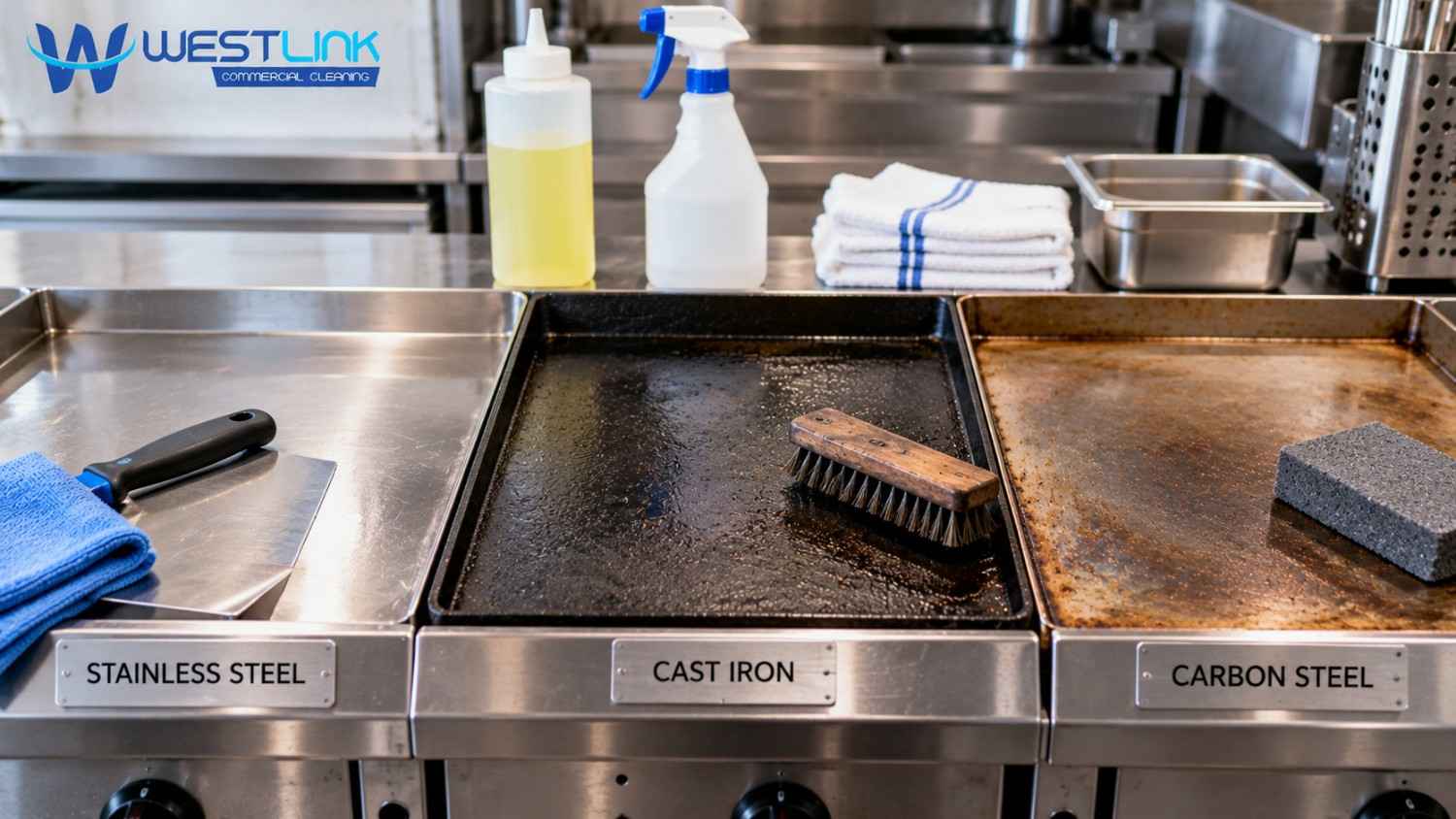
How to Deep Clean a Commercial Flat-Top Griddle: 8 Steps
Commercial griddle deep cleaning follows eight steps that separate debris removal, chemical cleaning, component cleaning, and surface protection.
Step 1: Turn Off the Griddle and Check the Cleaning Temperature
The equipment manual specifies the shutdown and cleaning-temperature instructions for each commercial griddle. Turn off the heating controls and let the plate reach the manufacturer-approved cleaning temperature. For example, certain Vulcan griddle instructions specify roughly 275°F to 300°F for particular daily procedures. That range is model-specific and does not apply to every griddle. Some cleaning systems work on hot surfaces, while other procedures require a substantially cooler plate.
Verify temperature with a surface thermometer when needed. Never pour ice or large amounts of cold water onto an overheated plate, because abrupt temperature changes create thermal stress and can distort or crack the plate. Keep electrical connections, control assemblies, and burner compartments away from cleaning liquids.
Step 2: Scrape Loose Food Debris and Surface Grease
Scraping removes food particles, loose carbon, and excess grease before intensive cleaning begins. Use a scraper approved for the plate material, hold the recommended blade angle, and apply controlled pressure that loosens deposits instead of digging into the surface. Push debris towards the grease trough and confirm that the grease collection system is installed and able to receive waste.
Check the places where residue collects: plate corners, rear and side edges, grease drainage openings, high-fat cooking zones, and the area near the backsplash. Avoid striking splash guards or plate edges with force, because damage there creates gaps that are hard to clean.
Step 3: Loosen Hardened Grease and Carbon Buildup
Carbon removal requires a method that dislodges deposits without exceeding the plate’s abrasion tolerance. Compatible standard steel plates accept an approved griddle brick, cleaning screen, or commercial cleaning pad. Chrome and composite surfaces accept only the manufacturer’s permitted non-abrasive tools.
Start with light pressure. Repeated controlled passes protect the plate better than aggressive scraping, which risks gouging. Where chemical cleaning is permitted, an approved griddle cleaning solution softens baked-on deposits before final removal. The goal is to remove carbonized material while preserving the metal finish or seasoning layer.
Step 4: Apply a Manufacturer-Approved Griddle Cleaner
A commercial griddle cleaner removes grease, food soils, and stubborn residue through chemical action suited to the surface and operating conditions. Before application, verify six points:
- Compatibility with the plate material
- Approved application temperature
- Dilution requirements
- Required contact or dwell time
- Personal protective equipment requirements
- Rinsing and residue-removal instructions
Follow the product label and the Safety Data Sheet (SDS). Allow only the specified contact time, and do not extend dwell time because deposits resist removal. Never combine different cleaning chemicals, since incompatible products create dangerous reactions and damage equipment. Household oven cleaner, chlorine-based sanitiser, and strong alkaline degreasers are not automatically suitable for a commercial cooking plate.
Step 5: Scrub the Cooking Plate Without Scratching It
Controlled scrubbing removes loosened residue while limiting abrasion. Select the pad, brush, or screen permitted for the plate and work across the surface in a systematic pattern. On standard steel plates that permit abrasives, follow the recommended cleaning direction, including the metal grain where specified. On polished chrome, use the approved brush or non-abrasive system instead of a griddle brick.
If residue remains, repeat the approved procedure rather than switching to a more aggressive tool. Excessive pressure scores plates permanently, and incompatible abrasives damage protective coatings and specialised finishes.
Step 6: Remove All Cleaning Solution and Loose Residue
Griddle cleaning stays incomplete until chemical residue and loosened soil are gone from the food-contact surface. Use the rinse or wiping method specified by the equipment manufacturer and the chemical product label. Where water rinsing is permitted, use the instructed temperature and quantity, then remove liquid with an approved squeegee or cloth and direct waste into the designated collection system.
Do not flood the griddle housing or let liquid reach electrical components, gas controls, or inaccessible cavities. Continue rinsing or wiping until the plate shows no visible debris or product residue.
Step 7: Clean the Grease Trough, Grease Drawer, and Splash Guards
Deep cleaning covers the grease management components as well as the upper cooking surface. Turn off the equipment and let removable parts and collected grease cool to a safe handling temperature. Remove the grease drawer or tray following the manufacturer’s instructions and dispose of the grease through the kitchen’s approved waste system.
Wash removable components with compatible products, rinse as required, and dry before reinstalling. Clean the accessible grease channels, backsplash, side guards, and front grease lip. Inspect drainage openings for debris and confirm that grease flows into the collection container without obstruction. Do not dismantle gas, electrical, or heating components during routine cleaning unless the manufacturer authorises the procedure for trained staff.
Step 8: Dry the Plate and Restore Surface Protection
Complete drying reduces corrosion risk and prepares the griddle for the next operating cycle. Remove standing moisture from the plate, corners, edges, and accessible components using the manufacturer’s recommended drying procedure. Standard steel and cast iron plates may need a thin protective oil layer or full seasoning restoration after intensive cleaning.
Chrome-plated and specialty plates have different conditioning requirements, so do not apply a carbon-steel seasoning method to every commercial griddle. Inspect the plate for remaining deposits, scratches, corrosion, or coating damage before returning the equipment to service.
How Do You Remove Thick Carbon Buildup From a Commercial Griddle?
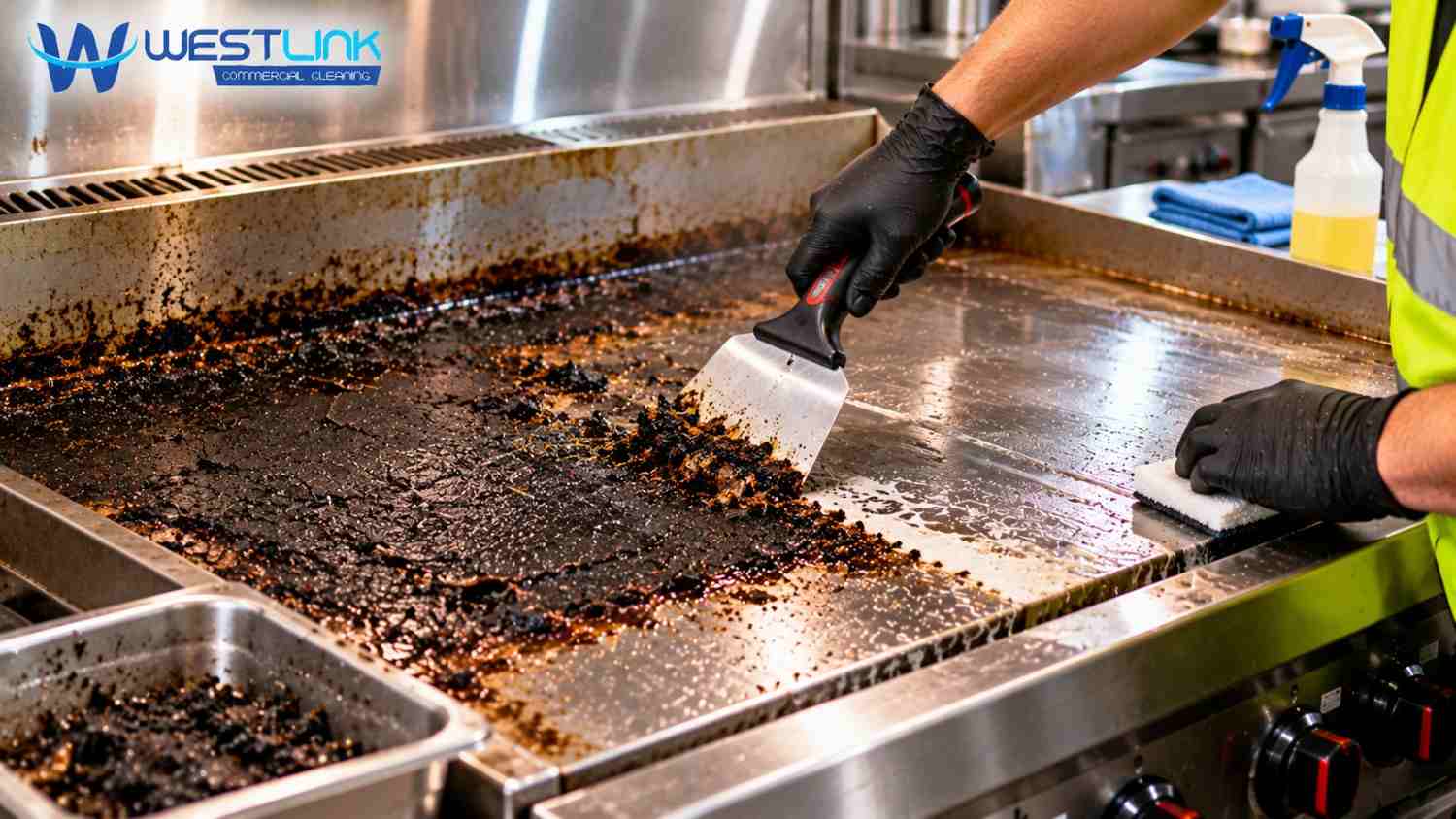
Thick carbon buildup on a commercial griddle comes off with a combination of approved mechanical cleaning and approved chemical degreasing. Carbonised grease forms when repeated heating cycles turn oil and food residue into hardened deposits. The deposits appear as black patches, raised crusts, or stubborn layers near heavily used cooking zones.
For compatible standard steel griddles, follow this sequence:
- Let the plate reach its approved cleaning temperature.
- Remove loose surface debris with a commercial griddle scraper.
- Apply an approved griddle cleaner when necessary.
- Allow the cleaner to work for the labelled contact time.
- Remove softened deposits with an approved pad, scraper, or griddle brick.
- Repeat the permitted procedure if heavy buildup remains.
- Remove cleaning residue, dry the plate, and restore surface protection as required.
Do not use this abrasive procedure on polished chrome or composite griddles unless the manufacturer specifically permits it. If thick black residue stays attached after repeated approved cycles, the plate needs professional inspection instead of more aggressive scraping. Some dark areas are normal seasoning or heat-related discolouration, not removable contamination.
Should You Use a Griddle Brick on a Commercial Flat-Top Grill?
A griddle brick cleans only commercial plates whose manufacturers permit abrasive stone cleaning. The abrasive texture of a griddle brick mechanically removes carbonised grease and baked-on residue from compatible standard steel griddles. The same texture scratches polished chrome, damages coatings, and alters specialty finishes, so a griddle brick is never a universal grill cleaning tool.
Check the plate material and the equipment manual before using a brick. When the manufacturer approves it, apply controlled pressure and follow the specified temperature and technique.
Which Cleaning Mistakes Damage a Commercial Griddle?
Incompatible abrasives, excessive force, unsuitable chemicals, abrupt temperature changes, and neglected grease drawers cause most commercial griddle damage.
| Cleaning mistake | Possible consequence | Preventive action |
| Using a griddle brick on chrome | Scratches and plating damage | Use approved chrome-safe tools |
| Scraping with excessive force | Gouges and deep scoring | Maintain controlled blade pressure |
| Applying ice to a hot plate | Thermal stress and possible distortion | Follow approved cooling and rinsing instructions. |
| Using an incompatible degreaser | Staining, corrosion, or finish damage | Check chemical compatibility. |
| Leaving detergent residue | Food-contact contamination risk | Complete the specified rinse process |
| Failing to dry steel surfaces | Rust and corrosion | Dry and protect the plate as directed. |
| Overapplying seasoning oil | Sticky or uneven seasoning | Use the manufacturer’s seasoning procedure. |
| Neglecting the grease drawer | Overflow and increased grease hazards | Empty and clean at scheduled intervals |
| Using abrasive screens on composite plates | Surface scoring and finish deterioration | Use model-approved non-abrasive pads. |
Stop the cleaning procedure when staff find unexpected coating damage, structural deformation, persistent chemical residue, or any other condition that affects safe operation.
How Often Should a Commercial Griddle Be Deep Cleaned?
Commercial griddle cleaning frequency depends on cooking volume, residue accumulation, plate material, and manufacturer requirements. High-volume restaurant kitchens need intensive cleaning more often than foodservice operations with shorter service periods.
| Interval | Recommended maintenance |
| During service | Remove loose debris and excess grease with approved tools. |
| End of shift | Complete the manufacturer’s daily cooking-surface cleaning procedure |
| Daily | Clean accessible grease troughs, grease drawers, and splash areas. |
| Weekly or as specified | Perform intensive cleaning of carbon deposits and accessible components |
| Monthly or per maintenance schedule | Inspect plate condition, accessible components, controls, and signs of wear. |
| As needed | Address persistent carbon, rust, drainage problems, or abnormal cooking performance. |
These intervals are planning guidelines. Manufacturer instructions and local food safety rules take precedence. Kitchens with frequent high-fat cooking or continuous griddle operation may need intensive cleaning more often. A documented maintenance schedule assigns cleaning responsibilities, standardises procedures, and supports equipment inspections.
How Do You Prevent Carbon Buildup on a Commercial Flat-Top Griddle?
Commercial griddle carbon buildup is prevented by removing grease and food residue before repeated heating cycles harden the deposits. Restaurant staff scrape compatible plates regularly during service and complete the prescribed cleaning procedure at the end of every shift.
Four additional habits reduce buildup: keep grease drainage channels clear, empty grease drawers before they overflow, avoid unnecessary overheating, and maintain the plate’s required protective finish. Temperature management matters because excessive heat accelerates grease degradation and deposit formation. Preventing heavy accumulation costs less plate wear than repeated aggressive deep cleaning.
How Do You Restore Seasoning on a Commercial Steel Griddle?
Seasoning restoration rebuilds the protective oil layer on carbon steel and cast iron griddle plates. Controlled heating of cooking oil forms the layer, which reduces food sticking and protects the underlying metal from moisture.
After cleaning and drying the plate, apply the manufacturer-recommended cooking oil in a thin, even coating. Heat the plate according to the equipment’s seasoning instructions. Depending on the model and plate condition, additional thin applications may be needed. Avoid excess oil, since thick deposits produce an uneven, sticky surface instead of a stable seasoning layer. Chrome and proprietary-coated griddles follow their own manufacturer-specific finishing instructions.
How Do You Troubleshoot Common Griddle Cleaning Problems?
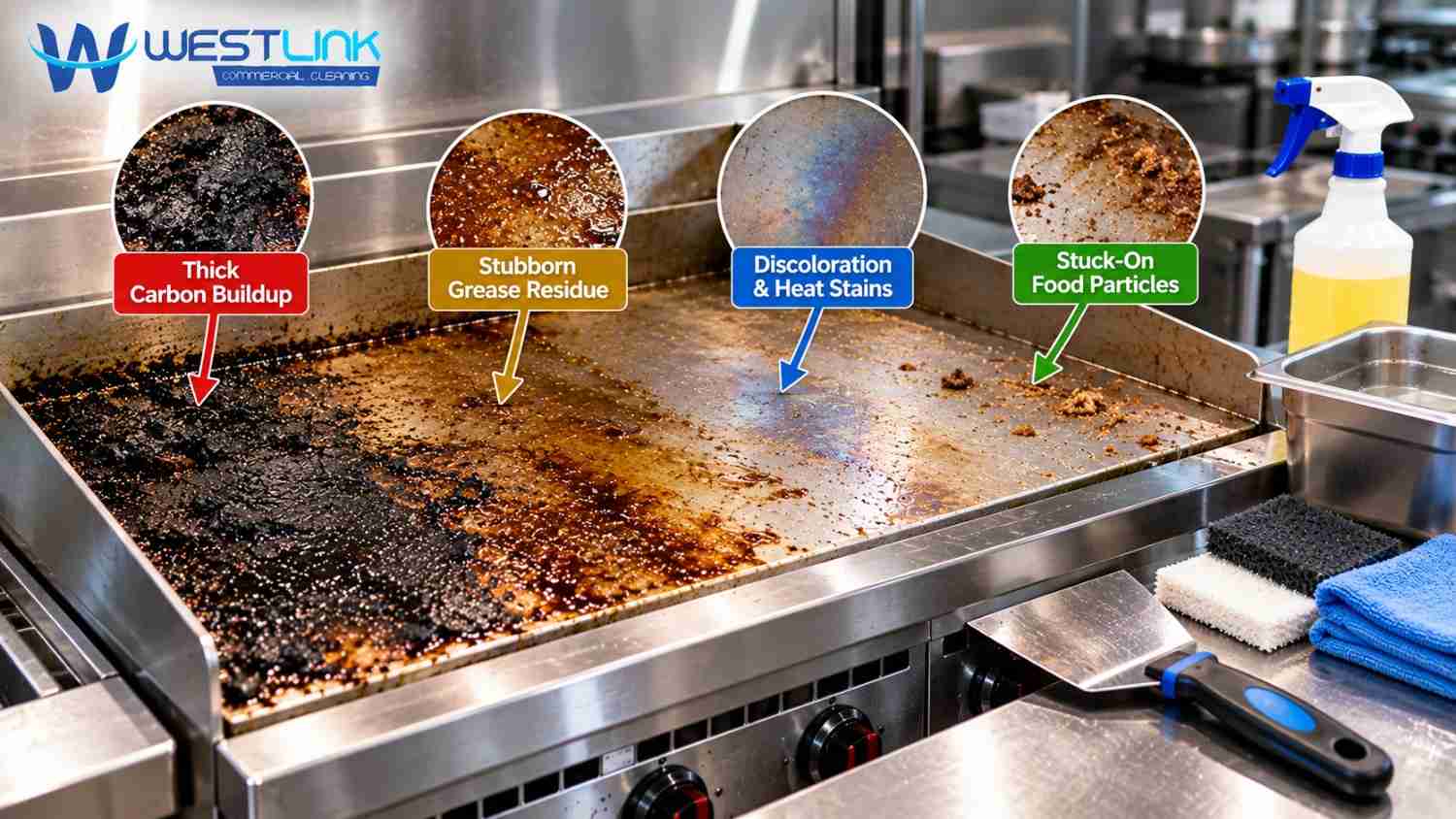
Commercial griddle cleaning problems are diagnosed by residue type, plate material, and visible surface damage.
Why Does a Commercial Griddle Show Black Residue After Cleaning?
Black residue after cleaning indicates remaining carbonised grease, loosened cleaning deposits, or deteriorating seasoning on a steel plate. Inspect the surface and repeat the approved cleaning process if removable contamination is present. Do not keep scrubbing a seasoned steel plate just to make it look polished.
Why Is a Commercial Griddle Sticky After Cleaning?
A sticky griddle holds residual grease, leftover cleaner, or excessive seasoning oil. Remove the remaining cleaning product following the approved procedure. If the plate requires seasoning, check whether the oil coating is too thick or insufficiently cured.
Why Is Rust Forming on a Commercial Flat-Top Griddle?
Rust forms when susceptible steel surfaces stay exposed to moisture without adequate protective treatment. Remove light surface oxidation only through the manufacturer’s approved restoration procedure, dry the plate thoroughly, and restore seasoning or protective oil where required. A qualified commercial equipment technician should assess deep pitting or widespread corrosion.
Why Does a Commercial Griddle Heat Unevenly After Cleaning?
Uneven heating after cleaning points to remaining carbon deposits, plate condition, temperature-control problems, or heating system faults. Verify first that the cooking surface is clean and unobstructed. If temperature differences persist, arrange a qualified service inspection instead of adjusting gas burners, electrical elements, or thermostats without authorisation.
When Should a Commercial Griddle Be Professionally Serviced?
A qualified service technician should inspect a commercial griddle when approved cleaning does not resolve a problem or when physical damage is visible. Eight conditions call for service:
- Persistent carbon deposits that approved cleaning cannot remove
- Deep scratches, cracks, or deteriorating chrome plating
- Warped or severely pitted plates
- Repeated rust despite correct maintenance
- Blocked or damaged grease drainage components
- Unexplained temperature variation
- Faulty control knobs, thermostats, or heating assemblies
- Abnormal burner performance or electrical faults
Cleaning staff should not attempt internal gas or electrical repairs without authorisation and technical qualifications. A professional inspection determines whether the problem needs cleaning, component replacement, adjustment, or more extensive repair.
Frequently Asked Questions
What Is the Best Way to Deep Clean a Commercial Flat-Top Grill?
The best method is to scrape loose debris, remove hardened grease with manufacturer-approved tools and products, rinse or wipe away residue, and clean the grease collection system, and dry and protect the plate. The exact procedure depends on the plate material.
Can You Use Vinegar on a Commercial Griddle?
Vinegar belongs on a commercial griddle only when the manufacturer permits it. Acidic solutions are not universally suitable for commercial cooking finishes and can affect certain surfaces or coatings. A manufacturer-approved cleaner is the safer default.
Can You Use Baking Soda on a Commercial Flat-Top Grill?
Baking soda is not a universal commercial griddle cleaner. Suitability depends on the plate material, surface finish, and manufacturer instructions. Commercial operators should use documented, compatible procedures instead of improvised mixtures.
What Temperature Should a Commercial Griddle Be for Cleaning?
The correct cleaning temperature depends on the equipment model and the cleaner. Certain Vulcan procedures specify approximately 275°F to 300°F, while other systems have different requirements. Always use the temperature stated in the applicable instructions.
Can You Clean a Commercial Griddle While It Is Hot?
Some commercial griddles and specialised cleaning systems are designed for controlled hot-surface cleaning. The surface temperature, cleaner, tools, and protective equipment must all meet manufacturer requirements. Hot cleaning should never be improvised.
How Do You Remove Burnt Grease Without Scratching a Griddle?
Use an approved scraper for loose deposits, apply a surface-compatible cleaner if required, and loosen remaining grease with the permitted pad or brush. Avoid excessive pressure, and do not use abrasive bricks on chrome or any surface that prohibits them.
Do Commercial Griddles Need Seasoning After Deep Cleaning?
Many standard steel and cast iron griddles need seasoning or protective oil after intensive cleaning. Chrome-plated and composite surfaces have different maintenance requirements. Follow the model-specific instructions instead of assuming every plate uses the same procedure.
How Often Should a Restaurant Flat-Top Grill Be Cleaned?
Restaurant griddles generally need cleaning during service and at the end of every operating shift, with additional intensive cleaning as necessary. Frequency should reflect manufacturer instructions, production volume, accumulated residue, and applicable sanitation requirements.
Can the Same Cleaner Be Used on Steel and Chrome Griddles?
Steel, chrome, and composite plates have different chemical compatibility requirements, so one cleaner does not necessarily suit all three. A commercial cleaning product must be specifically approved for the material and application conditions.
Can Improper Griddle Cleaning Affect Food Safety?
Improper griddle cleaning creates food-contact hygiene risks. Leftover cleaning chemicals, accumulated food residue, and neglected grease collection systems are the main sources. Commercial kitchens should follow documented cleaning and sanitisation procedures before returning equipment to food preparation.