

Cleaning a commercial dishwasher involves draining the wash tank, removing food debris from filters, clearing blocked spray arms and checking sanitising performance. Regular maintenance prevents grease buildup, improves water circulation and supports food safety in restaurants, cafés and catering facilities. Alongside daily dishwasher maintenance, professional commercial kitchen cleaning services in Sydney help businesses manage grease, food residue and hygiene across commercial kitchen equipment and surfaces.
Commercial dishwashers in restaurants, hotels and catering kitchens run repeated wash cycles under heavy soil loads. Food particles can obstruct the filtration system, grease can accumulate in the wash tank, and mineral deposits can block rinse jets. Even a dishwasher that appears clean may fail to sanitise dishes if the final rinse temperature or chemical concentration is incorrect.
This guide explains daily commercial dishwasher cleaning, periodic descaling, and practical sanitising checks for undercounter, hood-type, pass-through and conveyor machines. The exact component layout, cleaning frequency and approved products depend on the machine model and local food-safety requirements.
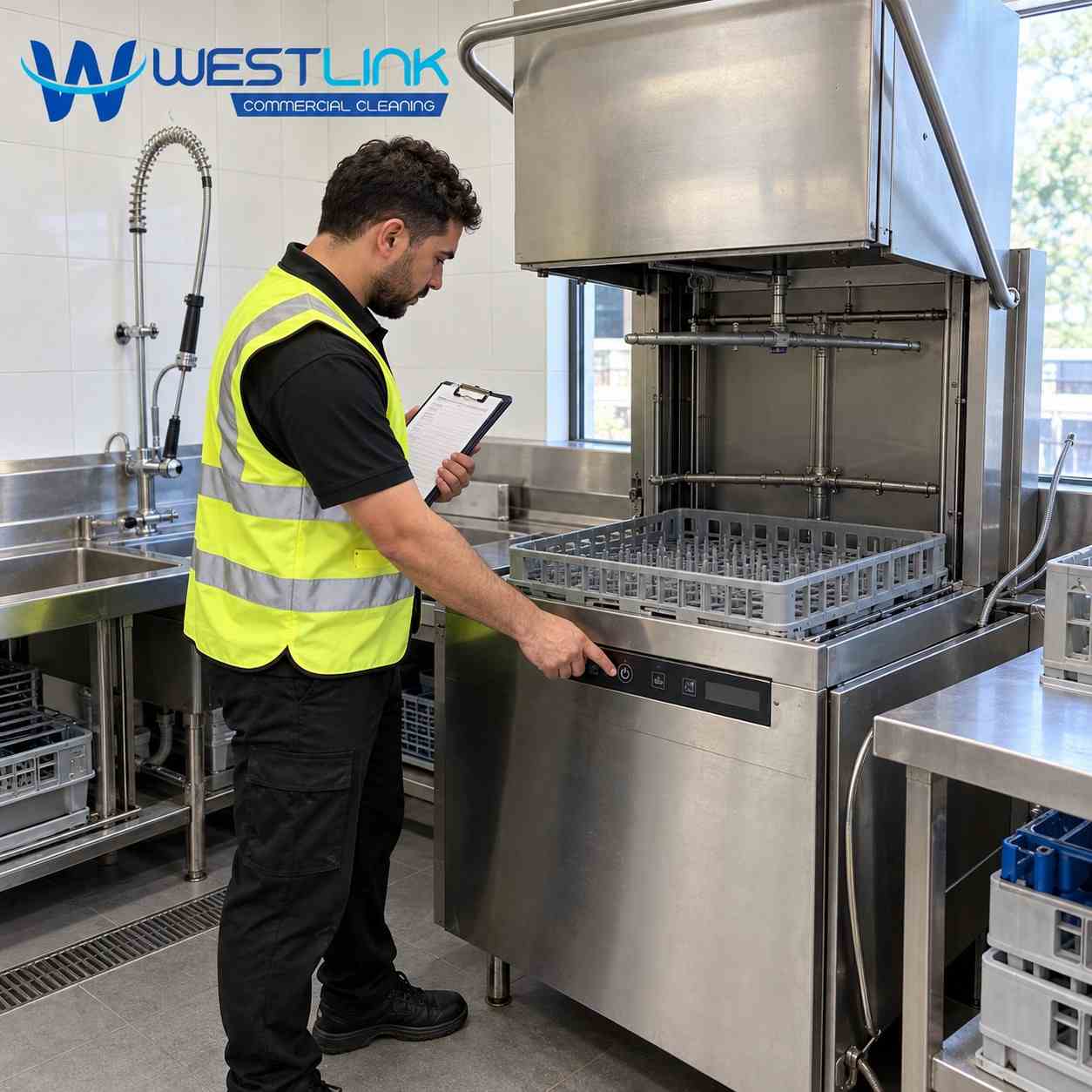
What Should You Check Before Cleaning a Commercial Dishwasher?
A commercial dishwasher should be switched off, made safe and allowed to cool as directed by its operating manual before staff remove internal components. Hot water, steam, moving parts, electrical equipment and concentrated cleaning chemicals create hazards during end-of-shift maintenance.
Before starting:
- Finish the wash cycle and remove clean racks and utensils.
- Turn off the machine using the manufacturer’s shutdown procedure; isolate electrical power whenever the manual requires it for cleaning or maintenance.
- Allow hot surfaces and wash water to cool to a safe handling temperature.
- Wear suitable protective gloves and any additional personal protective equipment specified on the cleaning product’s safety data sheet.
- Gather a soft brush, non-abrasive cloth, approved detergent, waste container and the model’s cleaning instructions.
- Identify the wash tank, scrap basket, strainers, pump intake screen, wash arms, rinse arms and drain arrangement before removing parts.
Never mix cleaning agents. Acidic descalers and chlorine-based products can release hazardous gas if combined. Do not spray electrical controls or open sealed panels; internal electrical, pump and heater work belongs to trained service personnel.
How Do You Clean a Commercial Dishwasher Step by Step?
A complete commercial dishwasher cleaning procedure moves from draining and debris removal to component cleaning, reassembly and operational verification. Cleaning removes food soil and mineral deposits; sanitising checks then establish whether the machine’s rinse system is operating within its required limits.
Step 1: Drain the Wash Tank and Remove Loose Food Debris
The wash tank holds recirculated detergent solution that collects food residue during service. Use the model’s drain control, standpipe or drain valve to empty the tank. Never reach into hot water or remove a standpipe unless the operating instructions permit it.
Remove large scraps from accessible tank surfaces and direct them into the scrap basket or an appropriate waste container. Check that wastewater drains normally. Slow drainage can indicate a blocked strainer, drain outlet or waste line, but staff should not dismantle a pump or plumbing connection to investigate.
On conveyor dishwashers, additional tank sections, curtains and debris trays may require separate cleaning. Follow the machine-specific sequence so food soil does not wash into an exposed pump intake.
Step 2: Remove and Wash the Dishwasher Filters
Commercial dishwasher filters and strainers trap food particles before those particles recirculate through the wash pump and spray system. A blocked mesh filter restricts water flow and can reduce wash coverage.
To clean removable filters:
- Lift out the scrap basket, strainer pan, mesh filter or filter cassette in the order shown by the manual.
- Empty trapped food into the bin rather than forcing it into the drain.
- Rinse the filters under running water and dislodge grease or particles with a soft-bristle brush.
- Inspect mesh panels, seals and mounting points for tears, distortion or missing parts.
- Clean the accessible filter housing and ensure no debris enters the pump intake.
- Refit each filter securely after the interior and spray components have been cleaned.
Do not bang strainer baskets against a hard surface to loosen debris: this can deform the parts and compromise their fit. A damaged filter should be replaced with the correct manufacturer-approved component.
When should commercial dishwasher filters be cleaned? Inspect filters during busy service periods and clean them whenever debris accumulates. Empty and wash removable strainers during the end-of-shift routine, or more often when the operating manual requires it.
Step 3: Clean the Wash Arms and Rinse Arms
Commercial dishwasher wash arms distribute detergent solution, while rinse arms deliver water for the rinse and sanitising stage. Blocked spray nozzles can leave dishes soiled or prevent rinse water from reaching all exposed surfaces.
Use this spray arm cleaning procedure when the model permits removal:
- Release the upper and lower wash arms and rinse arms using the specified clips, caps or retaining fittings.
- Check spray holes for seeds, food fragments and visible limescale.
- Flush water through the arms and remove loose material with a soft, non-metallic brush or the manufacturer-approved nozzle cleaning tool.
- Inspect end caps, seals, bearings and mounting points for wear or damage.
- Reinstall each arm in its original position and orientation, secure the retaining fittings, and confirm that rotating arms move freely where applicable.
Some machines use fixed rinse manifolds rather than rotating rinse arms. Inspect their nozzles without forcing or dismantling the assembly. Avoid using metal wire, drill bits or sharp objects unless the manufacturer expressly specifies a particular tool; enlarging a jet changes the spray pattern.
If a nozzle remains obstructed after approved cleaning, stop and arrange service rather than modifying the component.
Step 4: Clean the Interior, Sump and Door Seals
The dishwasher interior collects grease, detergent residue and food soil on tank walls, door edges, splash zones and the sump. Removing these deposits helps keep the next wash solution clean.
Wipe accessible stainless steel panels, rack guides, door gaskets, corners and the sump with a soft cloth or brush and a cleaner approved for the machine. Rinse away loosened soil as instructed. Check the door seal for trapped debris, cracking or leakage.
Conveyor models may have removable curtains and additional strainers. Wash and dry these components according to their operating instructions. Do not use steel wool, aggressive abrasive pads or unapproved bleach-based cleaners on stainless steel surfaces.
Step 5: Refit Components and Complete the Shutdown or Start-Up Cycle
Correct reassembly restores the intended water path through the filters, pumps, wash arms and rinse arms. Refit strainers, spray arms, curtains, end caps and drain parts in the order specified by the manufacturer. Check that no tool or loose component remains inside the chamber.
If cleaning is complete for the day, follow the manufacturer’s shutdown guidance; many machines require doors to be left open to promote drying. If the dishwasher will return to service, refill and heat it according to the operating instructions, run the prescribed test or initial cycle, and inspect for leaks, unusual noise and error messages.
How Do You Check Whether a Commercial Dishwasher Is Sanitising Correctly?
Commercial dishwasher sanitising checks verify either adequate heat at the utensil surface or correct chemical sanitiser delivery, depending on the machine type. A clear filter and an unobstructed spray arm are necessary for effective washing, but they do not alone confirm sanitisation.
Commercial dishwasher cleaning and sanitising are separate processes. According to Food Standards Australia New Zealand, food businesses must remove dirt, grease and food residue before sanitising equipment and utensils. Proper cleaning allows heat or approved chemical sanitisers to work effectively on food-contact surfaces.
| Machine type | What to verify | Suitable check |
| High-temperature, heat-sanitising dishwasher | Required cycle conditions and utensil surface temperature | Machine display plus an appropriate irreversible temperature indicator or other approved device |
| Low-temperature, chemical-sanitising dishwasher | Correct sanitiser, concentration, dosing, temperature and contact conditions | Product-specific test strips and the manufacturer/local-authority procedure |
| Any commercial dishwasher | Detergent supply, rinse coverage, cycle completion and visible cleanliness | Visual inspection, chemical supply check and operating log |

High-Temperature Dishwashers: Verify Heat Sanitisation
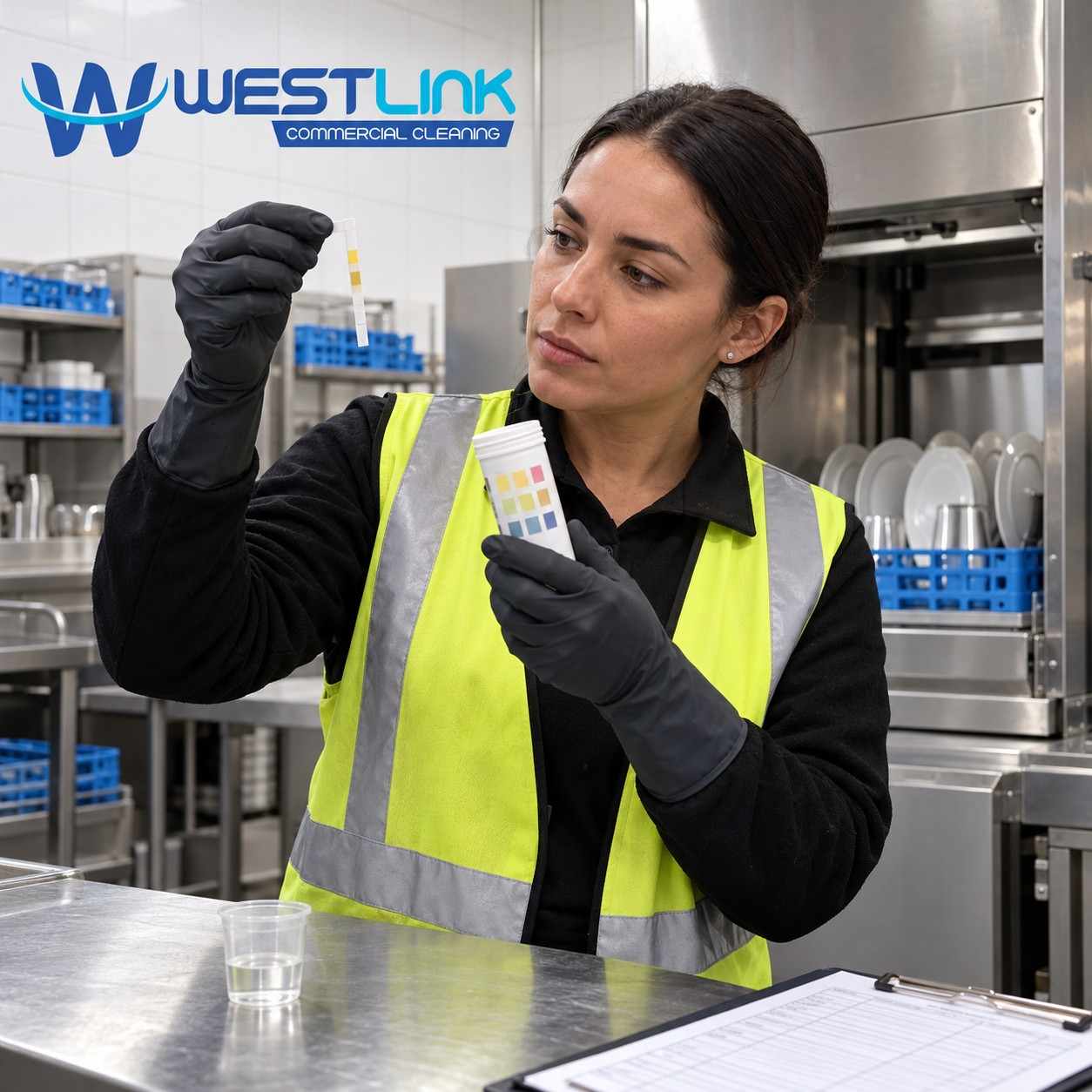
Heat-sanitising dishwashers use high-temperature final rinse water to reduce microorganisms on washed utensils. The NSW Food Authority provides guidance on cleaning and sanitising food-contact equipment in commercial kitchens. Operators must follow the dishwasher manufacturer’s recommended sanitising cycle and verify that the required conditions are achieved.
Those are US model-code values, not universal settings for every country or dishwasher. Follow the applicable local rule, equipment data plate and operating manual. A control-panel rinse temperature is not the same measurement as the surface temperature reached by a plate or utensil.
To verify heat sanitisation, allow the machine to reach operating conditions, run an appropriately loaded test rack with an approved temperature indicator, and read the result as directed. If the required result is not achieved, remove the machine from food-contact service and have the cause corrected before re-testing.
Chemical-Sanitising Dishwashers: Test Sanitiser Concentration
Chemical-sanitising dishwashers depend on an approved sanitiser reaching the required concentration under the correct operating conditions. The acceptable result depends on the active chemical, product label, water temperature, pH, water hardness and contact time.
Check the sanitiser container and feed tubing for empty supply, kinks or disconnections. Use test strips matched to the actual chemical—for example, chlorine strips for a chlorine product—and sample at the point and time prescribed by the test procedure. Compare the result with the product label, machine manual and local food code.
Do not assume that a single parts-per-million figure is suitable for chlorine, iodine and quaternary ammonium sanitisers. If a test fails, stop using the dishwasher for food-contact utensils, correct the dosing or operating fault through authorised procedures, and repeat the check before restarting service.
Record Failed Checks and Corrective Actions
A warewashing hygiene log links test results to the dishwasher, the shift and the action taken. Record the date, machine identification, temperature-indicator result or sanitiser concentration, operator initials, and any corrective action. Follow the business’s food-safety management system or HACCP-based procedures for retesting and handling utensils processed since the last satisfactory check.
When Should You Descale a Commercial Dishwasher?
Commercial dishwasher descaling removes mineral deposits that accumulate on heating surfaces, tank walls and spray jets when the machine uses hard water. A white, chalky coating, reduced rinse performance or repeated scale-related faults can indicate that deliming is needed.
Descaling frequency depends on water hardness, machine use, water treatment and manufacturer instructions; a fixed weekly schedule will not suit every kitchen. Use only a delimer approved for the specific dishwasher, follow the prescribed dilution and rinse cycle, and wear the required protective equipment.
Never combine an acid-based delimer with a chlorine sanitiser or chlorine-containing residue. If the manufacturer requires chemical lines to be isolated or the dosing system to be serviced, use a trained technician.
How Often Should a Commercial Dishwasher Be Cleaned?
Commercial dishwasher cleaning frequency should reflect the manufacturer’s instructions, service volume and observed soil buildup. The following schedule is a practical planning template, not a substitute for model-specific requirements.
| Frequency | Cleaning or inspection task |
| During service | Scrape dishes before loading; inspect and empty accessible scrap baskets when needed; check chemical supplies and machine alerts |
| At the end of each shift or meal period | Drain as directed, remove food debris, clean filters and strainers, wipe the tank and accessible surfaces, and perform the prescribed arm checks |
| At start-up and at intervals set by the food-safety plan | Verify heat or chemical sanitising performance and record results |
| Weekly or as the manual specifies | Inspect spray holes, seals, curtains, arms, drainage and visible scale more thoroughly |
| As condition and water hardness require | Run manufacturer-approved descaling and water-treatment checks |
| On the prescribed service schedule | Have a qualified technician inspect dosing, heaters, pumps, sensors and worn components |
High-volume kitchens may need to empty filters multiple times per shift. A machine that accumulates food scraps quickly may also need better pre-scraping and rack-loading practices, not merely more frequent deep cleaning. Regular equipment inspection helps prevent blockages and poor wash performance, while professional commercial equipment cleaning services in Sydney address grease, dirt and residue buildup across commercial machinery.
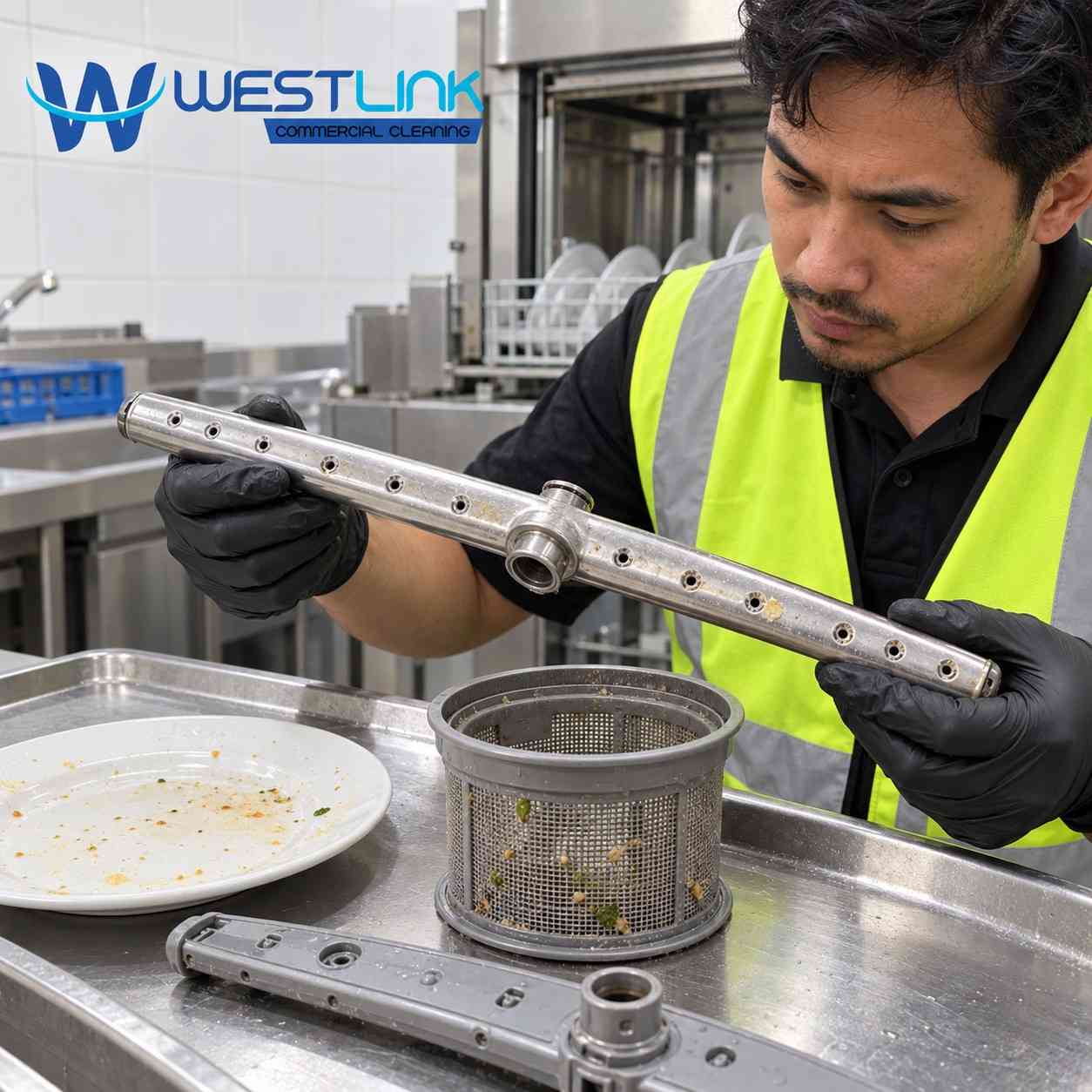
What Problems Can Dirty Filters or Blocked Spray Arms Cause?
Dirty filters and blocked spray arms disrupt water circulation and wash coverage, often producing visible cleaning faults before a complete machine failure. Match the symptom to a safe first check rather than immediately replacing parts.
| Symptom | Possible cause | Safe first action |
| Food particles remain on plates | Full scrap basket, clogged strainer or poor pre-scraping | Clean accessible filters and improve pre-scraping |
| Uneven cleaning across a rack | Blocked wash jets, incorrect loading or arm obstruction | Inspect jets and arm movement; reload to expose surfaces |
| White deposits on utensils or tank | Hard-water scale or chemical/rinse issue | Check water treatment and approved descaling procedure |
| Water remains in the tank | Blocked accessible drain strainer or drain fault | Inspect accessible strainers; call service if drainage remains poor |
| Sanitiser test fails | Empty chemical container, dosing issue or incorrect test method | Check supply and retest using approved instructions; keep machine out of service until it passes |
| Heat-sanitising temperature check fails | Insufficient warm-up, heater/control fault or rinse-system issue | Allow prescribed warm-up and retest; arrange service if still below requirement |
If a dishwasher repeatedly fails sanitising verification, do not treat visibly clean plates as safe evidence that the process worked. Follow the kitchen’s corrective-action procedure and seek qualified service.
Commercial Dishwasher Cleaning Checklist
A written commercial dishwasher cleaning checklist makes daily tasks repeatable across shifts and staff members. Adapt these checkpoints to the machine and the site food-safety plan:
- Complete the wash cycle, remove utensils and shut down safely.
- Drain the wash tank according to the manual.
- Empty and rinse scrap baskets, strainers and removable filters.
- Inspect wash and rinse arms; clear approved removable nozzles.
- Clean accessible tank walls, sump, rack guides and door seals.
- Inspect drain points, gaskets and components for visible damage.
- Refit filters, spray arms, caps and curtains correctly.
- Complete required start-up or shutdown steps.
- Check detergent and sanitiser supplies where applicable.
- Verify sanitising performance at the required interval.
- Record failed checks, corrective actions and service requests.
Frequently Asked Questions
Can you clean a commercial dishwasher with vinegar?
Vinegar is not a universal or automatically approved commercial dishwasher descaler. Acids can affect some components and may interact dangerously with residual chlorine chemicals. Use the cleaning or deliming product specified by the dishwasher manufacturer rather than a household remedy.
Should you remove commercial dishwasher spray arms every day?
Spray arm removal frequency depends on the machine design and operating manual. Some machines require daily removal and flushing, while others specify a less frequent inspection or built-in cleaning cycle. Inspect spray coverage and visible blockages whenever wash performance deteriorates.
Can a dishwasher pass a visual cleanliness check but fail sanitising checks?
A commercial dishwasher can produce visibly clean utensils without meeting the required sanitising conditions. Food soil removal and microbial reduction are different outcomes. Verify heat sanitisation with the approved temperature test or chemical sanitisation with the correct test strips and operating limits.
What is the difference between cleaning and sanitising a commercial dishwasher?
Cleaning removes visible and invisible soil, while sanitising reduces microorganisms on food-contact surfaces under validated conditions. A commercial warewasher normally washes utensils first and then uses its designated heat or chemical sanitising stage. Cleaning the machine’s own parts supports that process but does not replace verification of the sanitising cycle.
When should a commercial dishwasher be taken out of service?
A commercial dishwasher should not be used for food-contact ware when it cannot meet required sanitising conditions or has a fault that compromises safe operation. Examples include repeated failed temperature or chemical tests, leaking electrical components, damaged safety devices or a wash/rinse system that does not function as designed. Follow the site’s corrective-action procedure and arrange qualified service.