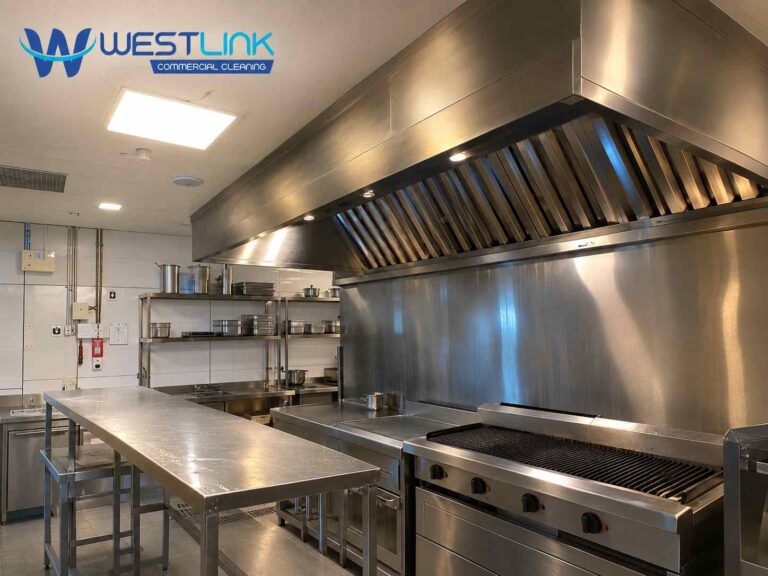
A commercial kitchen deep clean removes grease, carbon deposits and food residue from cooking equipment, preparation areas and other kitchen surfaces. Exhaust cleaning targets the extraction system: the canopy interior, grease filters, plenum, ductwork and exhaust fan.
The difference matters when you compare quotes. The two scopes meet at the canopy, and that is where kitchens either pay twice for the same work or find a section nobody cleaned. Some contractors include canopy and filter cleaning in both services. Others exclude ductwork, roof access or equipment dismantling altogether.
This guide explains what each quote typically covers, where the scopes overlap, what drives the price, which NSW rules apply in 2026, and what records to ask for before you book.
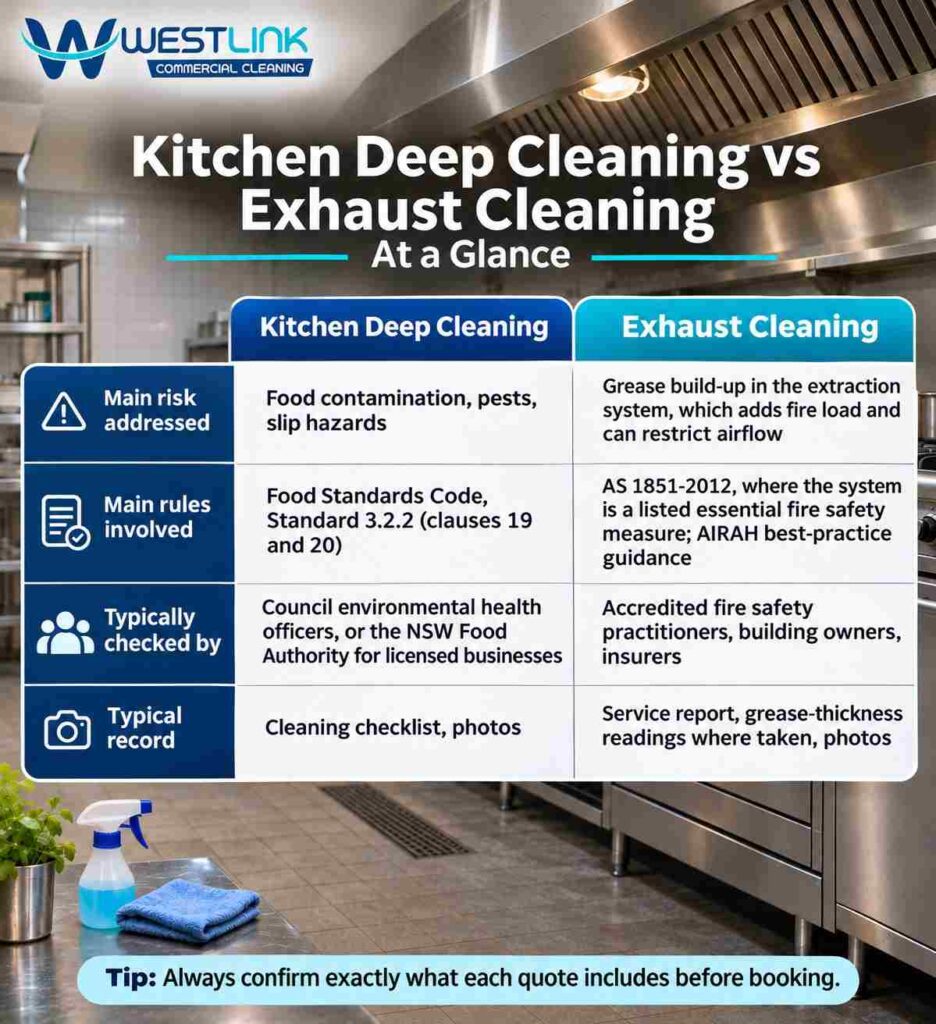
Kitchen deep cleaning vs exhaust cleaning at a glance
| Kitchen deep cleaning | Exhaust cleaning | |
| Main risk addressed | Food contamination, pests, slip hazards | Grease build-up in the extraction system, which adds fire load and can restrict airflow |
| Main rules involved | Food Standards Code, Standard 3.2.2 (clauses 19 and 20) | AS 1851-2012, where the system is a listed essential fire safety measure; AIRAH best-practice guidance |
| Typically checked by | Council environmental health officers, or the NSW Food Authority for licensed businesses | Accredited fire safety practitioners, building owners, insurers |
| Typical record | Cleaning checklist, photos | Service report, grease-thickness readings where taken, photos |
These rules overlap in practice. A greasy canopy is both a hygiene problem and a fire-load problem, so treat the table as a guide to which quote usually answers which rule, not a strict dividing line.
What does a commercial kitchen deep cleaning quote include?
A kitchen deep cleaning quote covers the equipment and surfaces named in its written scope. The list below is typical for a Sydney restaurant, but each contractor sets its own, so check yours line by line. Westlink’s commercial kitchen deep cleaning in Sydney service follows the same structure.
- Cookline: oven cavities, door glass and racks, fryers, flat-top grills, hotplates, cooktops, barbeques and splashbacks.
- Canopy exterior: the outer stainless steel faces of the rangehood above the cookline.
- Prep and wash-up: prep benches, food-contact surfaces, sinks, dishwashers and wash areas.
- Refrigeration: cool rooms, refrigerators, shelving and door seals.
- Floors and drains: floors, grout lines, edges and floor drains.
- Walls and ceilings: tiles, ceilings, doors, handles and switches.
- Dry storage: shelving, racking and storage surfaces.
- Under and behind equipment: floors and walls behind movable equipment. Gas-connected or fixed equipment may need to be isolated or disconnected by a competent person first, so the quote should say who arranges that.
- Waste areas: bins, bin wash zones and the surfaces around the grease trap.
The last item is surface cleaning only. Pumping out a grease trap and disposing of the waste is a separate specialist service, so confirm whether it is excluded.
Crews remove carbonised food, polymerised grease and protein residue with chemical degreasing, steam and hot-water pressure washing. Food-contact surfaces then get a separate sanitising step. Cleaning removes dirt, grease and food waste; sanitising reduces microorganisms to a level that does not compromise food safety (FSANZ).
What does a commercial kitchen exhaust cleaning quote include?
An exhaust quote covers the route grease-laden vapour travels, from the canopy through to the roof. A full quote names these components:
- Canopy interior: inner hood faces, grease channels, gutters and collection trays.
- Grease filters: baffle or mesh filters, degreased and refitted, or swapped through a filter exchange.
- Plenum: the chamber behind the filters where the canopy meets the duct.
- Ductwork: horizontal runs, vertical risers, bends and joints, reached through access panels.
- Exhaust fan: blades or impeller, housing and grease containment tray.
- Roof discharge: the external outlet where the exhaust leaves the building.
A quote that stops at the canopy and filters is a clean hood. It leaves the ducts and fan untouched. For the full route, see Westlink’s commercial kitchen exhaust cleaning service. Two related terms are often used interchangeably: canopy cleaning and range hood cleaning. Ask each contractor which components they mean by those words.
Removing grease deposits can improve airflow where grease is restricting the system, but a clean does not guarantee any particular airflow result.
How much grease is too much?
AIRAH’s Commercial Kitchen Exhaust Management Best Practice Guide recommends choosing a cleaning frequency that keeps grease below 0.2 mm (200 microns) as a mean across the system, based on thickness readings taken at representative locations. It also recommends before-and-after readings where practicable, with each post-clean reading no higher than 50 microns. This is industry best-practice guidance, not a legal limit, and a reading is only meaningful if the report says where and how it was taken. Read the guide on the AIRAH commercial kitchen exhaust page.
Where do the two scopes overlap?
The deep clean ends at the canopy exterior and, sometimes, the grease filters. The exhaust clean runs from the canopy interior to the roof discharge. Cooking fumes follow that order, so it makes a useful order for the lines on a quote.
Scope map, from the cooktop to the roof:
- Cookline equipment: deep clean only
- Canopy exterior: deep clean, and often also listed by exhaust contractors (overlap)
- Grease filters: exhaust clean, sometimes offered in the deep clean (overlap)
- Canopy interior and plenum: exhaust clean
- Duct runs and risers: exhaust clean, where accessible
- Exhaust fan and roof discharge: exhaust clean, subject to roof access
The canopy exterior and the grease filters are the two lines both quotes can claim. If two contractors, or two lines in one quote, both price them, you can end up paying twice. If each assumes the other has them, they go uncleaned. Give each one an owner and a price.
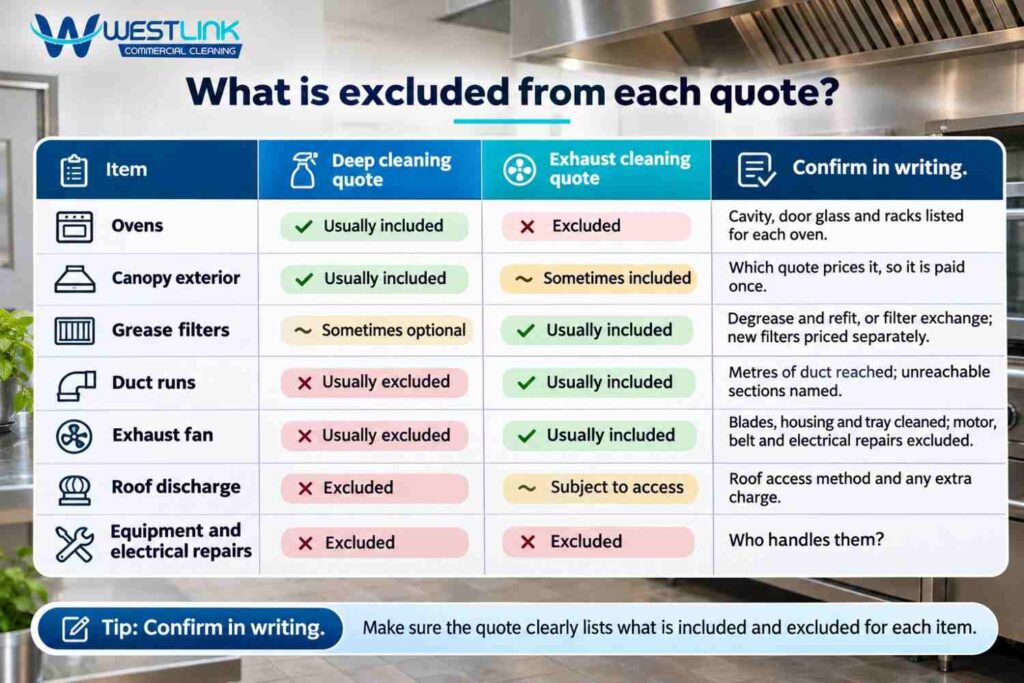
What is excluded from each quote?
| Item | Deep cleaning quote | Exhaust cleaning quote | Confirm in writing. |
| Ovens | Usually included | Excluded | Cavity, door glass and racks listed for each oven |
| Canopy exterior | Usually included | Sometimes included | Which quote prices it, so it is paid once |
| Grease filters | Sometimes optional | Usually included | Degrease and refit, or filter exchange; new filters priced separately |
| Duct runs | Usually excluded | Usually included | Metres of duct reached; unreachable sections named |
| Exhaust fan | Usually excluded | Usually included | Blades, housing and tray cleaned; motor, belt and electrical repairs excluded |
| Roof discharge | Excluded | Subject to access | Roof access method and any extra charge |
| Equipment and electrical repairs | Excluded | Excluded | Who handles them? |
This table shows common market practice. It is not a promise about any one contractor, so the written quote is the only scope that counts.
Inaccessible ductwork is the exclusion that deserves the most attention. Where a duct has no access panels, a crew may not be able to reach its full length. Some sites can be handled with alternative access methods, and others need new panels installed first, which is usually quoted separately. A good report names the sections it could not reach and says why.
What do access and completion records look like?
Deep cleaning needs floor-level access to a closed kitchen. Exhaust work needs access panels in the duct, possibly ceiling-space access, and safe roof access to the fan, with appropriate height-safety controls.
For the records, ask what each service produces:
- Deep clean: cleaning checklist, before-and-after photos, chemicals used with safety data sheets.
- Exhaust clean: a service report listing each component and the method used, sections that could not be reached and why, photos at access points, grease thickness readings where taken, and a recommended next service date.
Contractors differ on which of these are standard and which are optional extras. Confirm at booking which ones come with your clean.
How much does each service cost in Sydney?
Price depends on the scope and the condition of the kitchen, so the only reliable figure is an itemised quote after a site assessment. The factors that move it are:
Kitchen deep cleaning
- Floor, wall and ceiling area in scope
- Number and complexity of appliances (combi ovens and multi-basket fryers take longer to dismantle)
- Level of build-up: carbonised grease takes more labour than weekly residue
- Trading hours: overnight, weekend and public holiday work changes labour rates
Exhaust cleaning
- Duct length and configuration: bends, branches and shared risers slow the work
- Grease thickness when the crew arrives
- Access panels: missing panels add cost or leave sections excluded
- Roof access: ladders, anchors and fan location affect set-up time
Treat published “per hour” or “per square metre” cleaning rates with caution. General commercial cleaning rates do not necessarily reflect specialist grease removal, appliance dismantling or exhaust work, which have different labour and access needs. Check whether any price you are given includes or excludes GST, and whether it is fixed or hourly.
[Westlink to insert verified price ranges or anonymised real quotes here, with GST status stated.]
Example of a combined quote
Illustrative template only, not an actual Westlink quotation. Example: a Sydney restaurant with one commercial canopy.
| Component | Deep clean | Exhaust |
| Ovens and grills | Included | n/a |
| Fryers | Included | n/a |
| Prep benches | Included | n/a |
| Floors and drains | Included | n/a |
| Canopy exterior | Included | Not duplicated |
| Canopy interior | n/a | Included |
| Grease filters | n/a | Included |
| Plenum | n/a | Included |
| Accessible ductwork | n/a | Included |
| Exhaust fan | n/a | Included |
| Roof discharge | n/a | Subject to access |
| New access panels | n/a | Separately quoted |
| Equipment repairs | Excluded | Excluded |
| Line | Amount |
| Kitchen deep cleaning | $___ |
| Exhaust system cleaning | $___ |
| Additional access costs | $___ |
| GST | $___ |
| Total | $___ |
Actual pricing, boundaries and exclusions are confirmed after a site assessment.
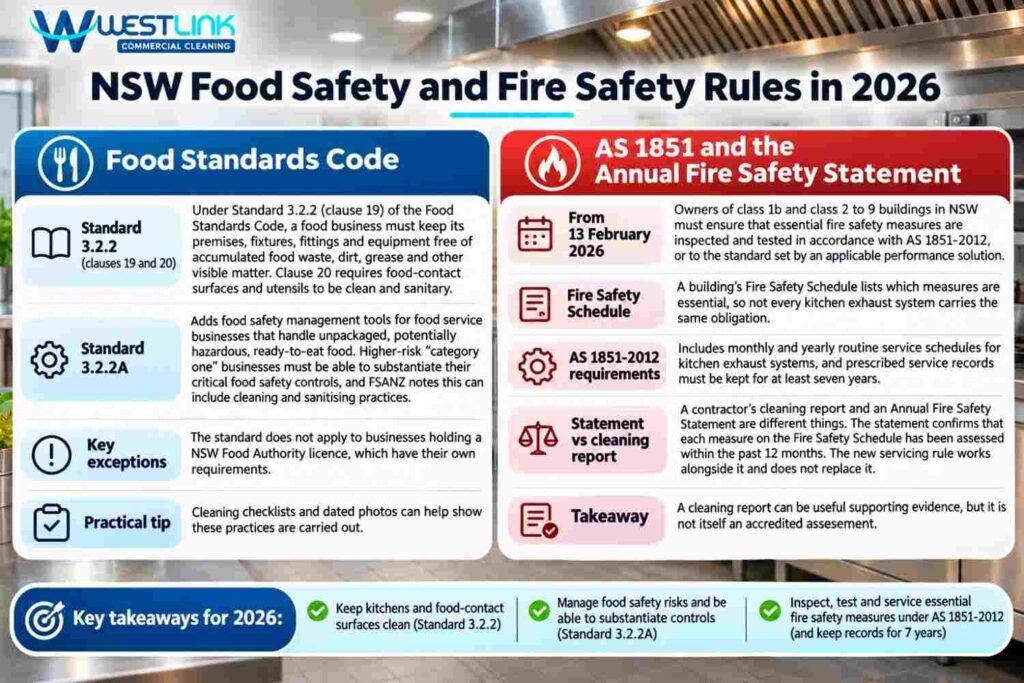
NSW food safety and fire safety rules in 2026
Food Standards Code
Under Standard 3.2.2 (clause 19) of the Food Standards Code, a food business must keep its premises, fixtures, fittings and equipment free of accumulated food waste, dirt, grease and other visible matter. Clause 20 requires food-contact surfaces and utensils to be clean and sanitary (WA Health summary of the clauses).
Standard 3.2.2A adds food safety management tools for food service businesses that handle unpackaged, potentially hazardous, ready-to-eat food. Higher-risk “category one” businesses must be able to substantiate their critical food safety controls, and FSANZ notes this can include cleaning and sanitising practices (FSANZ). The standard does not apply to businesses holding a NSW Food Authority licence, which have their own requirements (NSW Food Authority). Cleaning checklists and dated photos can help show these practices are carried out.
AS 1851 and the Annual Fire Safety Statement
Since 13 February 2026, owners of class 1b and class 2 to 9 buildings in NSW must ensure that essential fire safety measures are inspected and tested in accordance with AS 1851-2012, or to the standard set by an applicable performance solution. A building’s Fire Safety Schedule lists which measures are essential, so not every kitchen exhaust system carries the same obligation (Building Commission NSW). AS 1851-2012 includes monthly and yearly routine service schedules for kitchen exhaust systems, and prescribed service records must be kept for at least seven years.
A contractor’s cleaning report and an Annual Fire Safety Statement are different things. The statement confirms that each measure on the Fire Safety Schedule has been assessed within the past 12 months. The new servicing rule works alongside it and does not replace it (North Sydney Council). A cleaning report can be useful supporting evidence, but it is not itself an accredited assessment.
If you are unsure what applies to your premises, ask your building manager or an accredited fire safety practitioner.
Who is responsible: landlord or tenant?
The regulation places the duty to maintain essential fire safety measures on the building owner. Who actually arranges and pays for kitchen exhaust work often depends on the lease (Mondaq on fire safety in leases). Check your lease and speak to your property manager before you book. Shared ducts and risers in food courts and multi-storey buildings add another layer, so confirm who controls access.
Should you book both services together?
A combined booking can suit a kitchen whose deep clean and exhaust clean fall due around the same time and whose duct route is reachable. It can mean:
- one closure instead of two, depending on job size and access
- one crew mobilisation and one roof set-up
- the canopy and filter lines priced once
Separate bookings can suit kitchens where the cycles differ (a high-volume wok kitchen may need exhaust work more often than a deep clean), where duct access needs remedial work first, or where an insurer or certifier wants a stand-alone exhaust report. Cleaning frequency should follow how heavily the kitchen is used and what the grease readings show, so treat any fixed schedule as an example, not a rule.
Either way, a combined quote should still itemise each scope.
Quote comparison checklist
Ask every contractor the same questions:
- Which oven, fryer and grill components are cleaned?
- Who owns the canopy exterior and the grease filters, and are they priced once?
- Are filters cleaned, exchanged or replaced, and what does each cost?
- How many metres of duct, which risers and which fan sections can the crew reach?
- What happens to sections without access panels?
- How is the roof fan reached, and is there a roof access charge?
- Are prices fixed or hourly, and do they include GST?
- Who isolates gas and power?
- What exactly is in the report, and which parts cost extra?
- Are equipment repairs, grease trap pumping and waste disposal excluded?
Frequently asked questions
Is exhaust cleaning included in a kitchen deep clean? Only when the written scope says so. A deep clean normally reaches the canopy exterior and sometimes the filters. The plenum, ductwork and fan need an exhaust scope that names each component.
Is duct cleaning included in hood cleaning? Usually not. A hood clean stops at the canopy and filters. Duct cleaning covers the runs, risers and bends behind the plenum.
Does filter cleaning replace exhaust cleaning? No. Filters capture only part of the airborne grease. The rest settles in the ducts and fan.
Are grease filters charged separately? Often. Quotes may price degreasing and refitting, a filter exchange, or new filters as separate lines.
Is grease trap pumping part of a deep clean? No. A deep clean covers surfaces around the trap. Pumping and waste disposal are specialist services.
Who pays for exhaust cleaning in a leased restaurant? The building owner carries the statutory duty, but the lease may pass the cost to the tenant. Read the lease and ask your property manager.
Does an exhaust cleaning report satisfy the Annual Fire Safety Statement? Not by itself. The statement rests on an assessment of each measure on the Fire Safety Schedule. A cleaning report can support it.
What if the contractor can’t reach the whole duct? The report should name the unreachable sections and the reason, and the contractor should quote the remedial options, such as access panels.
How can I check the duct was actually cleaned? Ask for photos at each access point and, where taken, before-and-after grease readings. These cover accessible components only, which is why the report must list what was not reached.
Can I book exhaust cleaning without a deep clean? Yes. They are separate services and can run on separate cycles.
The short answer
A kitchen deep cleaning quote covers equipment and surfaces named in its scope. An exhaust cleaning quote covers the route from the canopy interior to the roof discharge. The canopy exterior and grease filters are the overlap lines to price once. Inaccessible duct sections are the exclusion to check, and the service report is the record to keep.
Get an itemised kitchen and exhaust cleaning quote
Not sure whether your Sydney kitchen needs a deep clean, exhaust cleaning or both? Westlink Commercial Cleaning can assess your equipment, canopy, filters, duct access and roof fan before preparing a written quote. The quote shows the proposed cleaning areas, overlapping tasks, access limits and any separately priced work, so you know what is included before you book.
Request your free site assessment and itemised quotation.
Sources
- Building Commission NSW: Responsibilities of building owners under AS 1851-2012
- North Sydney Council: Fire safety servicing requirements and the AFSS
- AIRAH: Commercial Kitchen Exhaust Management Best Practice Guide
- FSANZ: Cleaning and sanitising
- FSANZ: Standard 3.2.2A overview
- NSW Food Authority: Standard 3.2.2A
- WA Health: Cleaning and sanitising food premises and equipment
- Mondaq: Fire safety in leases