

Commercial end-of-lease cleaning is the thorough one-off clean a business tenant completes before handing leased premises back to the landlord at the end of a commercial lease. A commercial lease sets the cleaning standard through its own wording, so the handback, yield-up, and make good clauses decide how clean the premises must be. End-of-lease cleaning is the final clean of the premises, while make-good is a lease obligation to return the premises to a specified condition and can include far more than cleaning. Preparation for a commercial handover starts with reading the lease clauses, finding the condition benchmark and agreeing on the cleaning scope in writing before any cleaning begins. A zone-by-zone commercial end-of-lease checklist covers reception and common areas, offices, meeting rooms, kitchens, amenities, glass, floors, and back-of-house areas such as storerooms, loading docks, and bin enclosures. An effective commercial handover follows a fixed sequence: remove contents, complete defit and make good works, clean from top to bottom, treat floors last, then inspect against the agreed scope. A tenant can clean a small, simple tenancy in-house, but a specialist commercial contractor suits larger premises, tight handover windows, building access rules, and leases that specify professional cleaning. Commercial end-of-lease cleaning in Australia typically costs about $6 to $12 per square metre for the base clean, according to 2026 prices published by Australian cleaning providers and cost guides. The duration of a commercial end-of-lease clean depends on floor area, zone count, condition, access hours and drying time, so a reliable quote states a written schedule rather than a single hourly estimate. Professional carpet or hard-floor cleaning is required at the end of a commercial lease only when the lease or its condition benchmark says so, not as a universal rule. The final inspection compares the premises’ handback condition with the lease requirements and the starting condition benchmark, and the landlord’s acceptance affects the release of the tenant’s security. The most costly commercial handover mistakes are scoping from a walkthrough instead of the lease, booking the clean too late and keeping no evidence of the completed work.
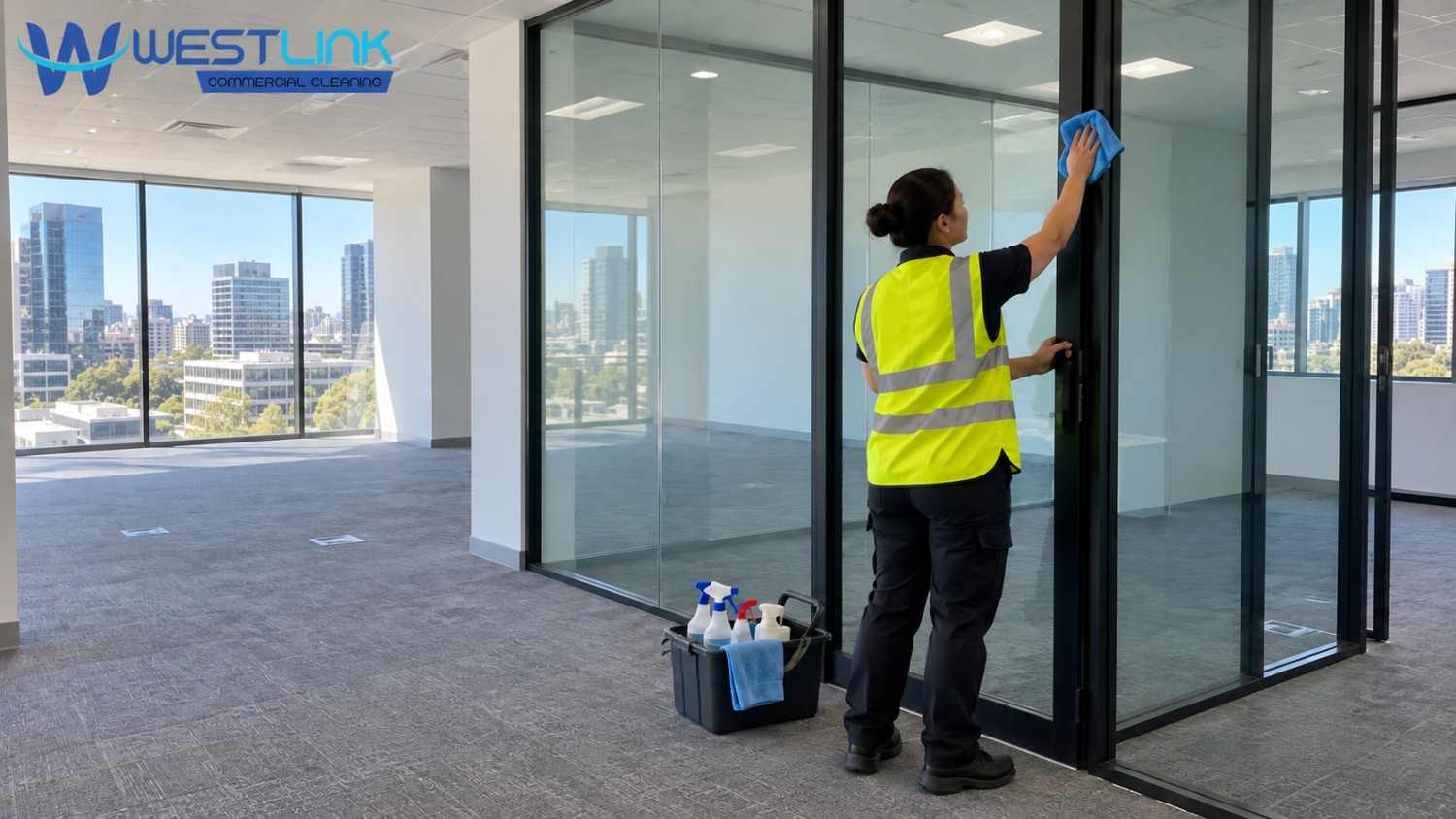
What Is Commercial End-of-Lease Cleaning?
Commercial end-of-lease cleaning is the thorough one-off clean a business tenant completes before handing leased premises back to the landlord at the end of a commercial lease.
The service also goes by handover clean, final clean and end of tenancy clean. The terms ‘bond cleaning’ and ‘vacate cleaning’ usually describe residential tenancies, which run under different legislation and a different security arrangement. This guide covers business premises: office suites, retail shops, warehouses and industrial units, medical and dental clinics, and hospitality venues.
A routine commercial cleaning contract keeps premises presentable while staff work in them, so it is repeated, partial and scheduled around occupancy. A handover clean happens once, after the tenancy is emptied, and is judged against a fixed condition. The lease, not industry custom and not the previous tenant’s habits, defines that condition.
This guide gives business tenants a zone-by-zone checklist, explains where cleaning ends and makes good begins, and sets out how to scope, price and evidence a handover clean. It is general information, not legal advice, and no cleaning company can guarantee that a landlord will release a bank guarantee or security deposit in full.
Does a Commercial Lease Require End-of-Lease Cleaning?
A commercial lease sets the cleaning standard through its own wording, so the handback, yield-up and make good clauses decide how clean the premises must be.
Residential tenancies usually follow a statutory standard of reasonable cleanliness. Commercial obligations come mainly from the contract, so two businesses leaving identical office suites can owe different things. One lease may ask only that the premises be left clean and tidy, while another ties the handback to a condition report prepared at the start of the term.
Look for four things in your lease:
- The yield-up, condition or handback clause, which states the state of repair and cleanliness required when the lease ends.
- The make good clause, which may add removal of fit-out, repainting and reinstatement.
- The condition benchmark, such as a schedule of conditions, condition report or dilapidations report prepared at the start of the term.
- The notice, inspection and key-return provisions, including any holding-over terms if handover slips past the end date.
Fair wear and tear is commonly excluded from the tenant’s obligations, but the exact wording matters. A worn carpet in a walkway and a stained carpet are treated differently. Where a clause is vague, the dispute usually turns on the words the parties signed, which is why reading the clause before booking any cleaner is the most valuable first step.
Do retail leases follow different rules from other commercial leases?
Yes, retail shop leases in most Australian jurisdictions sit under specific retail leasing legislation, while office, warehouse, cleaning and most industrial premises are governed largely by the lease itself. Examples include the Retail Leases Act 1994 (NSW), the Retail Leases Act 2003 (Vic), the Retail Shop Leases Act 1994 (Qld), the Retail and Commercial Leases Act 1995 (SA), the Commercial Tenancy (Retail Shops) Agreements Act (WA) and the Leases (Commercial and Retail) Act 2001 (ACT). Coverage and thresholds differ between jurisdictions, so confirm which regime applies to your premises before negotiating anything about handover.
What Is the Difference Between End-of-Lease Cleaning and Make Good?
End-of-lease cleaning is the final clean of the premises, while make-good is a lease obligation to return the premises to a specified condition and can include far more than cleaning.
The label ‘make good’ has no fixed legal meaning. A clause may demand little more than cleaning and minor repairs, or it may require removing the tenant’s fit-out and restoring the premises to base-building condition. Make good works commonly fall into five groups: strip-out, building fabric reinstatement, services reinstatement, cleaning and handback condition.
| Item | Usually cleaning | Usually make good |
| Dust, grease, marks and grime on surfaces that stay | Yes. | No |
| Carpet and hard-floor cleaning | Yes, where the lease requires it | No |
| Removing partitions, joinery, cabling or signage | No | Yes (strip-out or defect) |
| Patching holes and repainting walls | No | Yes (reinstatement) |
| Adhesive residue and paint shadow after signage removal | Sometimes | Often, because the substrate may need repair |
| Reinstating ceilings, lighting or services to a capped condition | No | Yes (licensed trades may be needed). |
| Final clean after all works are finished | Yes. | Often the last step of making good |
If your lease only requires the premises to be left clean, you need a handover clean. If it contains a make good clause, cleaning is one part of a larger obligation, and the works are often quoted by different trades. When the make good is not carried out, the landlord may do the work and claim the cost, depending on the lease, so agree on the scope of both obligations early.
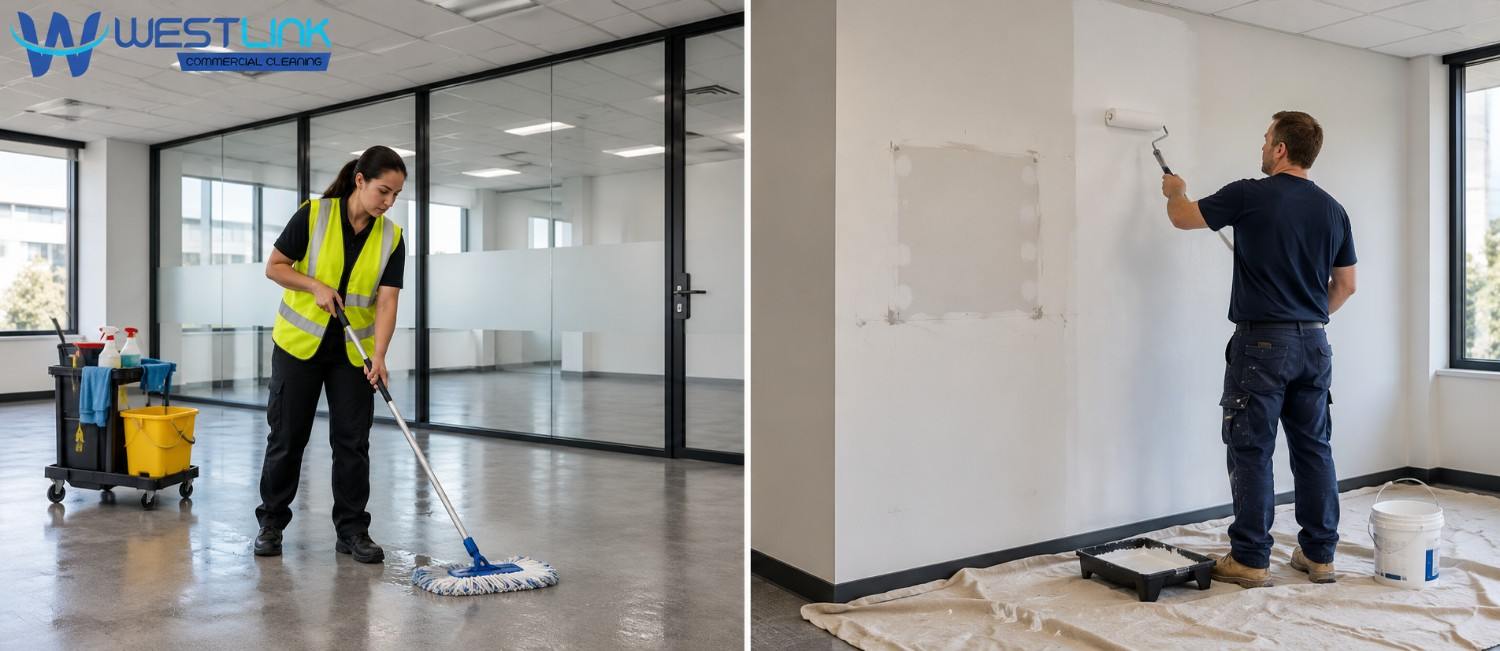
How Do You Prepare for Commercial End-of-Lease Cleaning?
Preparation for a commercial handover starts with reading the lease clauses, finding the condition benchmark and agreeing the cleaning scope in writing before any cleaning begins.
Complete these eight tasks before the first cleaner enters the premises:
- Read the lease clauses. Locate the yield-up, condition, make good, notice and key-return provisions, and note any that name a specific cleaning requirement, such as professional carpet cleaning.
- Find the condition benchmark. Retrieve the schedule of condition, condition report, dilapidations report or start-of-lease photographs. These records show what the premises looked like when you took possession.
- Confirm which lease regime applies. Establish whether the premises are a retail shop lease under state legislation or a general commercial lease governed mainly by the contract.
- Ask the landlord or agent about the inspection process. Confirm the handover date, who inspects, what they check and how keys, swipe cards, fobs, remotes and alarm codes are returned.
- Agree the cleaning scope in writing. Send the zone-by-zone scope to the property manager before cleaning and ask whether anything is missing from their perspective.
- Sequence the trades. Schedule removalists first, then defit and make good works, then cleaning, with a gap between each so no trade undoes another’s work.
- Meet building requirements. Arrange contractor inductions, after-hours access, lift and loading dock bookings and certificates of currency for contractor insurance.
- Book specialist work early. Carpet extraction, hard-floor stripping and sealing, external glass at height and waste removal often need separate appointments.
What equipment and safety planning does a commercial handover clean need?
Commercial handover cleans often need equipment beyond domestic tools, including carpet extractors, floor scrubbing machines, industrial vacuums and access equipment for glass or ceilings above reach. Work at height, heavy machinery and chemical handling carry workplace health and safety duties, so use suitably trained and insured contractors for those tasks and follow product labels and safety data sheets.
Safety note: Never mix bleach with ammonia, acids or other cleaners. Do not remove electrical covers, work at height without proper equipment, or handle clinical, chemical or hazardous waste yourself. Test products on an inconspicuous area first to avoid damaging stone, timber, laminate, glass or paint.
What Does a Zone-by-Zone Commercial End of Lease Cleaning Checklist Include?
A zone-by-zone commercial end of lease checklist covers reception and common areas, offices, meeting rooms, kitchens, amenities, glass, floors and back-of-house areas such as storerooms, loading docks and bin enclosures.
Use the zones that apply to your premises, then compare the results with the lease and the condition benchmark. The checklist is not a legal requirement to restore every item to a new finish, and the lease decides which items belong to the tenant.
Reception, corridors, lift lobbies and stairwells
Common areas are the first things an inspector sees, and they are easy to under-clean because they are circulation space rather than workspace.
☐ Dust high surfaces first: ledges, door frames, cable trays, vents, light fittings and the tops of partitions.
☐ Remove cobwebs from ceiling junctions, corners and behind doors.
☐ Wipe walls, door handles, push plates, switch plates and access-card readers; remove scuff marks without lifting paint.
☐ Clean entry doors, sidelights, glazed screens and reception counters.
☐ Clean stair handrails, treads and landings, including edges and corners.
☐ Empty bins and remove rubbish.
☐ Vacuum carpet including edges; mop or machine-clean hard floors.
Commonly missed: the tops of door frames, access-reader surrounds, stair edges and the tracks of sliding doors.
Open-plan offices, workstations and meeting rooms
Office cleaning at handover removes dust, marks and residue from workspace fittings once furniture and equipment have left.
☐ Empty and wipe desks, drawers, filing cabinets, lockers and shelving inside and out.
☐ Clean the underside of desk returns, cable trays and accessible floor boxes.
☐ Vacuum or spot-clean workstation screens and fabric partitions according to the material.
☐ Clean both faces of glazed partitions and meeting-room glass, plus frames and door furniture.
☐ Wipe whiteboards, pinboards and the walls behind them.
☐ Remove adhesive residue from decals, wall graphics and cable clips where this can be done without damaging the surface.
☐ Dust skirting boards, vents, window sills and any blinds that belong to the premises.
☐ Check under and behind fixed furniture that stays with the tenancy.
Staff kitchens and kitchenettes
Kitchen areas fail inspections more often than other office zones because grease builds up gradually and is easy to feel but hard to see from a distance.
☐ Remove all food and wipe cupboards and drawers, including runners and handles.
☐ Degrease benchtops, splashbacks and the walls behind appliances.
☐ Clean the sink, taps and drain, removing mineral marks rather than wiping over them.
☐ Clean appliances that remain with the premises, including fridge, dishwasher, microwave and boiling-water unit, with their seals and filters.
☐ Clean the floor, including the gaps beside and behind cabinetry.
☐ Empty and sanitise bins.
Washrooms, showers and amenities
Amenities are inspected closely because the standard is hygiene as well as appearance.
☐ Clean and sanitise toilet pans, cisterns, urinals, seats and the fixings and floor around them.
☐ Wipe cubicle partitions, doors, latches and the tops of partitions.
☐ Clean basins, tapware, mirrors, hand dryers and dispensers.
☐ Remove scale and soap scum from tiles and grout; clear accessible floor wastes.
☐ Empty and sanitise bins and sanitary units, arranging supplier servicing where applicable.
☐ Clean showers, lockers, benches and drying areas in end-of-trip facilities.
Glass, windows, partitions and walls
Glass shows streaks and fingerprints more than any other surface, so check it at an angle to the light.
☐ Clean internal window glass, frames, sills and tracks.
☐ Clean external glass only where the lease makes it the tenant’s responsibility and it can be reached safely; use qualified high-access contractors for work at height.
☐ Dust or wash blinds according to their material.
☐ Spot-clean walls with a method safe for the paint finish.
☐ Remove fingerprints from glazed doors and internal glass.
Floors: carpet, vinyl, tiles and polished concrete
Floor cleaning depends on the floor covering, existing stains and the specific lease requirement.
☐ Remove loose debris, then vacuum carpet including edges, corners and the areas under removed furniture.
☐ Treat spots promptly, testing colourfastness and product suitability first.
☐ Arrange professional carpet extraction where the lease requires it, and keep the receipt or certificate.
☐ Clean vinyl, tile and sealed concrete with methods suited to the surface.
☐ Confirm whether the lease requires hard-floor stripping and resealing, which is separate from cleaning.
☐ Allow carpets and wet floors to dry fully before the inspection.
Ceilings, lights, vents and high-level surfaces
High-level surfaces collect dust that falls onto cleaned areas below, so treat them before floors.
☐ Dust accessible light fittings, diffusers, ceiling vents and fans with the power off.
☐ Wipe accessible air-conditioning grilles; leave servicing of air-conditioning plant to qualified technicians.
☐ Remove cobwebs from ceilings, corners and cornices.
☐ Check whether the lease requires failed lamps or tubes to be replaced.
Retail shopfronts and sales floors
Retail handovers add shopfront glass, display fixtures and signage to the checklist.
☐ Clean shopfront glass, door frames, thresholds and entry areas.
☐ Remove display fixtures and shelving where the lease requires, then clean the residue and marks left behind.
☐ Clean counters, fitting rooms, back counters and stockrooms.
☐ Remove window decals and adhesive residue.
☐ Clean floors, including the areas under removed fixtures.
☐ Check signage obligations; removing fascia signage and repairing the surface may fall under make good.
Warehouses, workshops and industrial units
Industrial premises focus on floors, high surfaces and the separation of dirt from damage.
☐ Remove stock, pallets and racking where the lease requires it.
☐ Sweep and machine-clean floors, treating oil and chemical marks with suitable methods.
☐ Dust beams, ledges and high surfaces using safe access equipment.
☐ Clean loading docks, roller doors and dock-area floors.
☐ Clean lunchrooms and amenities.
☐ Dispose of hazardous waste through licensed providers, and note that stained or damaged concrete may be assessed as damage rather than dirt.
Medical, dental and clinic premises
Clinic handovers add decontamination and waste obligations that the lease or applicable regulations may set.
☐ Remove equipment, sharps, chemicals and clinical waste first, using licensed providers where required.
☐ Clean consulting and treatment rooms, benches, cabinetry, sinks and floors.
☐ Clean reception, waiting areas and amenities.
☐ Confirm with the landlord whether any infection-control or decontamination standard applies at handback.
Hospitality venues and commercial kitchens
Commercial kitchen handovers involve grease, exhaust systems and licensed services that go beyond an office kitchenette clean.
☐ Degrease cooking areas, benches, walls and the floor behind and beneath equipment.
☐ Clean exhaust canopies and filters, and arrange duct cleaning by a qualified provider where the lease requires it.
☐ Arrange grease trap servicing through a licensed provider.
☐ Remove food, oils and waste, and check for pest activity.
☐ Clean the front of house, bar, cool rooms and outdoor seating areas.
☐ Keep service records and receipts for the handover file.
Back-of-house, storerooms, loading docks and external areas
Back-of-house areas belong to the tenancy and are inspected, even when nobody uses them.
☐ Clean and clear storerooms, cleaner’s cupboards, plant cupboards and comms rooms, leaving equipment and cabling untouched.
☐ Sweep and clean loading docks, car bays, yards and bin enclosures.
☐ Remove rubbish, forgotten belongings, redundant signage and bulk waste.
☐ Check roof access points, balconies and courtyards included in the demised premises.
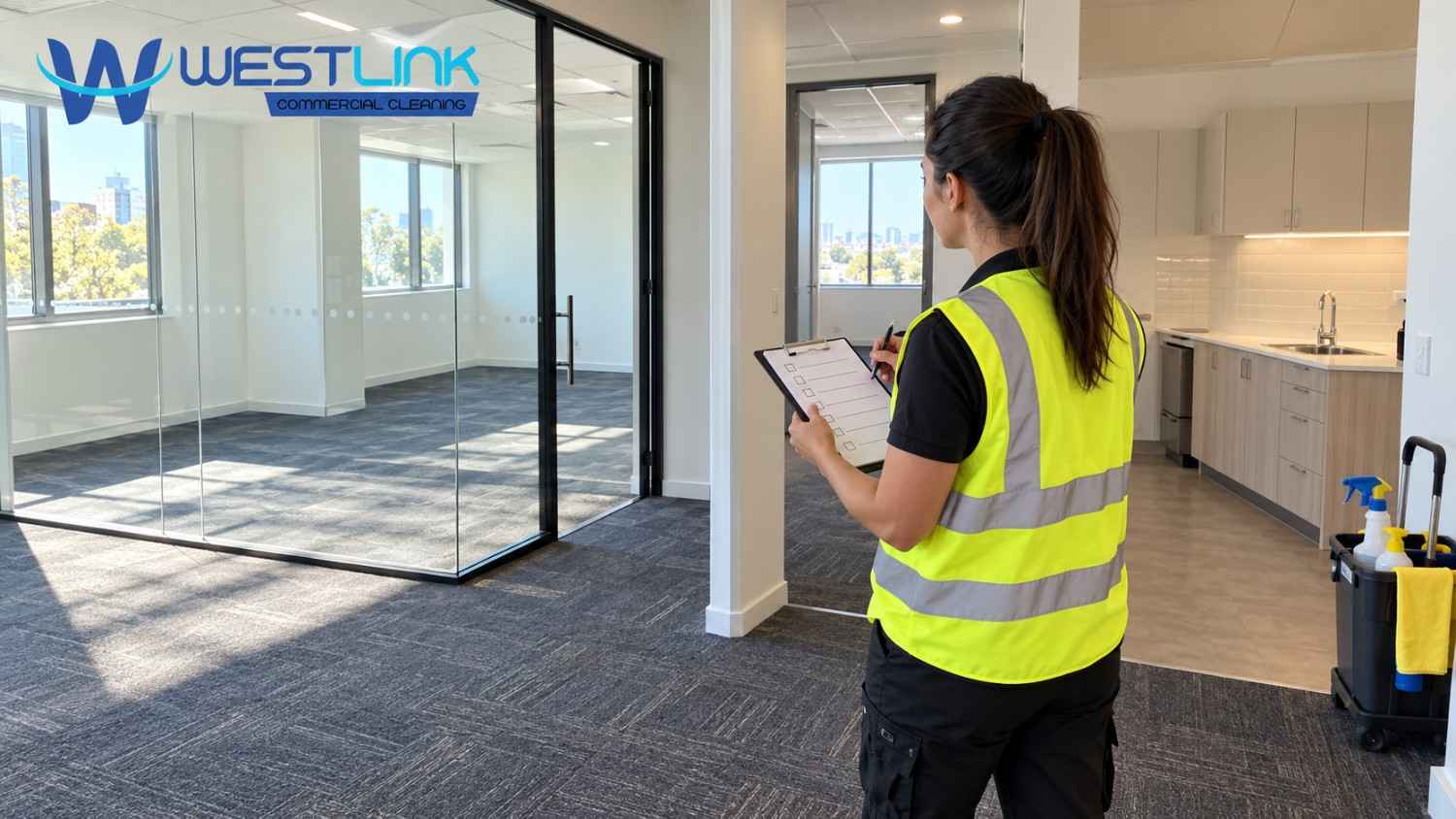
What Order Should You Follow for a Commercial Handover?
An effective commercial handover follows a fixed sequence: remove contents, complete defit and make good works, clean from top to bottom, treat floors last, then inspect against the agreed scope.
- Remove contents: Clear furniture, stock, equipment and rubbish so every surface is accessible.
- Complete defit and make good works: Finish removal, patching and repainting before cleaning, because these trades create dust and debris.
- Dust high to low: Treat vents, light fittings, ledges and partition tops before lower surfaces.
- Clean fixtures and fittings: Work through kitchens, amenities, joinery, glass and walls.
- Treat the floors last: Vacuum, extract, mop or machine-clean after overhead and bench work so nothing falls onto finished floors.
- Allow drying and buffer time: Leave a gap before inspection so carpets dry and any flagged items can be fixed while you still hold access.
- Inspect against the agreed scope: Walk each zone with the written scope, the lease clauses and the condition benchmark.
What does a sample commercial handover timeline look like?
The timeline below is a planning example, not a promise that every tenancy follows the same schedule. Larger, multi-storey or heavily fitted-out premises need more time at every stage.
| Stage | Priority tasks |
| Well before lease end | Read the lease, find the condition benchmark, confirm notice dates and the lease regime, and agree the scope in writing. |
| Removal week | Remove furniture and equipment, then complete defit and make good works. |
| Cleaning window | Complete the zone-by-zone clean, specialist floor treatment and waste removal. |
| Buffer days | Allow carpets to dry, correct missed items and photograph each zone. |
| Inspection and handover | Attend the final inspection, resolve flagged items, return keys, cards and codes, and obtain written acceptance. |
Should You Clean In-House or Hire a Commercial Cleaning Contractor?
A tenant can clean a small, simple tenancy in-house, but a specialist commercial contractor suits larger premises, tight handover windows, building access rules and leases that specify professional cleaning.
| Consideration | In-house or routine contractor | Specialist handover contractor |
| Access hours | Often limited to normal hours, which may not suit an empty tenancy or a building with restricted access | Scheduled around the handover date, including after hours where the building permits |
| Site induction and WHS | Your staff may not hold the inductions a building requires for contractors | Induction and site-rule compliance form part of the engagement |
| Insurance | Check whether your policies cover staff doing this work, especially at height or with machinery | Confirm public liability and workers’ compensation cover in writing before work starts |
| Equipment | Domestic or light commercial equipment rarely suits carpet extraction or floor machines | Equipment matches the scope; specialist work may be subcontracted |
| Scale | Workable for a small suite in good condition | Better suited to multi-zone tenancies, warehouses and tight handover windows |
| Documentation | Rarely produced, which leaves you without evidence at inspection | A written scope and photographs, where agreed, give you evidence |
In-house cleaning works when the tenancy is small, the fit-out is simple, the premises are in good condition and the lease asks only that they be left clean. It becomes a poor choice when the lease names professional cleaning for specific elements, when the building imposes contractor requirements, or when the handover date leaves no room to redo work.
What should a commercial end of lease cleaning quote specify?
A commercial end of lease quote should state the scope zone by zone so that two quotes can be compared on equal terms. Ask each contractor to confirm:
- The floor area, number of zones and which rooms and back-of-house areas the price covers.
- The carpet and hard-floor methods included, and whether stripping and sealing costs extra.
- Whether external glass, high-access work, waste removal and signage residue removal are included.
- Whether the quote is fixed or subject to a site inspection, and whether it includes GST.
- The working hours, access arrangements and finish date.
- Current insurance certificates, site induction capability and the contractor’s re-clean policy, including its time limit.
- Which documents you will receive at completion, such as an itemised invoice and dated photographs.
A contractor’s advertised re-clean or handover guarantee is a business policy, not a promise that the landlord will accept the premises or release the security in full. Read the actual service terms.
How Long Does Commercial End of Lease Cleaning Take?
The duration of a commercial end of lease clean depends on floor area, zone count, condition, access hours and drying time, so a reliable quote states a written schedule rather than a single hourly estimate.
No reliable single hours figure exists for commercial premises, because a single open floor cleans faster per square metre than the same area divided into offices, meeting rooms and amenities. Ask each contractor for a written schedule and use the factors below to test it.
| Factor | Why it changes the schedule |
| Floor area and number of zones | More separate rooms, amenities and kitchens increase the work per square metre. |
| Condition at handover | Accumulated grease, adhesive residue and neglected amenities take disproportionately longer than general dust. |
| Whether the tenancy is fully emptied | Cleaning around remaining furniture or stock forces a return visit, the most common cause of overrun. |
| Access hours | After-hours and weekend work may be required by the building and may need advance booking. |
| Lift and loading dock bookings | Moving equipment and waste in a multi-storey building depends on a booked service lift. |
| Site induction lead time | Some buildings require inductions or approved-contractor status before work starts. |
| Security and alarms | Out-of-hours access may need an escort, alarm isolation or a temporary access card. |
| Drying time | Carpet extraction and wet floors need drying time before the inspection. |
| Staged handover | Handing back floor by floor takes longer in total but can protect the lease deadline. |
Book the clean to finish several days before the inspection, not on the same day, so you have time to fix anything the property manager flags while you still hold access.
What Do Landlords Check at the Final Inspection and How Do You Protect Your Security?
The final inspection compares the premises’ handback condition with the lease requirements and the starting condition benchmark, and the landlord’s acceptance affects the release of the tenant’s security.
Commercial landlords commonly hold a bank guarantee, a cash security deposit or a third-party guarantee against the tenant’s obligations. Cleaning that does not meet the required condition is one of the simpler, better-documented grounds for a claim, because the evidence is photographic and the remedy has an invoice attached.
Final handover walkthrough checklist
☐ Check each zone against the lease clauses, the condition benchmark and the written scope.
☐ Inspect kitchens, amenities, glass and floors at standing height with the lights on.
☐ Check back-of-house areas, loading docks, bin enclosures and external areas.
☐ Confirm carpets and floors have dried, and collect receipts or certificates for professional services.
☐ Take clear, dated photographs of every zone, plus a video walkthrough if useful.
☐ Keep the written scope, invoices, certificates and all correspondence together.
☐ Return keys, swipe cards, fobs, remotes and alarm codes as the lease requires, and record the handover.
☐ Ask for written acceptance, and confirm the process and timing for the release of your security.
What if the property manager says the premises failed the inspection?
Ask for the list of concerns in writing, with the location of each item and photographs where available. Check each item against the agreed scope, the lease obligation and the condition benchmark, then agree who will fix it and by when.
Items inside the agreed cleaning scope are corrected under that arrangement. Items that turn out to be make good, damage or repair are a different obligation and usually a different trade. If you disagree, put your position in writing, keep your records and follow the dispute process in your lease. For retail leases, the state small business commissioner or tribunal may offer a mediation or dispute pathway. If the handover slips past the lease end, the lease may treat you as holding over, which can mean continued rent, so check the relevant clause.
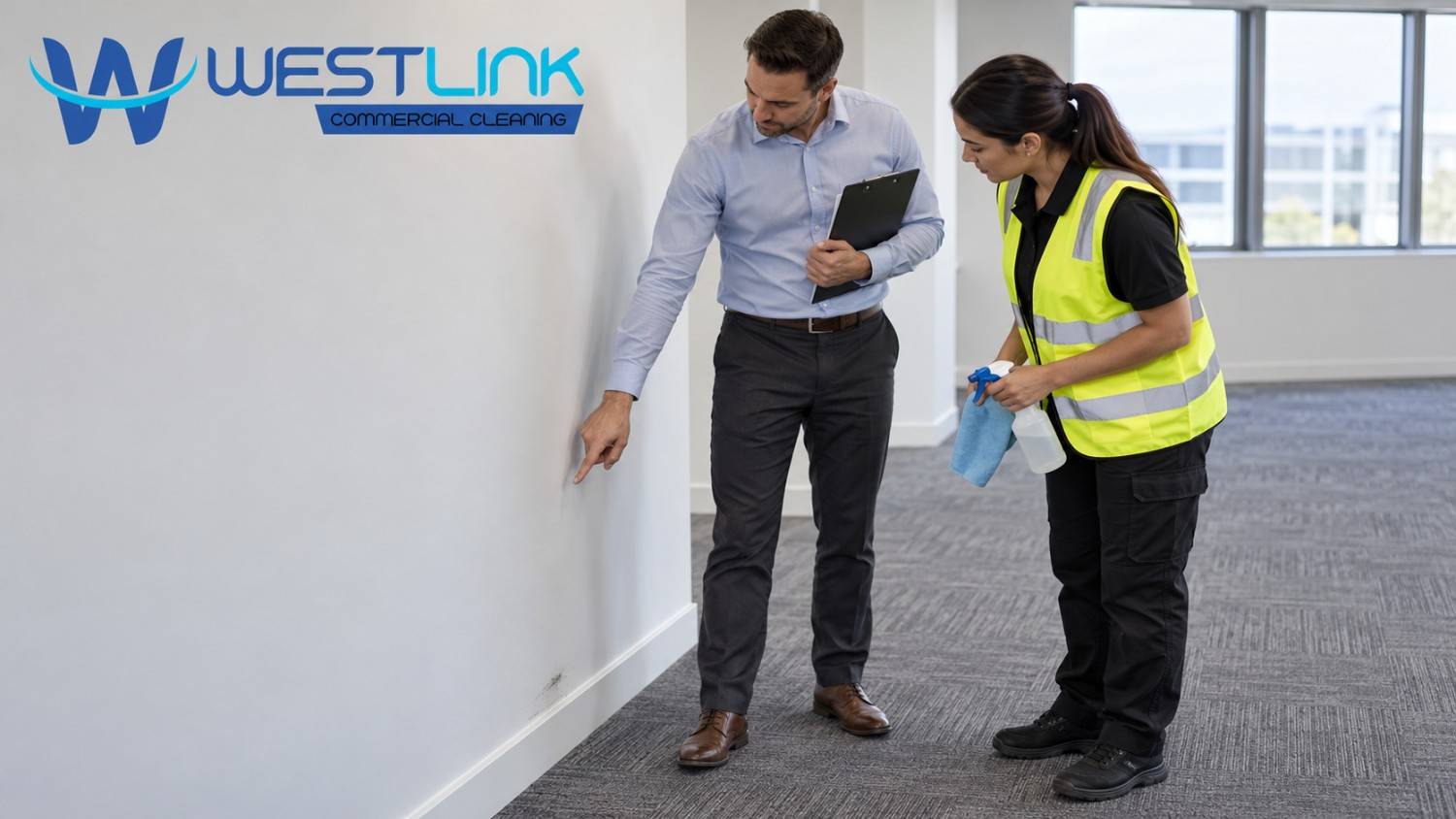
Which Commercial End of Lease Cleaning Mistakes Should You Avoid?
The most costly commercial handover mistakes are scoping from a walkthrough instead of the lease, booking the clean too late and keeping no evidence of the completed work.
- Booking the clean for the handover date itself: If the inspector flags anything, there is no time to fix it.
- Scoping from a walkthrough instead of the lease: A cleaner quoting on what they can see will not know that the lease requires professional carpet cleaning or substrate repair after signage removal.
- Cleaning before the tenancy is fully emptied: Furniture, stock and cabling left in place force a second visit and a second charge.
- Assuming cleaning satisfies make good: Strip-out, repainting and reinstatement are separate obligations.
- Ignoring back-of-house areas: Storerooms, plant cupboards, loading docks, yards and bin enclosures belong to the tenancy and are inspected.
- Applying residential rules: Bond cleaning checklists and residential cleanliness standards do not define a commercial handback.
- Keeping no evidence: Without a written scope and dated photographs, a dispute becomes one recollection against another.
Frequently Asked Questions About Commercial End of Lease Cleaning
Is commercial end of lease cleaning compulsory?
Commercial end of lease cleaning is compulsory when your lease requires the premises to be returned clean or in a stated condition, which most leases do. The lease wording sets the standard, so read the yield-up, condition and make good clauses to learn exactly what you owe.
Is end of lease cleaning the same as make good?
No, end of lease cleaning is the final clean, while make good is a lease obligation to return the premises to a specified condition. Make good may include removing fit-out, repainting and reinstating services, and cleaning is often one part of it.
Is bond cleaning the same as commercial end of lease cleaning?
No, bond cleaning is a residential term linked to a rental bond held under tenancy legislation. Commercial tenants usually provide a bank guarantee, security deposit or cash bond, and the lease sets the handback standard.
Can our own staff do the handover clean?
Yes, in-house staff can clean a small, simple tenancy when the lease only requires the premises to be left clean. Hire a contractor when the lease names professional cleaning, the building imposes contractor requirements, or the work involves machinery or height.
Do commercial carpets have to be professionally cleaned?
Only when the lease or condition benchmark requires it. Where a lease names professional carpet cleaning, an in-house clean will not satisfy the clause, so book a professional and keep the receipt or certificate.
Who is responsible for cleaning external windows?
Responsibility depends on the lease and, in a multi-tenant building, on what the landlord provides as building services. External and high-level glass also raises access and safety questions, so confirm it as a scope item instead of assuming.
How much does commercial end of lease cleaning cost?
Commercial end of lease cleaning typically costs about $6 to $12 per square metre for the base clean, based on 2026 provider and cost-guide prices, with carpet extraction at about $3 to $6 per square metre as an add-on. Request itemised quotes against a written scope, because condition, access and add-ons change the total.
How long does commercial end of lease cleaning take?
Duration depends on floor area, zone count, condition, access hours and drying time, so no single figure fits every tenancy. Ask for a written schedule and book the clean to finish several days before the inspection.
Can the landlord claim against my bank guarantee or deposit?
A landlord may claim against the security for unmet lease obligations, including cleaning and make good, according to the lease terms. Keep your scope, photographs and receipts so you can test any claim against the lease and the condition benchmark.
Does retail leasing legislation apply to my premises?
Retail leasing legislation applies to retail shop leases, with coverage and thresholds that differ by state and territory, while offices, warehouses and most industrial premises are governed largely by the lease. Check with your state’s small business commissioner or a lawyer if you are unsure.
What should I do after finishing the clean?
Complete the walkthrough, photograph every zone, keep receipts and certificates, return keys, cards and codes as the lease requires, and obtain written acceptance. Keep your records until the landlord has released your security.