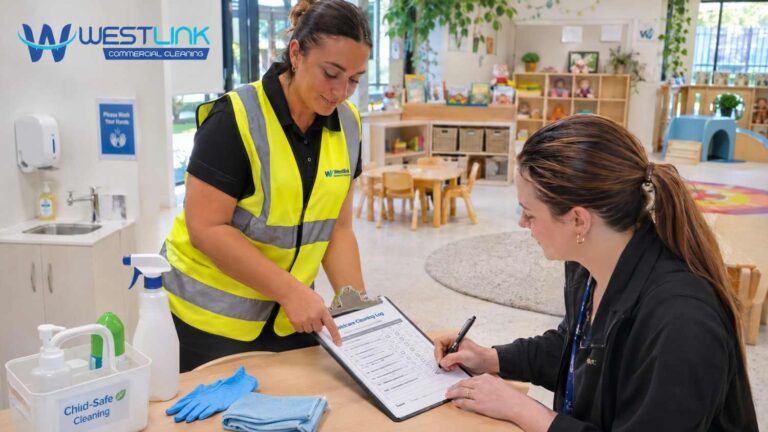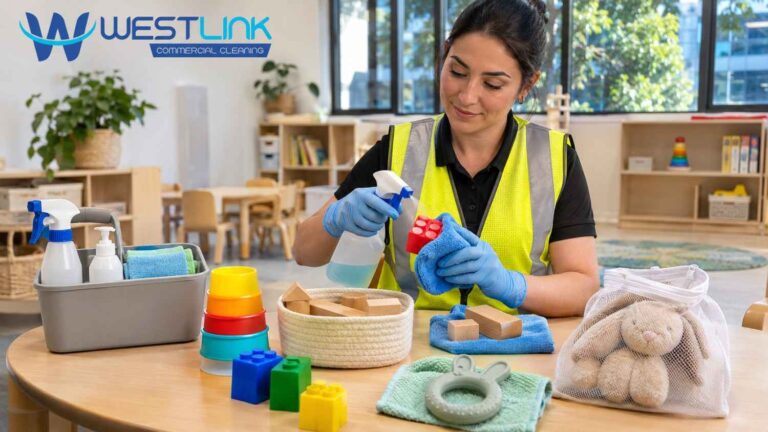
A childcare cleaning log is a written or digital record of cleaning activities performed in a childcare facility. Childcare cleaning records document cleaning history, staff responsibilities and hygiene follow-up actions. A childcare cleaning log includes the centre name, area, task, frequency, method, completion time, status, staff initials, supervisor verification and corrective action. Daily, weekly and monthly templates organise cleaning records by frequency. Event-triggered cleaning covers spills, contamination and illness-related incidents. Staff sign off each completed task, and a supervisor verifies the entries. A missed task stays in the record and links to a corrective action. Legal requirements, the assessment standard, official guidance and centre procedures form four separate layers of childcare cleaning rules. The templates below provide a blank daily log, a sign-off sheet, a completed example and a corrective action form.
What is a childcare cleaning log?
A childcare cleaning log is a written or digital record of cleaning activities performed in a childcare facility. The log identifies which areas were cleaned, when the work was completed and which staff member performed the task.
Childcare cleaning logs support hygiene monitoring in infant rooms, toddler classrooms, preschool areas, bathrooms, kitchens and shared play spaces. Each log entry connects one cleaning task with its completion record.
A childcare cleaning log template is a pre-formatted form for recording cleaning tasks, completion times, staff initials and supervisor verification in a daycare or early learning centre.
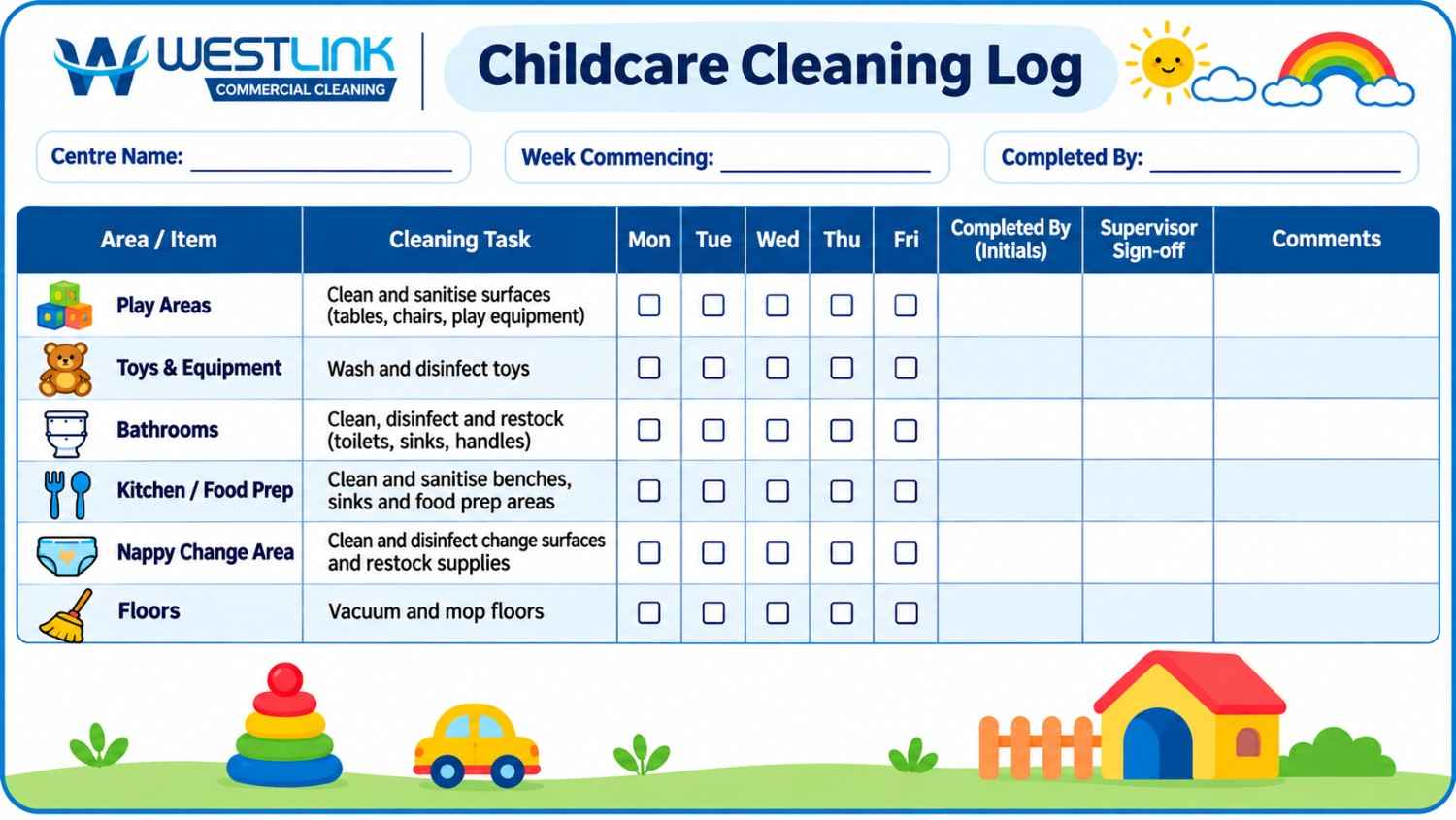
How does a cleaning log differ from a cleaning schedule and a cleaning checklist?
A cleaning schedule specifies when cleaning must occur, a cleaning checklist identifies the tasks staff must complete, and a cleaning log records completed and outstanding work.
| Document | Purpose | Example |
| Cleaning schedule | Specifies when cleaning must occur | Bathroom cleaning every day |
| Cleaning checklist | Identifies tasks that staff must complete | Clean sinks, taps and toilet seats |
| Cleaning log | Records completed tasks and outstanding work. | The bathroom was cleaned at 10:30 am by staff member AB |
A childcare cleaning policy establishes the required hygiene practices. Cleaning procedures explain the approved cleaning methods. The cleaning log records whether staff completed the scheduled work.
Why do childcare centres keep cleaning records?
Childcare cleaning records provide a documented history of cleaning activities, staff responsibilities and hygiene-related follow-up actions. A room leader or supervisor uses the record to check whether scheduled tasks were completed and to find cleaning gaps that need attention.
Cleaning logs support five operational functions:
- Task accountability: staff initials identify who recorded the completion of an assigned cleaning task.
- Cleaning verification: supervisor sign-off documents a review of cleaning entries.
- Infection prevention: cleaning records support the monitoring of routine hygiene practices.
- Inspection preparation: dated records provide supporting documentation for hygiene assessments.
- Corrective action tracking: missed cleaning tasks link to follow-up actions and their outcomes.
A completed cleaning log documents reported work. A completed log does not replace a physical inspection and does not prove that a surface was cleaned correctly.
Westlink Commercial Cleaning pairs its childcare cleaning in Sydney with written cleaning scopes, so a centre can check completed work against the agreed tasks.
What information should a childcare cleaning log include?
A childcare cleaning log should identify the facility, cleaning task, scheduled frequency, completion details, responsible staff member and verification status. The following fields create a traceable cleaning record:
| Record field | Information to enter |
| Centre name | Registered or operating name of the childcare service |
| Room or cleaning area | Infant room, bathroom, kitchen or play area |
| Cleaning date | Date the task was performed |
| Cleaning task | Specific surface, equipment or activity |
| Cleaning frequency | Daily, weekly, after use or another trigger |
| Cleaning method | Approved cleaning procedure or product reference |
| Completion time | Actual time the task was finished |
| Task status | Completed, missed, deferred or not applicable |
| Staff initials | Identification of the person completing the task |
| Supervisor verification | Reviewer name, initials, date or signature |
| Corrective action | Details of unresolved or corrected cleaning problems |
A childcare centre can add a document version, shift designation, cleaning product name, inspection result or reference number.
Staff record the actual completion time, never the scheduled cleaning time. A missed task stays identifiable after corrective cleaning is completed.
What does a blank daily childcare cleaning log template look like?
A daily childcare cleaning log template combines a task table, a staff sign-off section and a notes section on one page. The blank form below can be copied into Word, Excel or Google Sheets and adapted for printing.
Childcare centre: ______________________ Room or area: ______________________ Date: ______________________ Shift: ______________________
| Cleaning task | Frequency or trigger | Time completed | Status | Staff initials |
| Clean classroom tables and chairs | Daily and when dirty | |||
| Clean shared toys and play equipment. | Daily and when dirty | |||
| Clean door handles and light switches | Daily and when dirty | |||
| Clean bathroom sinks, taps and toilets | Daily and when dirty | |||
| Check and clean the nappy-changing station. | After each change, end-of-day check | |||
| Clean kitchen and food preparation surfaces | According to food hygiene procedures | |||
| Clean floors and play mats | According to surface-specific schedule | |||
| Empty waste bins and clean as needed | According to centre schedule |
Status key: C = Completed; M = Missed; D = Deferred; N/A = Not applicable.
Cleaning product or procedure reference: ______________________ Cleaning issues or additional notes: ______________________ Staff name and signature: ______________________ Supervisor name and signature: ______________________ Verification date and time: ______________________
Each template entry represents one identifiable task or cleaning check. Repeated tasks, such as cleaning nappy-changing surfaces after every use, can need a separate task-specific record under the centre’s procedures. The frequencies shown are examples, and the centre checks them against applicable guidance.
How often should childcare cleaning tasks be recorded?
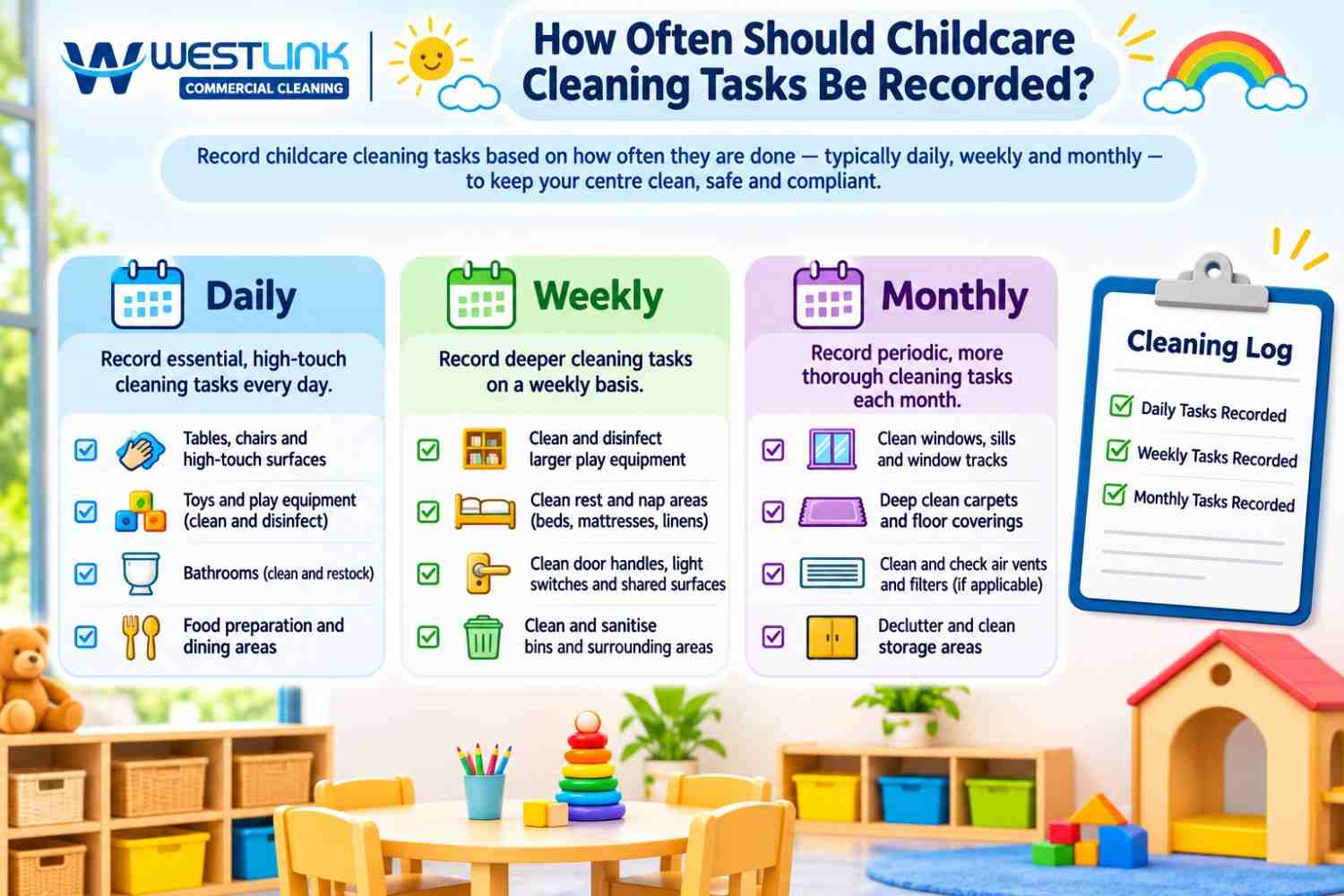
Childcare cleaning tasks are recorded according to their required frequency, including daily routines, scheduled periodic cleaning and event-triggered cleaning. Cleaning frequency depends on the surface, how children use the surface and the risk of contamination.
What does a daily childcare cleaning checklist cover?
A daily childcare cleaning checklist covers surfaces and equipment that need frequent attention during normal childcare operations. NHMRC’s Staying healthy (6th edition) recommends routine cleaning daily and when surfaces are visibly dirty. Task-specific frequencies, such as those for toys or nappy-changing stations, come from the centre’s own cleaning procedures.
A daily cleaning record covers:
- Classroom tables, chairs and frequently touched surfaces.
- Door handles, light switches and tap handles.
- Bathroom fixtures and toilet facilities.
- Shared toys and frequently handled learning equipment.
- Nappy-changing station cleaning checks.
- Kitchen and food preparation areas.
- Waste disposal and cleaning equipment checks.
Tasks that occur throughout the day are recorded at suitable intervals under the centre’s cleaning procedure.
What does a weekly childcare cleaning schedule look like?
A weekly childcare cleaning schedule records tasks assigned to a particular day or completed at an established weekly frequency. A sample schedule follows:
| Day | Example cleaning task | Responsible staff | Sign-off |
| Monday | Clean accessible storage shelves. | ||
| Tuesday | Check and clean washable play equipment. | ||
| Wednesday | Clean designated floor areas. | ||
| Thursday | Launder scheduled soft furnishings. | ||
| Friday | Inspect cleaning equipment and storage areas. |
Weekly assignments are examples, not universal minimum requirements. Carpeted surfaces, frequently touched equipment and visibly contaminated areas can need cleaning more often.
What does a monthly childcare cleaning checklist include?
A monthly childcare cleaning checklist documents periodic cleaning, equipment checks and scheduled maintenance tasks. Monthly records include:
- Cleaning of designated low-use storage areas.
- Inspection of cleaning equipment for damage.
- Review of cleaning chemical storage arrangements.
- Periodic cleaning of difficult-to-access fixtures.
- Review of overdue cleaning tasks.
- Inspection of cleaning documentation for missing entries.
A centre assigns monthly tasks based on its facility risk assessment, cleaning schedule and maintenance requirements. Monthly cleaning never replaces tasks that need daily or immediate attention.
When is additional cleaning required?
Event-triggered cleaning is required when an activity, spill, contamination incident or illness-related event creates a cleaning need outside the routine schedule. Examples include cleaning a nappy-changing surface after a change, responding to body-fluid spills and cleaning visibly contaminated equipment.
An illness outbreak can require enhanced cleaning measures directed by the relevant public health authority. The outbreak cleaning log identifies the affected areas, cleaning procedures, responsible staff and completion records.
How do staff complete and sign off a childcare cleaning log?
Staff sign off a childcare cleaning log after completing the assigned task, and a designated supervisor verifies the entries under the centre’s review procedure. The sign-off process has four stages:
- Task completion: the assigned educator or cleaner follows the relevant cleaning procedure.
- Completion recording: the staff member enters the actual cleaning time, task status and initials.
- Supervisor review: the room leader or supervisor checks entries for missing information and outstanding tasks.
- Corrective action closure: the designated reviewer confirms that unresolved cleaning issues were addressed.
A staff signature identifies the person who completed or recorded a task. A supervisor signature documents the review performed. A physical inspection is recorded as completed only when the inspection occurred.
What does a childcare cleaning sign-off sheet look like?
A childcare cleaning sign-off sheet records the date, area, assigned staff member, reviewer and review outcome of one cleaning log. The sheet attaches to the daily cleaning log or sits inside a digital cleaning record.
| Sign-off field | Entry |
| Cleaning date | |
| Room or area | |
| Assigned staff member | |
| Staff signature | |
| Cleaning record reviewed by | |
| Verification date and time | |
| Missing entries identified | Yes / No |
| Corrective actions outstanding | Yes / No |
| Supervisor signature | |
| Review notes |
Who is responsible for cleaning sign-off?
Cleaning sign-off responsibility belongs to the staff member assigned the task and the person designated to review the cleaning record. The exact roles depend on the childcare centre’s staffing structure:
| Role | Typical responsibility |
| Childcare educator | Completes and records assigned classroom cleaning |
| Childcare cleaner | Performs and records assigned facility cleaning |
| Room leader | Monitors cleaning records within a classroom |
| Shift supervisor | Reviews daily cleaning entries |
| Centre director or manager | Oversees hygiene procedures and unresolved cleaning issues |
| External cleaning contractor | Records contracted cleaning activities according to the agreed specification. |
A small team can combine responsibilities. The cleaning policy names the person responsible for each task and the person authorised to verify completion.
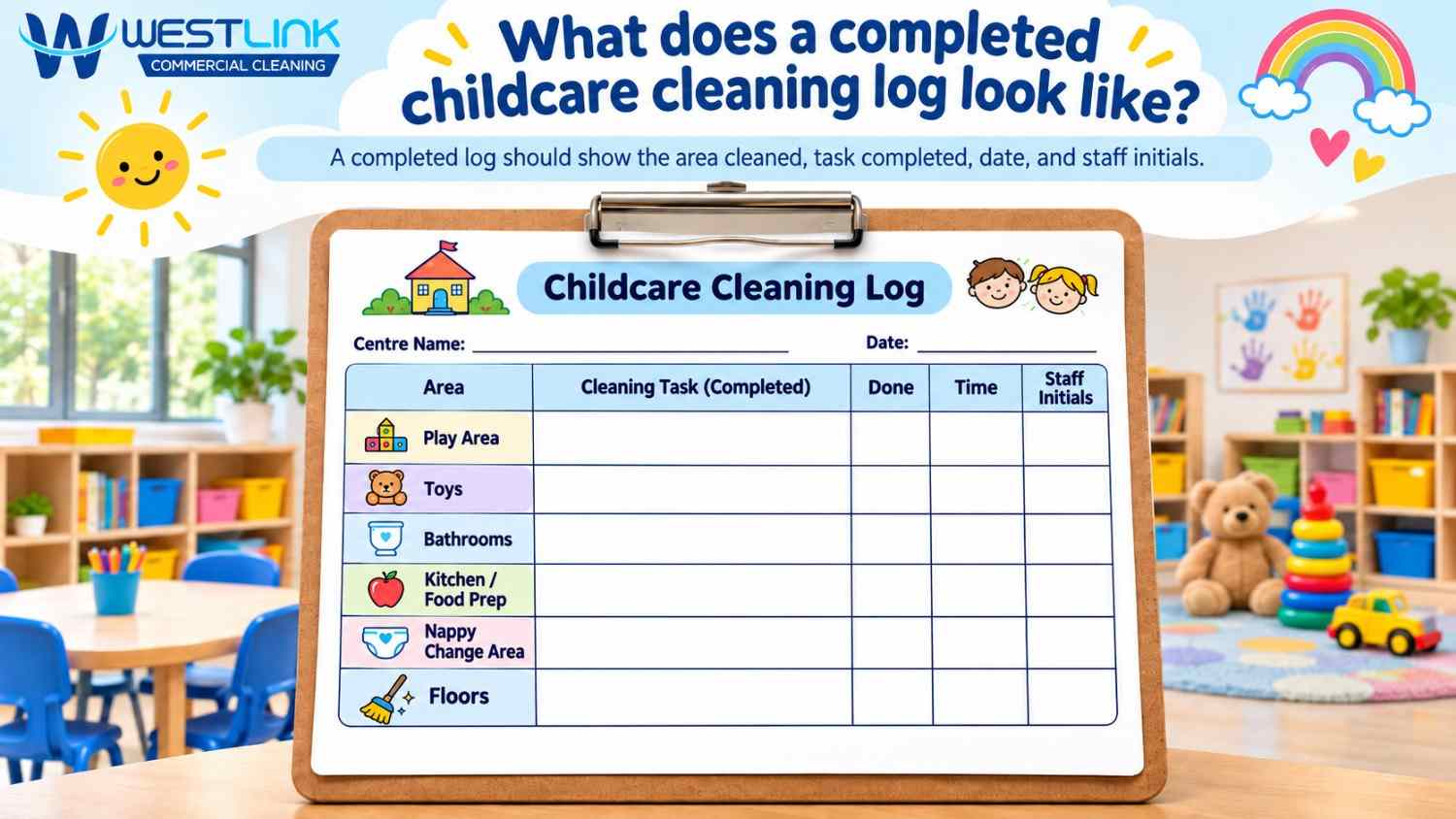
What does a completed childcare cleaning log look like?
A completed childcare cleaning log contains dated task entries, actual completion times, staff identification and an identifiable review outcome. The sample below shows how a childcare centre documents completed and missed cleaning tasks.
Centre: Example Early Learning Centre Room: Toddler Room and Shared Facilities Date: 12 November 2026
| Cleaning area and task | Completion time | Status | Staff initials |
| Toddler room: clean tables and chairs. | 8:20 am | Complete | AC |
| Shared play area: clean toys | 10:15 am | Complete | AC |
| Dining area: clean tables after lunch. | 12:40 pm | Complete | MR |
| Bathroom: clean sinks and tap handles | n/a | Missed | n/a |
| Entrance: clean door handles | 2:10 pm | Complete | MR |
Supervisor review: the bathroom cleaning entry is missing because the assigned cleaning supplies were unavailable at the scheduled time. Corrective action reference: CA-001 Supervisor: JT Review time: 3:00 pm
The example is illustrative and is not an actual childcare cleaning record.
What does a corrective action entry look like?
A corrective action record identifies an incomplete cleaning task, explains the problem and documents how the issue was resolved.
| Field | Example entry |
| Reference number | CA-001 |
| Date | 12 November 2026 |
| Cleaning area | Bathroom |
| Cleaning task | Clean sinks and tap handles |
| Initial status | Missed |
| Reason | Approved cleaning detergent unavailable |
| Corrective action | Replacement detergent obtained; surfaces cleaned. |
| Action completed | 2:45 pm |
| Staff initials | AC |
| Supervisor verification | JT, 3:00 pm |
| Final status | Corrective action completed and verified |
The original missed entry stays in the cleaning record. The corrective action entry adds the later completion details without concealing the earlier omission.
How should staff record missed cleaning tasks?
Staff mark a missed cleaning task as incomplete and link the task to a corrective action when follow-up is required. An accurate cleaning record separates work completed on schedule from work completed later.
A missed-task entry identifies:
The cleaning task and affected area.
The date and scheduled cleaning time.
The reason the task was missed.
The immediate action taken to manage any hygiene risk.
The person responsible for corrective cleaning.
The actual corrective cleaning completion time.
The person verifying the resolution.
Urgent hygiene risks need immediate action, not a wait for the next routine cleaning shift.
Staff never enter an earlier completion time for work performed later. A deferred task carries an identified reason and a follow-up arrangement.
What is the three-step cleaning process in daycare?
The three-step cleaning process for childcare surfaces is to clean the surface, rinse and dry the surface, and apply sanitising or disinfecting treatment when required. The appropriate treatment depends on the surface and the type of contamination.
The three-step description is a practical workflow, not a universal regulatory procedure. Childcare services follow their jurisdiction’s cleaning and infection-control requirements.
Step 1: How do staff clean the surface?
Cleaning removes dirt, organic material and many germs through detergent, water and physical wiping or scrubbing. Staff use equipment suitable for the surface and follow the centre’s approved procedure.
Step 2: How do staff rinse and dry the surface?
Rinsing removes loosened dirt and detergent residue, and drying reduces the moisture remaining on a cleaned surface. Australian NHMRC guidance identifies detergent cleaning, rinsing and drying as the routine method for hard surfaces.
Step 3: When do staff sanitise or disinfect?
Sanitising reduces germs to levels considered safe under relevant standards, and disinfecting targets specified harmful microorganisms. Food-contact surfaces, mouthed toys, body-fluid contamination and illness-related incidents can need different treatments under applicable guidance.
Staff follow product instructions for dilution, surface suitability, required contact time and safe use. After the cleaning procedure, staff record completion in the relevant cleaning log.
Which cleaning products and supplies should a cleaning log record?
A childcare cleaning log identifies the cleaning products or approved procedure used when that information is necessary to verify safe and consistent cleaning. Childcare cleaning supplies include detergent, disinfectant, cleaning cloths, buckets, mops, gloves and other equipment specified by the centre.
| Product information | Recording purpose |
| Product name | Identifies the cleaner or disinfectant used |
| Approved application | Connects the product with its intended surface |
| Dilution or concentration | Documents preparation when required |
| Contact time | Identifies the required disinfectant exposure period |
| Procedure reference | Links the task with approved instructions |
| Safety or equipment issue | Records problems affecting cleaning completion |
Staff store cleaning chemicals securely away from children, follow manufacturer labels, maintain ventilation and use the personal protective equipment specified for each product or procedure. Staff never mix cleaning chemicals unless the manufacturer explicitly permits it.
A cleaning log does not replace product labels, safety data sheets, chemical handling procedures or staff training.
How do cleaning logs support childcare hygiene compliance?
Childcare cleaning logs support hygiene compliance by documenting cleaning practices, staff responsibilities and follow-up actions for review. In Australia, National Quality Standard (NQS) Element 2.1.2 (Health practices and procedures) addresses effective illness, injury and hygiene practices, and Element 3.1.2 (Upkeep) addresses premises, furniture and equipment that are safe, clean and well maintained.
ACECQA’s Element 2.1.2 guide lists written procedures and schedules for a regular regime of washing children’s toys and equipment as documents assessors may sight. ACECQA’s Element 3.1.2 guide lists documented procedures and schedules for the cleaning of buildings, premises, furniture and equipment. A cleaning log supports those documents by showing when tasks were completed and how identified issues were managed.
Which childcare cleaning requirements are legal requirements and which are guidance?
Childcare cleaning rules sit on four layers: legal requirements, the assessment standard, official guidance and centre procedures.
| Layer | Source | What the layer sets |
| Legal requirements | Education and Care Services National Law and National Regulations, including Regulation 77 (Health, hygiene and safe food practices) and Regulation 103 (Premises, furniture and equipment to be safe, clean and in good repair) | Health and hygiene practices, and safe, clean premises, furniture and equipment |
| Assessment standard | NQS Elements 2.1.2 and 3.1.2 with the ACECQA assessment guides | What assessors observe, discuss and sight |
| Official guidance | NHMRC Staying healthy, 6th edition | Best-practice recommendations, such as routine cleaning daily and when surfaces are visibly dirty |
| Centre procedures | The service’s cleaning policy, schedules and logs | Task lists, frequencies, log format, signatures and review steps |
NMHRC describes staying healthy as a best-practice resource. A cleaning log template is not a government-prescribed form. Applicable laws, regulator directions and the centre’s own procedures set the log format, signature rules, cleaning frequencies and retention periods, and state or territory regulatory authorities can add requirements.
How long should childcare cleaning records be kept?
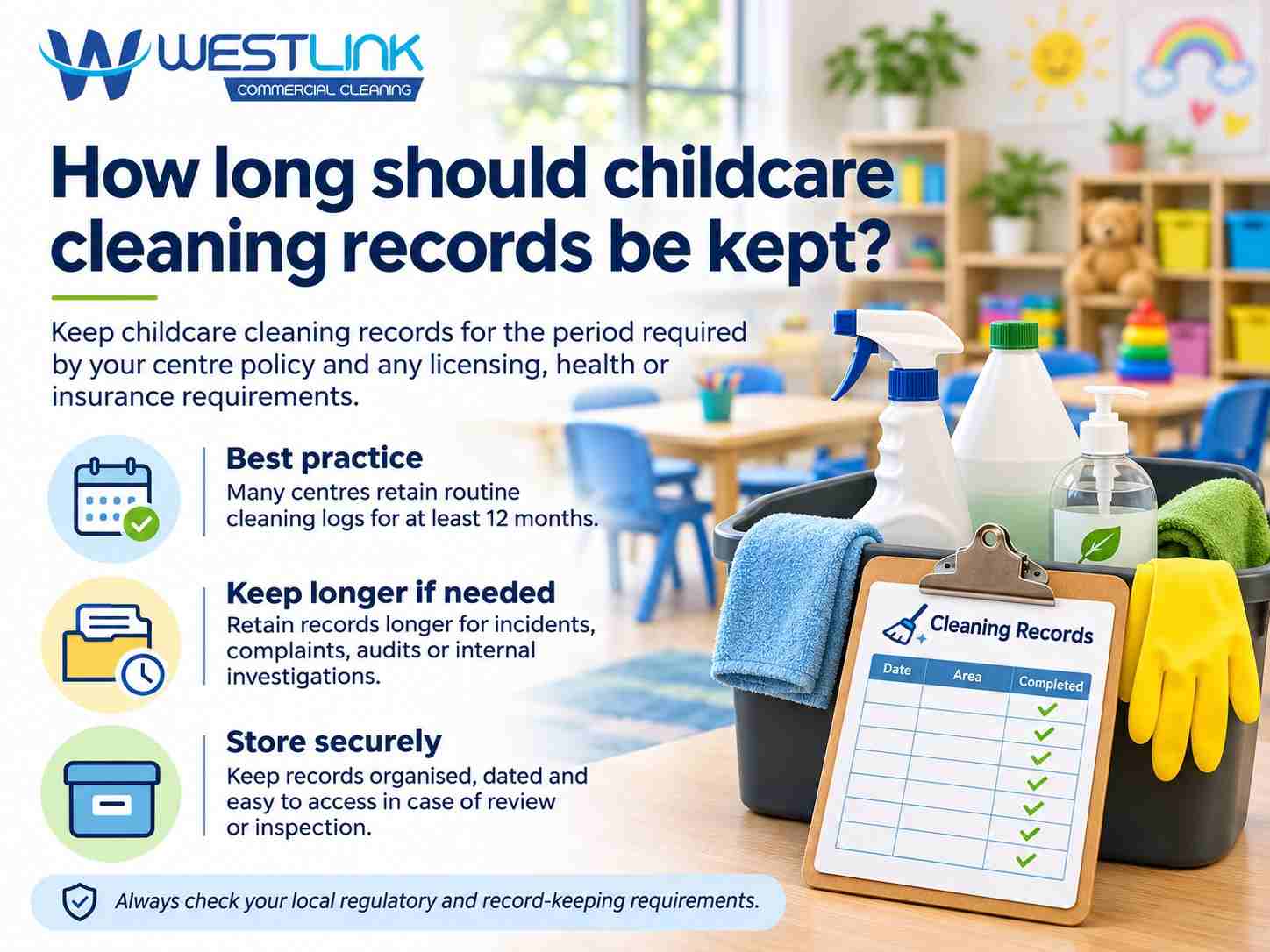
Childcare cleaning records are retained for the period required by applicable regulations and the childcare centre’s approved recordkeeping policy. No single retention period applies to every childcare cleaning log in every jurisdiction.
A document control process names the record owner, filing location, retention period, access permissions and disposal method. Paper records sit in dated cleaning binders. Digital records are organised by centre, room, reporting period and document version.
Should childcare cleaning logs be paper-based or digital?
Childcare cleaning logs can be paper-based or digital when the chosen format supports accurate entries, accessible records and reliable sign-off.
| Format | Practical use |
| Printable PDF | Fixed-format cleaning sheets for manual completion |
| Word template | Editable room-specific cleaning forms |
| Excel spreadsheet | Daily, weekly and monthly cleaning trackers |
| Google Sheets | Shared cleaning records with controlled staff access |
| Digital cleaning system | Electronic task status, timestamps and review history |
A paper-based log suits a single classroom or small childcare centre. A spreadsheet suits facilities that consolidate records across several rooms. Digital systems preserve the identity of the person entering information and any changes made to completed records.
Questions about childcare cleaning logs
Questions about childcare cleaning logs cover checklists, room-level logs, toy cleaning, inspections, supervisor sign-off, contractors and nurseries.
Is a childcare cleaning log the same as a cleaning checklist?
No, a childcare cleaning log is not the same as a cleaning checklist, because a checklist identifies required tasks, and a log documents their completion. A combined template contains both scheduled tasks and fields for actual completion times, staff initials and verification.
Does every childcare room need a separate cleaning log?
No, a childcare centre can use one register for all rooms, provided each task and responsible staff member stay identifiable. Separate logs improve accountability when rooms have different cleaning tasks or staff responsibilities.
How often should daycare toys be cleaned?
Daycare toys are cleaned according to their use, contamination risk and applicable hygiene guidance. NHMRC recommends routine cleaning daily and when surfaces are visibly dirty, and ACECQA’s Element 2.1.2 guide lists written procedures and schedules for a regular regime of washing children’s toys and equipment as evidence assessors may sight. Mouthed toys carry a higher contamination risk, so the centre’s procedure sets when those toys are removed and cleaned before another child uses them. Westlink commercical cleaning guide on how to clean childcare toys safely explains cleaning methods by toy material.
Can a childcare cleaning checklist be used for inspections?
Yes, a completed childcare cleaning checklist provides supporting documentation during a hygiene inspection. Inspectors also examine cleaning procedures, equipment, facility conditions and actual hygiene practices. A signed checklist alone does not establish regulatory compliance.
Can a supervisor sign off an incomplete cleaning log?
Yes, a supervisor can document a review of an incomplete cleaning log, but the review never represents missed work as completed. Outstanding tasks stay identified until the appropriate corrective action is performed and verified.
Can external daycare cleaners complete the cleaning log?
Yes, external daycare cleaners complete assigned cleaning records when the service agreement specifies their duties and recording requirements. The childcare centre names who reviews contractor entries and who is responsible for cleaning tasks outside the contract.
Can the same template be used for a preschool or nursery?
Yes, a childcare cleaning log template can be adapted for preschools, nursery schools, infant rooms and other early learning settings. Room-specific cleaning tasks, schedules and procedures reflect the age group, equipment and relevant hygiene risks.
Do childcare cleaning logs need to be signed every day?
A daily signature is set by the centre’s own procedure unless the state regulatory authority directs otherwise. ACECQA’s Element 2.1.2 guide lists written procedures and schedules as evidence assessors may see, and the sample log in this article is not a government-prescribed form. Centres confirm any signature or recordkeeping requirement with their regulatory authority.
Can an external cleaning contractor use a different log from the centre?
Yes, an external cleaning contractor can use its own log when the centre’s procedure accepts the format. The contractor log carries the same core fields as the centre’s log: area, task, actual completion time, status, staff initials and supervisor verification. The centre keeps access to the contractor’s records and names who reviews them.
How should cleaning tasks performed several times a day be recorded?
Staff record each repeated cleaning task as its own time-stamped entry, or as a tally with times, under the centre’s procedure. Nappy-changing surfaces, meal-time tables and toilet checks are examples. A single daily tick for a task done several times a day hides missed occurrences.
Should body-fluid spills be recorded separately?
Yes, a body-fluid spill is recorded as an event-triggered entry separate from routine tasks. NHMRC states that spills of any body fluids need extra cleaning beyond routine cleaning. The spill entry records the date, time, location, cleaning procedure used, staff initials and supervisor verification.
How can childcare centres maintain accurate cleaning records?
Childcare centres maintain accurate cleaning records by assigning clear responsibilities, recording tasks when completed, reviewing missed entries and retaining verified logs. A daily cleaning log documents routine cleaning activities, and weekly and monthly schedules track periodic tasks. Staff sign-off identifies responsibility, and supervisor review and corrective action records document follow-up.
Childcare centres review their templates whenever cleaning procedures, facilities, staffing arrangements or applicable hygiene requirements change. A cleaning log is most useful when entries reflect the cleaning work actually performed. The next step is to copy the blank daily template, adapt the task list to one room and run a first week of entries.
How does a cleaning contractor support childcare cleaning records?
A childcare cleaning contractor supports cleaning records by working to a written cleaning scope and recording contracted tasks for the centre to review. Westlink Commercial Cleaning provides professional childcare cleaning in Sydney, including site assessments and written cleaning scopes. A centre can use the log templates above as the basis for the records a contractor completes and can request a scope review to match tasks, frequencies and sign-off to the centre’s cleaning procedures.
Reference guidance
- NHMRC: Staying healthy: Preventing infectious diseases in early childhood education and care services (6th edition)
- NHMRC: Staying healthy, cleaning (routine cleaning and spills)
- ACECQA: Element 2.1.2 Health practices and procedures
- ACECQA: Element 3.1.2 Upkeep
- Education and Care Services National Regulations: Regulation 77 and Regulation 103, listed on the ACECQA element pages above
- CDC: How to Clean and Disinfect Early Care and Education Settings
The templates are adaptable operational examples. Childcare services confirm applicable local requirements before adopting them.