To clean childcare toys safely, wash suitable toys with warm water and detergent, rinse them thoroughly and allow them to dry completely. Choose the method according to the toy’s material, construction and manufacturer’s instructions. Additional sanitising or disinfection may be necessary in particular circumstances, but it is not required for every toy during routine cleaning.
Australian National Health and Medical Research Council (NHMRC) guidance recommends washing childcare toys at the end of every day. Educators should also remove toys from play during the day when children mouth, sneeze on or otherwise contaminate them.
Different materials need different treatment. Hard plastic blocks may tolerate immersion or dishwasher cleaning, while wooden toys, stuffed animals, foam equipment and electronic learning devices require more careful handling.
This guide explains how to clean childcare toys by material, when to use additional hygiene measures, how to organise a daily cleaning procedure, and how educators and professional cleaners can share responsibilities.
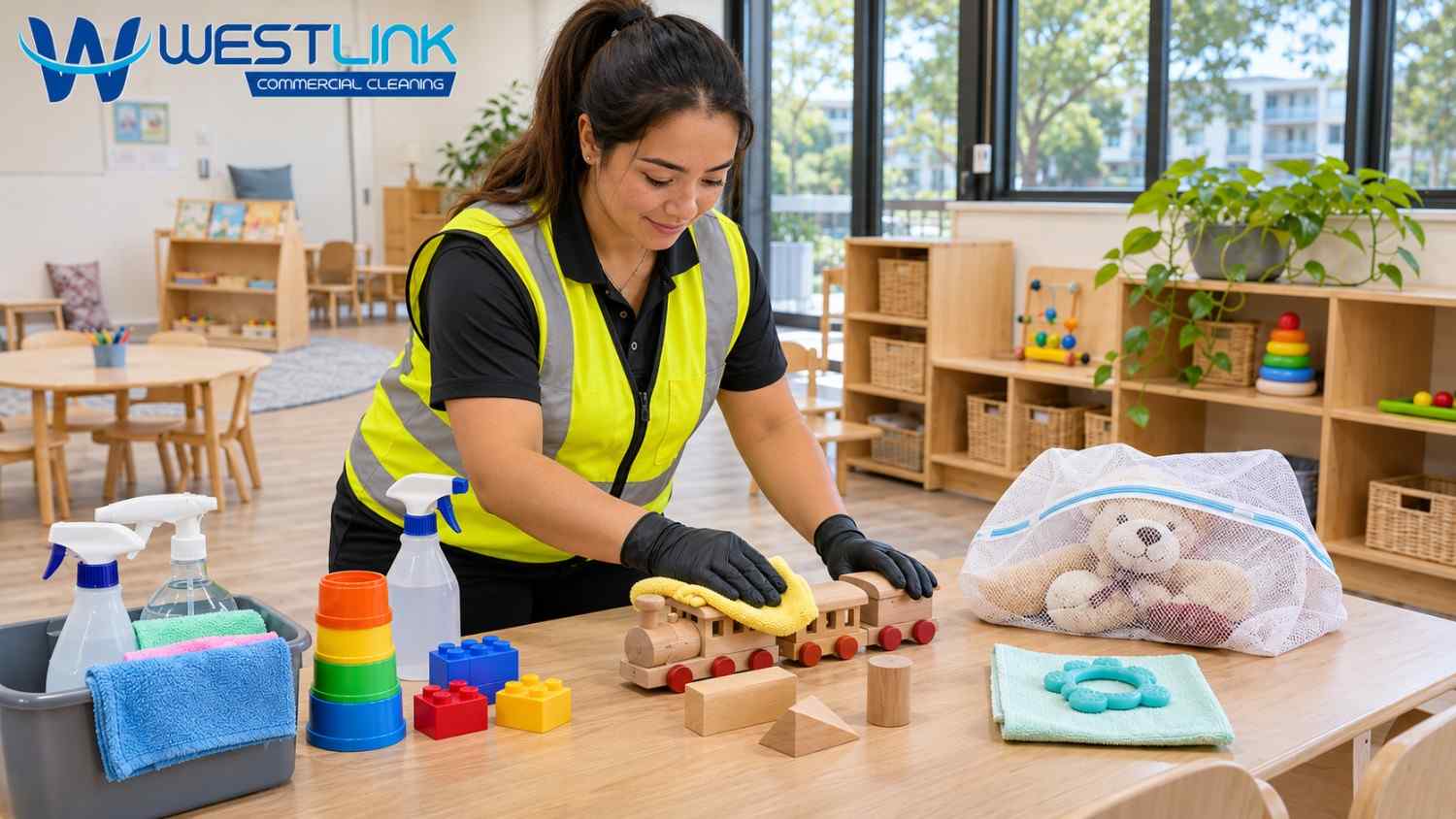
Quick Guide: How to Clean Different Childcare Toy Materials
Toy material determines how much moisture, heat, detergent and chemical treatment a toy can tolerate.
Use this comparison before selecting a cleaning method.
| Toy material | Suitable routine cleaning method | Main precaution |
| Hard plastic | Warm water, detergent, scrubbing, rinsing and drying | Use a dishwasher only when manufacturer-approved. |
| Silicone | Wash with mild detergent and water, rinse and dry | Boiling or steaming requires manufacturer approval |
| Natural or synthetic rubber | Gentle hand washing and thorough drying | Inspect for cracking, deterioration and trapped water |
| Sealed or painted wood | Wipe with a lightly dampened cloth and suitable detergent | Avoid soaking and damaged finishes |
| Unsealed wood | Limited-moisture cleaning where manufacturer-approved | May be unsuitable for shared use if effective cleaning is not possible |
| Fabric and plush | Appropriate laundering with detergent and complete drying | Check care labels, stuffing and non-washable components |
| EVA foam and padded equipment | Clean, compatible, washable surfaces and dry | Exposed or damaged absorbent foam is difficult to clean reliably |
| Electronic toys | Wipe with a lightly dampened cloth | Prevent liquid entering buttons, speakers and battery compartments. |
| Metal and mixed-material toys | Wash or wipe according to the most sensitive component. | Check for corrosion, loose parts and vulnerable finishes. |
| Bath and water-play toys | Wash, drain and air-dry thoroughly. | Avoid inaccessible water-retaining cavities. |
| Paper and cardboard toys | Wipe washable or sealed surfaces when appropriate. | Avoid saturation; remove items that cannot be cleaned safely |
Important: This is a material-selection guide, not permission to sanitise or disinfect every product using the same chemical. Manufacturer instructions, product labels and the type of contamination determine whether additional treatment is appropriate.
What Are the Australian Guidelines for Cleaning Toys in Childcare?
Australia’s NHMRC provides best-practice guidance for infection prevention in early childhood education and care services through the sixth edition of Staying healthy: Preventing infectious diseases in early childhood education and care services, published in 2024.
Its recommendations for toys and books are straightforward.
Wash Childcare Toys Every Day
NHMRC recommends washing toys at the end of each day, particularly in rooms used by younger children.
For washable toys, the recommended approach is to use warm water and detergent, rinse well and allow the items to dry.
This means a weekly or fortnightly toy-cleaning schedule cannot replace the centre’s daily routine. Additional periodic or contracted cleaning may complement daily washing, but the two activities serve different purposes.
Remove Mouthed and Contaminated Toys During the Day
Educators should maintain a designated container for toys awaiting cleaning.
NHMRC specifically recommends removing toys when a child:
- Puts a toy in their mouth.
- Sneezes on the toy.
- Uses the toy while sick.
The container should be kept out of children’s reach. Clean replacement toys can be supplied while contaminated items are awaiting washing.
Services can also rotate toy collections, allowing one set to be cleaned and dried while another remains available for play.
Choose Washable Toys for Shared Childcare Use
NHMRC recommends purchasing washable toys and removing non-washable soft toys intended for general shared use.
Individual comfort toys can be managed separately under the centre’s procedures.
Books should be inspected for visible dirt and cleaned appropriately without damaging their materials.
For the detailed recommendations, see NHMRC — A Healthy Environment, Section 3.2: Cleaning.
How Does Toy Cleaning Relate to the National Quality Standard?
The Australian Children’s Education and Care Quality Authority (ACECQA) addresses hygiene under National Quality Standard Element 2.1.2, Health practices and procedures.
Its assessment guidance refers to maintaining hygienic environments and implementing current health and hygiene practices. Assessors may examine written cleaning schedules and procedures for washing children’s toys and equipment.
The distinction matters: NHMRC provides best-practice cleaning recommendations, while ACECQA explains how hygiene practices fit within the National Quality Framework. Neither should be misrepresented as a requirement to disinfect every shared toy after every touch.
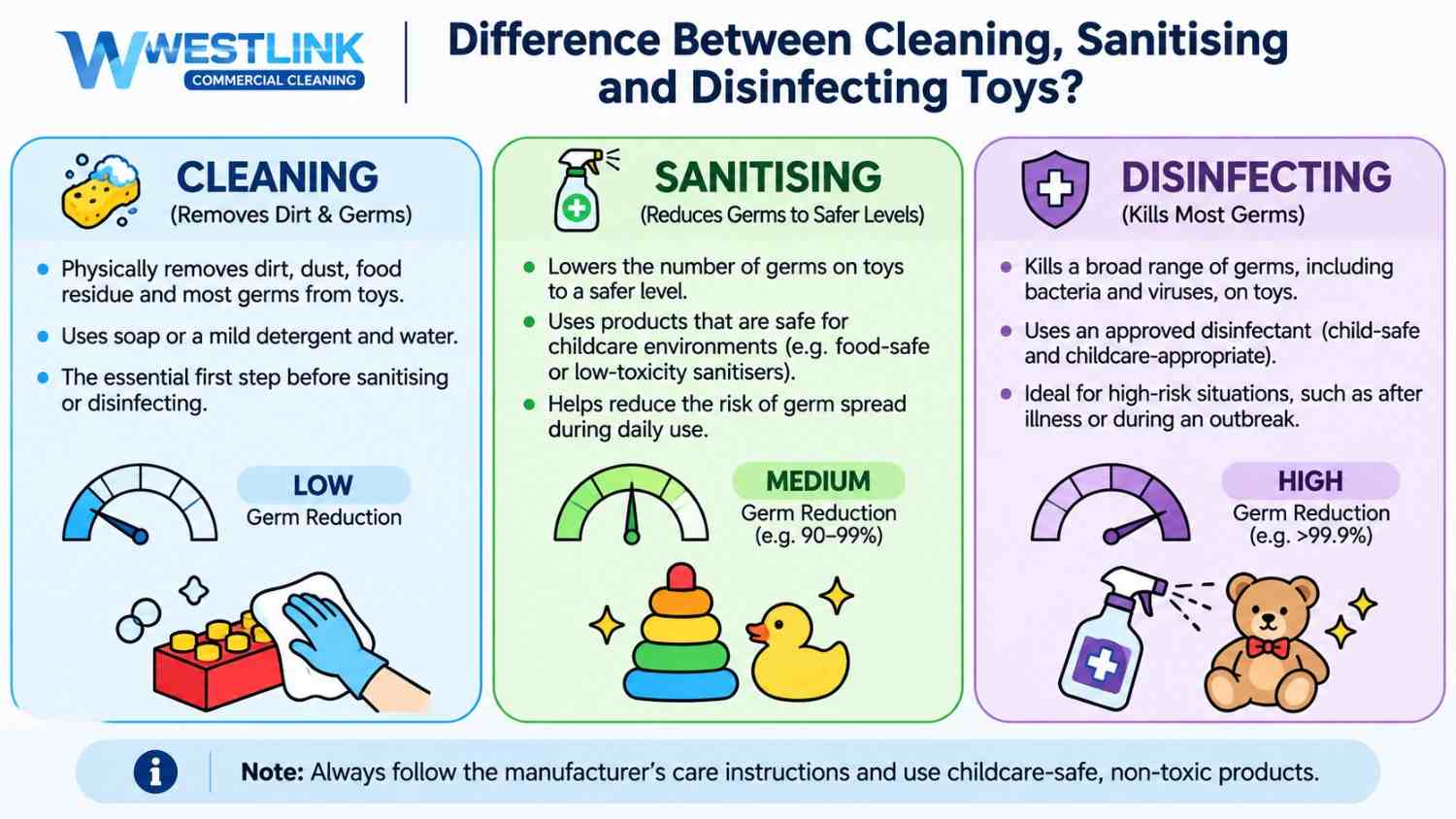
What Is the Difference Between Cleaning, Sanitising and Disinfecting Toys?
Cleaning removes dirt and many microorganisms, sanitising reduces microorganisms to an acceptable level, and disinfecting uses an effective product to inactivate susceptible disease-causing microorganisms.
These activities are not interchangeable.
| Process | Purpose | Appropriate use |
| Cleaning | Removes dirt, organic matter and many microorganisms through detergent, water and physical action | Daily toy washing and ordinary visible contamination |
| Sanitising | Reduces microbial contamination to a defined level under an applicable method or standard | Where the product, toy use and service procedure call for sanitising |
| Disinfecting | Inactivates susceptible pathogens when the correct product and method are used | Certain body-fluid contamination and outbreak-related situations |
Is Cleaning Enough for Everyday Childcare Toys?
For ordinary daily toy hygiene, NHMRC recommends detergent cleaning, rinsing and drying.
Scrubbing is important because physical action helps dislodge contamination from grooves, handles and textured surfaces.
A disinfectant is not automatically needed simply because several children have handled a toy.
However, everyday cleaning does not replace additional procedures required after contamination involving body fluids or during particular infectious disease incidents.
Do All Mouthed Toys Need Sanitising?
No universal Australian rule requires chemical sanitising of every mouthed toy.
NHMRC’s explicit recommendation is to remove mouthed toys from circulation during the day and wash them.
A service may adopt additional sanitising procedures for particular infant toys or circumstances, provided those procedures are suitable for the material and consistent with applicable guidance.
Heat-based sanitising or chemical treatment must not be assumed safe for wooden rattles, glued components, painted surfaces or heat-sensitive plastics.
When Should Childcare Toys Be Disinfected?
Disinfection becomes relevant when toys are contaminated by certain body fluids or when additional infection-control measures are needed.
NHMRC recommends cleaning and disinfecting surfaces after body-fluid spills. It also advises contacting or following the relevant public health authority when enhanced cleaning is needed during an outbreak.
For toys, educators must first assess whether the material and construction allow the required process.
If a contaminated toy cannot be cleaned and disinfected effectively when necessary, it should not return to shared play.
How to Clean Childcare Toys by Material
The following procedures apply the main cleaning principles to different toy materials. They are practical examples derived from material properties and public health guidance, not results of a Westlink laboratory test or product-specific compatibility trial.
How to Clean Hard Plastic Toys Safely
Hard plastic toys often have smooth, non-porous surfaces that allow thorough washing and rinsing.
Examples include building blocks, stacking cups, plastic animal figures, shape sorters, toy cars and counting cubes.
For routine cleaning:
- Remove detachable parts where the manufacturer permits.
- Wash with warm water and suitable detergent.
- Scrub grooves, connecting points, wheels and textured surfaces.
- Rinse with clean water.
- Drain and dry completely before reuse.
Pay particular attention to interlocking construction bricks and toys with recessed areas, as dirt can remain around their connectors.
Can plastic toys go in the dishwasher?
Some can. NHMRC permits dishwasher cleaning for toys made from suitable materials, but specifies that toys should not be washed alongside dishes.
The manufacturer’s instructions must confirm dishwasher suitability. Plastic type alone does not establish heat tolerance.
Polypropylene (PP), polyethylene (PE) and ABS plastics have different performance characteristics, and individual toy construction can include adhesives, finishes or components that cannot withstand a dishwasher cycle.
Keep battery-operated, heat-sensitive and unsuitable hollow toys out of the dishwasher.
How to Clean Silicone and Rubber Toys
Silicone and rubber toys frequently contain flexible handles, textured surfaces and grooves that collect saliva, food residue and dirt.
Common examples include silicone teething rings, sensory balls, pop-it toys, rubber animals and flexible stacking cups.
Wash compatible toys with mild detergent and warm water. Use a soft brush to clean textured chewing surfaces, rinse thoroughly and allow all openings to dry.
Can silicone toys be boiled or steamed?
Some solid silicone products tolerate boiling or steaming, but only when the manufacturer specifically approves the method.
Adhesives, internal components, surface finishes and attachments may make heat treatment unsuitable even when the main body is silicone.
Natural rubber can also deteriorate when exposed to incompatible chemicals or repeated high temperatures.
Remove toys showing cracks, sticky surfaces, splitting seams or other deterioration that affects their safety or cleanability.
How to Clean Wooden Toys Without Damaging Them
Wooden toys need careful moisture control because water can penetrate unsealed surfaces, exposed joints and damaged finishes.
Typical examples include wooden building blocks, Montessori puzzles, peg boards, balancing toys, wooden trains and stacking rings.
For sealed or painted wooden toys, use a clean cloth lightly dampened with a suitable detergent solution. Wipe the surface and accessible joints, remove detergent residue with another lightly dampened cloth, and dry promptly.
Do not soak wooden toys or use boiling water unless a specific product is designed for such treatment.
Can wooden Montessori toys be sanitised or disinfected?
Some sealed wooden toys may tolerate manufacturer-approved surface treatments. However, the result depends on the seal, finish, porosity and the disinfectant’s permitted use.
Unsealed wood is more difficult to sanitise reliably because it can absorb moisture and cleaning solutions.
If a wooden learning material cannot undergo the required cleaning or additional decontamination, it may be unsuitable for frequent shared mouthing or for reuse after significant contamination.
Selecting washable materials at purchase is often more practical than trying to disinfect a porous toy after an incident.
How to Clean Fabric Toys and Stuffed Animals
Fabric toys absorb moisture and contamination through the outer material, seams, stitching and stuffing.
Examples include teddy bears, cloth dolls, hand puppets, fabric activity books, soft sensory cubes and plush animals.
Machine-washable toys should be laundered with appropriate detergent using a cycle permitted by the care label. Delicate attachments may require protection or removal.
NHMRC’s general guidance for effective laundering of soft materials describes hot machine washing at 60°C or above and appropriate drying, but not every stuffed toy can tolerate those conditions.
Where a toy cannot withstand the cleaning process required for safe shared use, it should be reconsidered for the shared toy collection.
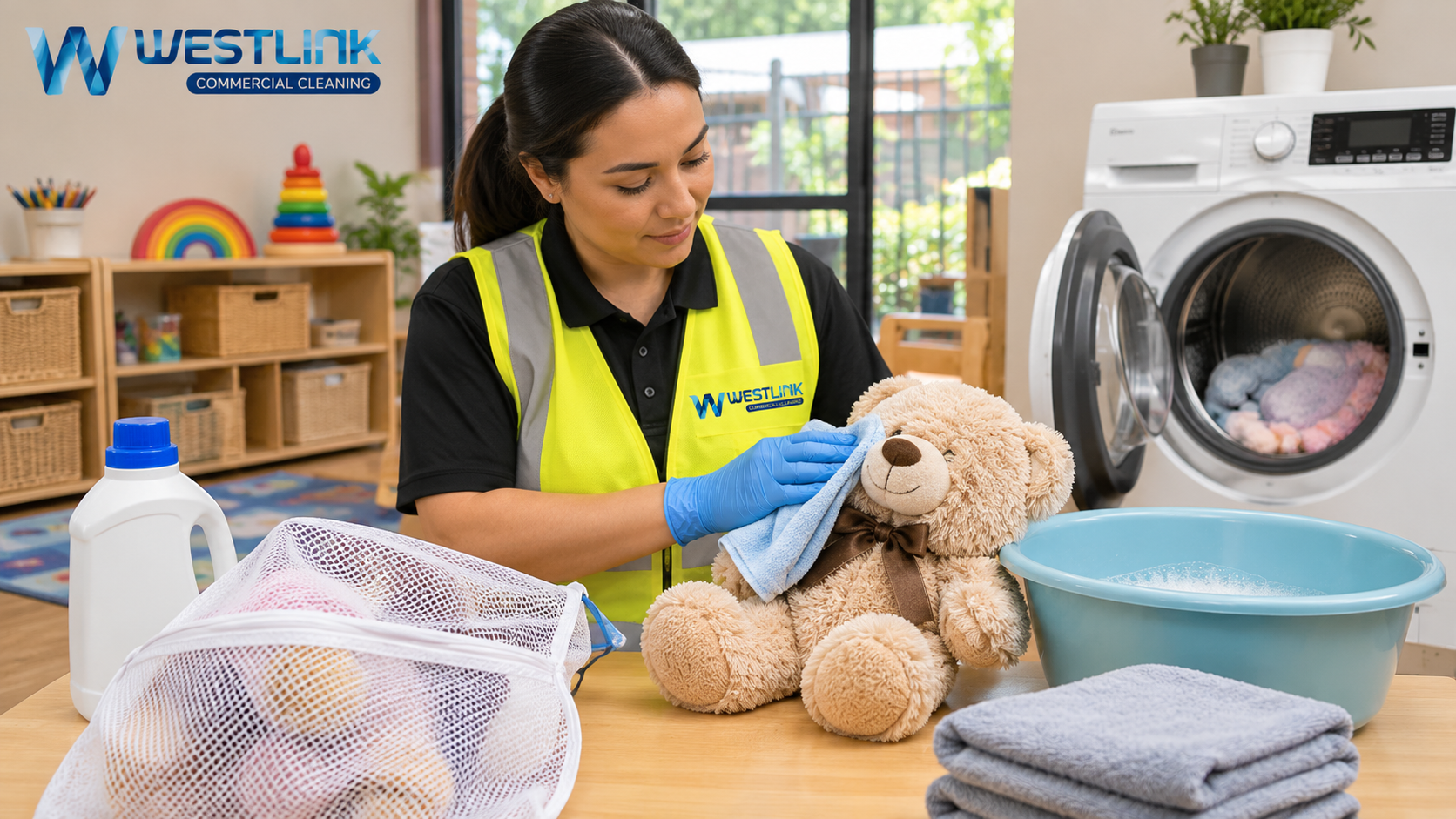
Can stuffed toys go in the washing machine?
Many can, provided the manufacturer’s instructions allow it.
Avoid machine washing toys with electrical sound boxes, delicate glued decorations or unsuitable fillings.
After laundering, check that seams, internal stuffing and attached parts are completely dry.
A toy that feels dry on the outside may still retain moisture inside its padding.
Non-washable plush toys should not be kept in general shared play when they cannot be hygienically maintained.
How to Clean Foam Toys, Sensory Blocks and Play Mats
The cleaning method for foam depends on whether the surface is sealed and washable or exposed and absorbent.
EVA foam floor tiles, foam alphabet puzzles, padded climbing shapes and polyurethane foam blocks have different constructions.
For compatible sealed surfaces, use a suitable detergent and a damp cloth; clean textured areas and interlocking edges, remove residue and dry both sides.
Inspect mats and climbing shapes for torn coverings, exposed filling and cracks.
Can foam toys be disinfected?
Some non-porous foam surfaces may tolerate an appropriate disinfectant if both the product label and equipment manufacturer permit the treatment.
Exposed, torn or absorbent foam is more difficult to disinfect effectively. Excess liquid can also become trapped inside the material.
Where contamination cannot be removed or the required disinfection cannot be completed, withdraw the equipment from shared use.
How to Clean Electronic and Battery-Operated Toys
Electronic toys contain moisture-sensitive components that may include circuit boards, battery contacts, speakers, USB ports and internal wiring.
Examples include musical keyboards, talking dolls, interactive alphabet panels, learning tablets and light-up sensory toys.
Switch off the equipment, disconnect external power and follow the manufacturer’s battery-removal instructions where applicable.
Wipe the casing and controls with a lightly dampened cloth using a suitable cleaning product. Avoid forcing liquid into speaker openings, buttons, battery compartments or charging ports.
If disinfection is required, use only a product and procedure compatible with the electronic equipment.
Allow the toy to dry fully before returning it to use.
Can battery-operated toys be immersed in water?
Usually not. Immersion is appropriate only when the complete product is explicitly designed and approved for it.
A waterproof-looking plastic casing does not mean its electrical compartments are waterproof.
For high-touch electronic toys, consider whether a manufacturer-approved wipeable protective cover can make routine cleaning easier.
How to Clean Metal, Mixed-Material and Paper Toys
Mixed-material toys should be cleaned according to the requirements of their most sensitive component.
A plastic vehicle with metal axles may tolerate surface washing while still needing careful drying around its wheels and screws.
For metal toys, use a suitable detergent, rinse or wipe as permitted, then dry joints promptly to reduce corrosion.
Inspect for rust, exposed sharp edges and loose attachments.
For cardboard puzzles, paper learning materials and board books, use limited-moisture wiping only where the surface permits it.
Do not saturate paper seams or bindings.
Remove heavily contaminated or damaged items when they cannot be cleaned appropriately.
How to Clean and Sanitise Bath Toys Safely
Bath toys need particular attention because hollow cavities and small drainage openings can retain water.
Squeezable rubber ducks, water-squirting animals and sealed floating toys may develop contamination on interior surfaces that cannot be reached through ordinary wiping.
A 2018 study published in npj Biofilms and Microbiomes examined 19 used bath toys collected from five households in Switzerland. Researchers found fungi in 58% of those used toys and observed microbial biofilms on their internal surfaces.
This was a small study of household bath toys, not an Australian childcare-centre prevalence survey. It demonstrates a possible moisture-related problem but does not establish the infection risk for every bath toy.
How to Clean Bath Toys After Water Play
After each water-play session:
- Remove the toys from the water.
- Empty any retained water.
- Wash accessible surfaces using suitable detergent.
- Clean internal surfaces if the toy can be opened safely.
- Rinse thoroughly.
- Drain and dry completely.
- Store in an open, well-ventilated area.
Apply additional sanitising only where required and compatible with the toy.
How to Prevent Mould Inside Bath Toys
Prefer solid, easily drained or fully openable bath toys over products with inaccessible cavities.
Check hollow toys for dark residue, discoloured water, unpleasant odours and internal buildup.
Repeatedly introducing cleaning chemicals into a sealed cavity does not guarantee effective removal of contamination.
If the interior cannot be accessed and cleaned reliably, replacement may be the most appropriate option.
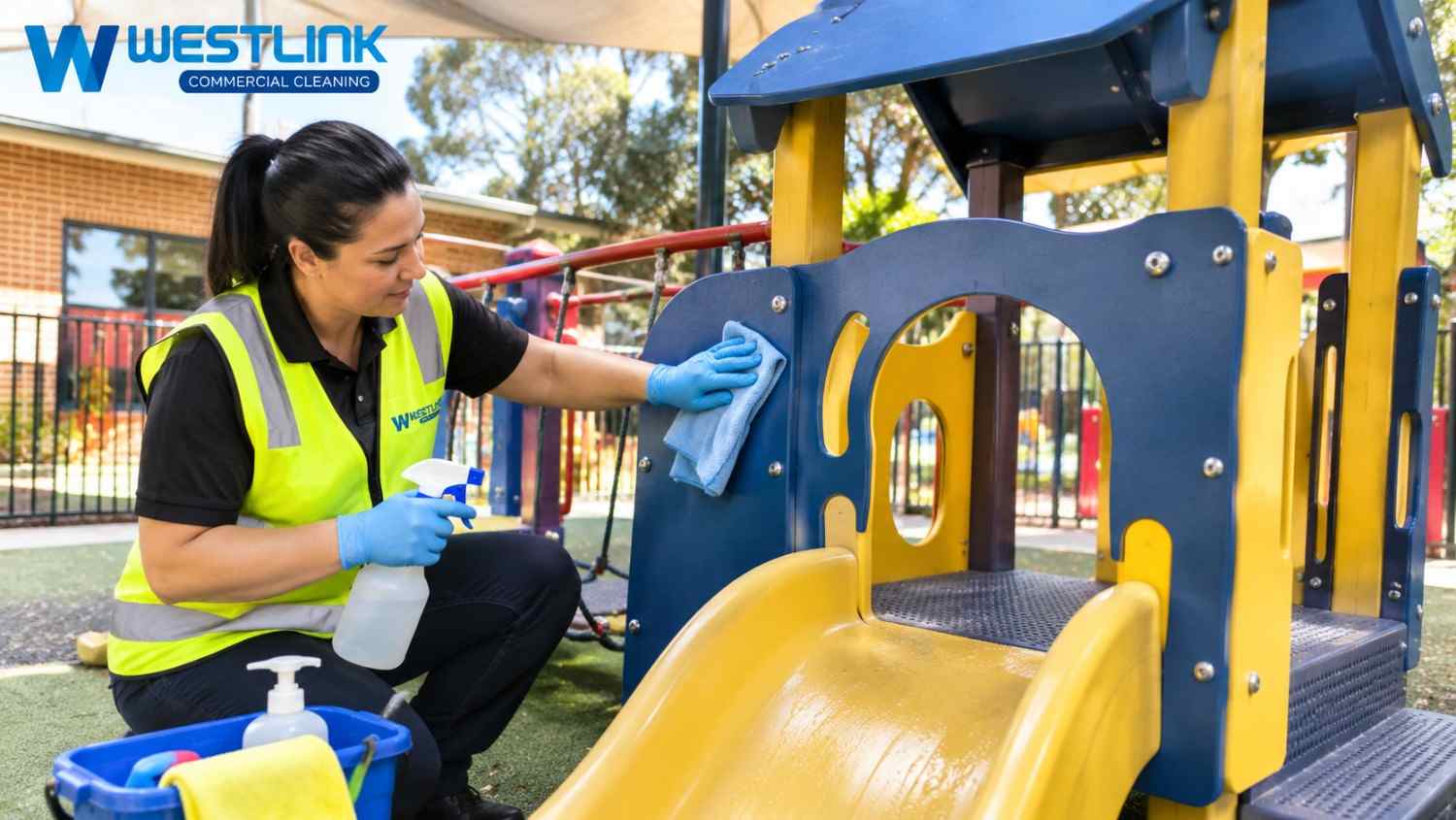
How to Clean Childcare Playground Equipment
Outdoor toys and playground equipment require cleaning based on material, use and visible contamination.
NHMRC’s outdoor-area guidance recommends cleaning frequently touched plastic and metal surfaces with detergent and water when visibly dirty. It does not recommend routine cleaning of outdoor timber structures, footpaths or groundcovers merely for infection control.
For plastic ride-on toys, outdoor play panels and suitable metal equipment, remove visible dirt and wash the affected surfaces using compatible detergent and water.
Allow the equipment to dry before reuse and check for damaged coatings, cracks, sharp edges or loose components.
Outdoor equipment should also receive separate safety and maintenance inspections.
Routine spraying of disinfectants across playgrounds is not recommended as a general infection-control measure.
How to Clean Toys After Mouthing, Illness or Body-Fluid Contamination
The type of contamination determines how a toy should be managed.
A toy used during ordinary play is not the same hygiene situation as one contaminated with saliva, vomit, faeces or blood.
| Situation | Immediate action | Follow-up procedure |
| Toy placed in a child’s mouth | Remove from shared play | Wash according to NHMRC guidance and the toy’s instructions |
| Toy sneezed on | Place in the designated dirty-toy container | Clean before reuse |
| Visible food, dirt or saliva | Remove and separate from clean toys | Wash, rinse and dry appropriately |
| Vomit, faeces or blood contamination | Isolate the item and affected area | Apply service body-fluid cleaning and disinfection procedures |
| Suspected gastroenteritis outbreak | Inform the nominated supervisor | Follow state or territory public health advice |
| Internal mould or inaccessible contamination | Withdraw the toy | Clean adequately if possible, otherwise replace |
| Cracked or damaged toy | Remove from circulation | Repair only if safe and appropriate, otherwise discard |
What Should Educators Do When a Child Mouths a Toy?
Remove the toy from shared use and place it in the designated container for washing.
Provide a clean replacement if needed.
Do not return the mouthed toy to circulation merely because it appears dry or free of visible saliva.
The toy should first undergo its appropriate cleaning process.
How Should Toys Be Cleaned After Vomiting or Diarrhoea?
A toy contaminated by vomit or faeces requires prompt removal and appropriate handling under the service’s body-fluid procedure.
Keep children away from the affected area, use suitable protective equipment and remove visible contamination safely.
For toys that can be processed, clean the material before applying a compatible disinfectant when indicated.
Follow the product’s organism-specific claims, contact time and rinsing instructions.
If a toy cannot be effectively disinfected when disinfection is necessary, withdraw it rather than returning it to play.
Norovirus requires particular care. Ordinary sanitisers are not automatically effective against it.
NHMRC recommends seeking or following public health guidance for enhanced outbreak cleaning. This is particularly relevant when a childcare service experiences multiple gastroenteritis cases.
Do Toys Need Extra Disinfection After Respiratory Illness?
Toys exposed to saliva or respiratory secretions should be removed from use and cleaned.
Additional disinfection depends on the circumstances, service policy and relevant public health advice.
Routine hand hygiene, ventilation, illness-management procedures and environmental cleaning remain important alongside toy care.
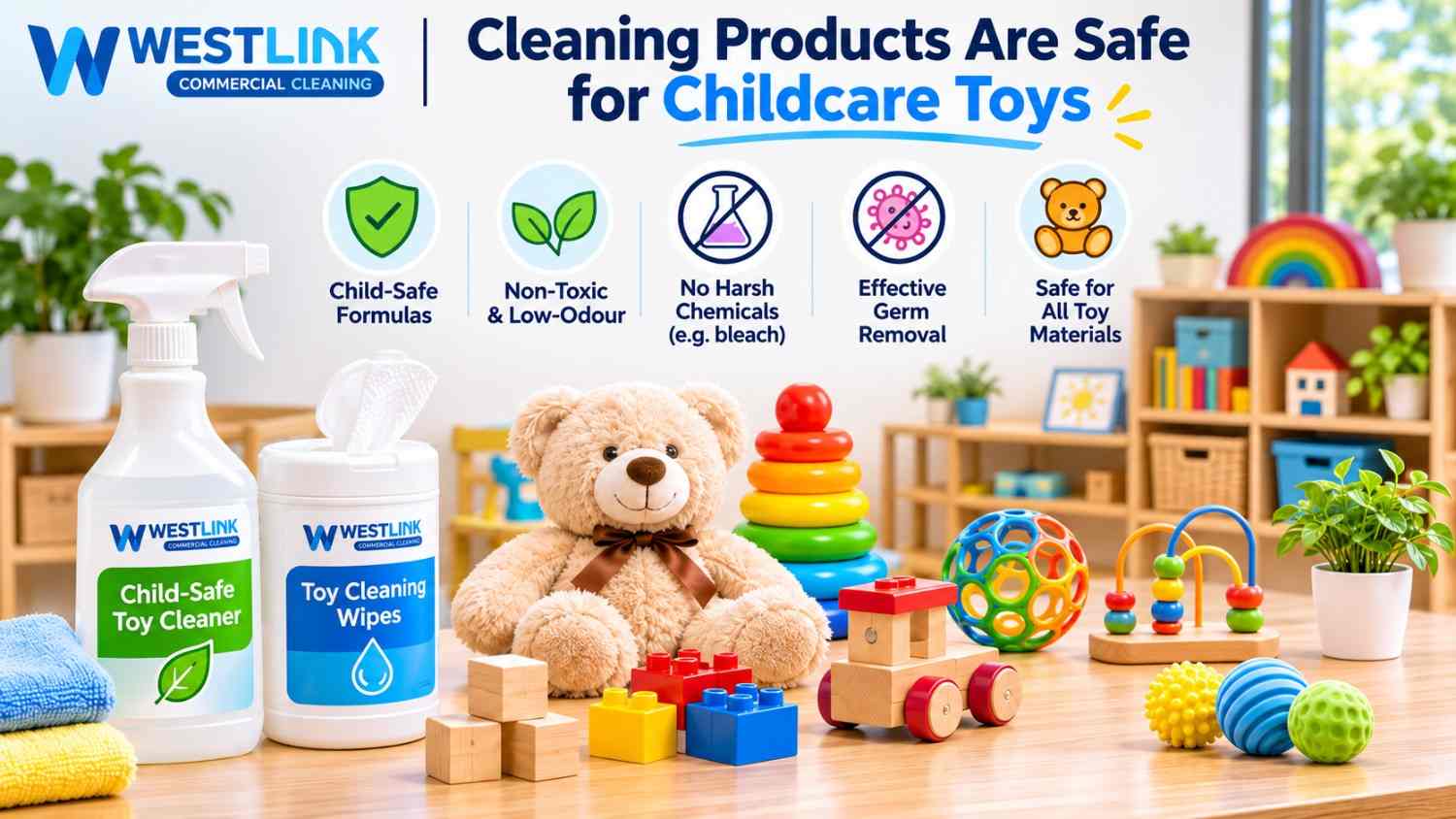
Which Cleaning Products Are Safe for Childcare Toys?
The suitability of a cleaning product depends on the material, contamination, intended use and the product’s instructions.
Terms such as natural, gentle, eco-friendly and non-toxic do not, by themselves, establish that a product is appropriate for every toy or capable of disinfecting it.
Mild Detergent and Water
Suitable detergent and water are the foundation of ordinary childcare toy cleaning.
Detergent loosens dirt and organic matter, while rubbing and scrubbing help remove contamination.
Rinsing removes loosened material and detergent residue, and complete drying reduces moisture-related hygiene problems.
NHMRC also recommends preparing fresh detergent solutions daily where mixtures are made up for cleaning, rather than repeatedly topping up old solutions.
What Disinfectant Can Be Used on Children’s Toys?
Select a disinfectant according to its label claims, compatibility with the surface and the type of contamination.
Check whether it is intended for the proposed application, including toys or surfaces that may contact children’s mouths.
The Therapeutic Goods Administration (TGA) distinguishes general cleaners, sanitisers and surface disinfectants.
In Australia, disinfectants making specified claims against organisms such as viruses or fungi generally require inclusion in the Australian Register of Therapeutic Goods (ARTG). Certain disinfectants without specific claims are exempt from ARTG listing but remain subject to applicable regulatory requirements.
Not every compliant surface disinfectant needs to be ARTG-listed.
For use in a childcare centre, staff should check the relevant product label, safety information and service procedures rather than relying solely on registration terminology.
Why Do Dilution and Contact Time Matter?
A disinfectant only works as intended when used according to its instructions.
The concentration determines how the product is prepared, while contact time is the period the treated surface must remain wet.
Some products also require rinsing before an item can safely contact a child’s mouth.
An incorrect dilution, unsuitable surface or shortened contact time can reduce effectiveness or introduce chemical exposure concerns.
Safety Data Sheets (SDS) support workplace chemical risk management, but the product label provides essential directions for the specific intended use.
Can Bleach Be Used on Childcare Toys?
Bleach may be appropriate for certain disinfection procedures, but it is not a universal toy-cleaning product.
It can damage materials and create exposure risks when used incorrectly.
NHMRC advises following the manufacturer’s dilution and safety instructions, using appropriate protection, and preparing fresh bleach solutions when needed.
Do not mix bleach with other chemicals, dilute it with hot water or apply it using a spray bottle.
Never invent a single bleach dilution for all toy materials or contamination incidents.
Is Vinegar Effective for Disinfecting Toys?
No. Vinegar is not a reliable substitute for an appropriately tested disinfectant.
NHMRC advises against using household ingredients such as vinegar and bicarbonate of soda as childcare cleaning products because they are less effective against germs than suitable formulated cleaning products.
Use appropriate detergent for routine cleaning and a suitable disinfectant when the circumstances require it.
What Is the Correct Daily Toy Cleaning Procedure in Childcare?
A repeatable childcare toy cleaning procedure has seven practical stages. Additional sanitising or disinfection is conditional rather than a mandatory step for every toy.
- Identify and inspect. Check the material, surface finish, joints, cavities and manufacturer instructions. Remove damaged items.
- Separate contaminated toys. Collect mouthed, soiled and illness-exposed toys in a labelled container out of children’s reach.
- Wash using an appropriate method. Use detergent and water for washable toys, mechanical scrubbing where needed, and controlled surface wiping for moisture-sensitive equipment.
- Rinse or remove cleaning residue. Rinse fully washable toys or use a clean damp cloth where immersion is unsuitable.
- Apply additional treatment if required. Sanitise or disinfect only when appropriate for the toy, product and contamination risk.
- Dry and inspect. Keep toys out of play until dry, checking seams, fabric fillings, joints and internal openings for retained moisture.
- Store and document. Place clean toys in a designated dry area and record completion or corrective actions according to the service’s procedures.
This process should be supported by sufficient cleaning equipment, suitable staff training and ready access to product instructions.
How Often Should Different Childcare Toys Be Cleaned?
Daily washing is the core NHMRC recommendation for childcare toys, supplemented by cleaning during the day when contamination occurs.
The following schedule shows how a centre might organise the routine.
| Toy or equipment category | Routine frequency | When to act sooner |
| Infant rattles and teething toys | Daily | Immediately after mouthing or contamination |
| Toddler blocks and shape sorters | Daily | After mouthing, sneezing or visible soiling |
| Preschool puzzles and learning materials | Daily, using material-compatible methods | When contaminated |
| Washable shared plush toys | Appropriate daily hygiene and laundering arrangements | When visibly soiled or contaminated |
| Electronic learning toys | Daily, using approved surface-cleaning methods | When contaminated |
| Bath and water-play toys | After each water-play session, plus the daily routine | When water is trapped or contamination is observed |
| Outdoor plastic and metal play equipment | When visibly dirty, in line with NHMRC outdoor guidance | Following significant contamination |
| Toys involved in body-fluid incidents | Remove immediately | Follow the service’s enhanced cleaning procedure |
Infant rooms generally need particularly close attention because young children frequently explore toys with their mouths.
Toddler rooms benefit from easily accessible clean-toy replacements and dirty-toy collection containers.
Preschool rooms still need daily toy hygiene even if children mouth fewer objects.
Centres should assess individual equipment, service procedures and public health directions when developing their schedules.
Who Is Responsible for Cleaning Toys in a Childcare Centre?
Toy cleaning responsibilities should be documented rather than assumed.
Educators are present when children mouth toys or contamination occurs. Contracted cleaners may be scheduled after hours or for agreed periodic tasks.
A professional cleaning contract does not automatically replace the centre’s immediate hygiene response during the day.
The following matrix is an example of a practical responsibility arrangement, not a legally prescribed allocation for every service.
| Cleaning activity | Typical responsible party | How responsibility is verified |
| Identify and remove mouthed toys | Educator or room staff | Room procedure and supervision |
| Collect toys in the dirty-toy container | Educator or designated staff member | Daily routine |
| Provide clean replacement toys | Educator | Clean-toy storage and rotation |
| Complete daily washing of shared toys | Centre staff or an explicitly assigned contractor | Written schedule and completed checklist |
| Clean equipment included in an after-hours contract | Contracted cleaning team | Agreed scope and service record |
| Perform periodic detailed toy and equipment cleaning | Assigned centre staff or contracted cleaner | Scheduled work and inspection |
| Respond to body-fluid contamination | Appropriately trained staff under the service’s procedure | Incident reporting and cleaning records |
| Review the cleaning policy and contractor scope | Approved provider, nominated supervisor or delegated manager | Policy review and written responsibilities |
| Arrange extra cleaning during an outbreak | Service management, with public health advice where required | Outbreak response documentation |
Daily Cleaning Versus Contracted Deep Cleaning
Daily toy hygiene includes removing contaminated toys throughout the day and ensuring the required routine washing occurs.
A contracted deep-cleaning programme might include detailed cleaning of compatible play equipment, hard-to-reach surfaces, storage areas and agreed periodic tasks.
However, a weekly contracted service should not be described as satisfying the centre’s daily toy-washing routine unless daily coverage is separately provided.
For directors and facility managers, the key question is not simply how frequently cleaners visit. It is whether the contract identifies who cleans each toy category, when the work occurs and who verifies completion.
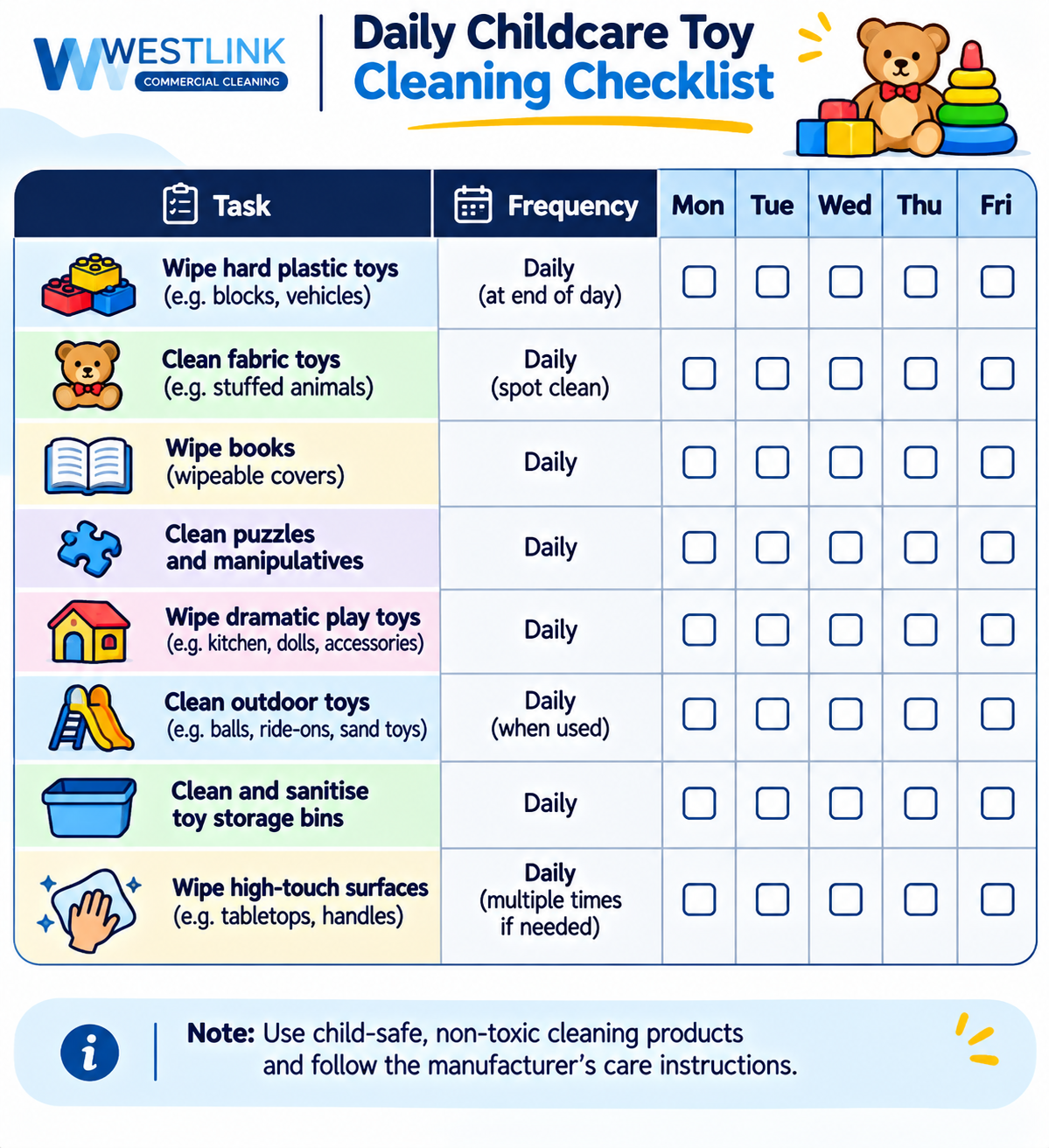
Daily Childcare Toy Cleaning Checklist
A written childcare toy cleaning checklist helps teams maintain a consistent routine across rooms, staff changes and cleaning shifts.
During the Day
- Inspect toys for dirt, damage and contamination.
- Remove mouthed or contaminated toys promptly.
- Keep the “Toys to Wash” container out of children’s reach.
- Supply clean replacement toys when needed.
- Report contamination requiring enhanced cleaning.
At the End of the Day
- Identify the appropriate cleaning method for each material.
- Wash compatible toys with detergent and water.
- Rinse or remove detergent residue appropriately.
- Apply additional sanitising or disinfection only when required.
- Check product dilution, contact time and rinsing instructions.
- Dry fabric, plastic, wooden and other compatible toys fully.
- Inspect bath toys for retained water.
- Withdraw toys that cannot be adequately cleaned.
- Store clean toys separately.
- Record completed tasks and corrective actions.
Printable resource: Childcare Toy Cleaning — Daily Checklist (PDF). A ready-to-print version accompanies this article draft and can be linked from the website’s media library.
Suggested cleaning record fields include the date, room, toy category, staff member, cleaning method, completion time and corrective action.
For greater consistency, childcare centres can add a supervisor’s sign-off and a note identifying any equipment removed from use.
How Can Childcare Centres Choose Toys That Are Easier to Clean?
Toy hygiene becomes easier when cleanability is considered before equipment is purchased.
A toy may be developmentally appropriate but difficult to maintain hygienically because of its materials, cavities, finish or construction.
The following assessment can help educators and centre managers evaluate shared toys.
| Cleanability question | What to inspect | Possible decision |
| Can the toy be washed? | Manufacturer’s care instructions | Prefer washable toys for shared use |
| Is the surface porous? | Unsealed wood, fabric or exposed foam | Determine whether effective cleaning is practical |
| Does the toy trap water? | Hollow chambers, tiny openings and seams | Prefer drainable or openable designs |
| Can it tolerate the proposed treatment? | Heat resistance, finish and chemical compatibility | Use only manufacturer-approved procedures |
| Are there difficult-to-reach parts? | Grooves, joints, wheels and connectors | Select suitable brushes or alternative equipment |
| Can it dry completely? | Stuffing, internal cavities and enclosed joints | Avoid returning damp toys to circulation |
| Can damage affect cleaning? | Cracks, tears, peeling coatings and exposed filling | Repair safely or withdraw the item |
| Is it suitable for repeated shared use? | Expected mouthing and cleaning frequency | Consider individual use or a more washable alternative |
This is a practical screening framework, not a certification test.
For a formal product assessment, a childcare centre can record the toy’s manufacturer, model, cleaning instructions, observed difficulties, approved method and the person who reviewed it.
Actual cleaning tests, photographs and measured results should only be published when the work has been completed and documented.
How Can Professional Childcare Cleaning Support Toy Hygiene?
Professional childcare cleaning can support a centre’s wider hygiene programme through agreed routine cleaning, detailed equipment care, after-hours cleaning and periodic maintenance.
The scope should be determined by the centre’s needs, the materials being cleaned and the responsibilities already assigned to educators.
For example, a centre may require its educators to collect mouthed toys during the day while a scheduled contractor cleans designated equipment or completes agreed after-hours tasks.
A written cleaning scope should identify:
- The rooms and toy categories included.
- Which tasks are completed daily or periodically.
- Which materials and methods are permitted.
- What happens when equipment is damaged or unsuitable for cleaning.
- Who supplies cleaning products and maintains relevant SDS information.
- How completed work, exceptions and corrective actions are documented.
Westlink Commercial Cleaning offers professional childcare cleaning services in Sydney, including customised cleaning schedules and additional cleaning arrangements for childcare environments.
Childcare directors and nominated supervisors can request a site-specific cleaning scope to clarify which cleaning tasks can be included in a service agreement and which remain part of the centre’s everyday responsibilities.
Frequently Asked Questions
Do Childcare Toys Need Disinfecting Every Day?
No. Australian NHMRC guidance recommends daily washing of childcare toys with appropriate detergent, rinsing and drying. Disinfection is used when circumstances call for it, such as particular body-fluid contamination or additional outbreak-related procedures.
Can Childcare Toys Be Cleaned in the Same Dishwasher as Dishes?
No. NHMRC advises that suitable toys can be cleaned in a dishwasher, but they should not be washed at the same time as dishes. The toy manufacturer must also permit dishwasher cleaning.
What Happens If a Toy Cannot Be Disinfected After Contamination?
If the toy cannot undergo the required cleaning and disinfection safely and effectively, remove it from shared use. Depending on the material, contamination and condition, replacement or disposal may be necessary.
Can Wooden Montessori Toys Be Cleaned Safely?
Many sealed wooden Montessori toys can be surface-cleaned using a compatible low-moisture method. Unsealed or damaged wooden toys are harder to maintain hygienically, especially where sanitising or disinfection is required. Follow manufacturer instructions and assess whether the item is suitable for shared use.
How Should Childcare Centres Document Toy Cleaning?
Use a checklist or log recording the date, room, task, responsible staff member and completion status. Include any equipment removed from use or corrective actions taken.
Documentation should match the centre’s actual cleaning programme, rather than being completed retrospectively without verification.
How Should Cleaning Change During a Gastroenteritis Outbreak?
A suspected outbreak requires prompt management under the service’s infection-control procedures and relevant public health advice.
Contaminated toys should be removed immediately. The centre may need enhanced cleaning and appropriate disinfection of affected surfaces and equipment.
Contact the relevant state or territory public health authority where required.
What Toy-Cleaning Tasks Can a Professional Contractor Perform?
A professional contractor may complete agreed routine or periodic toy washing, equipment cleaning, storage-area cleaning and other compatible tasks.
The contract must specify the work, timing, methods and verification arrangements. Educators still need a clear procedure for immediate contamination during operating hours.
Conclusion
Cleaning childcare toys safely depends on three connected decisions: identifying the material, understanding the contamination risk and selecting a compatible cleaning procedure.
Hard plastic toys are often straightforward to wash, while wooden, fabric, foam and electronic toys require material-specific care. Bath toys need proper drainage and drying, and damaged or difficult-to-clean toys may be unsuitable for shared use.
For Australian childcare centres, NHMRC’s daily toy-washing guidance provides the foundation. Prompt removal of mouthed or contaminated toys, appropriate detergent cleaning, complete drying and clear staff responsibilities make that guidance workable throughout the day.
A documented cleaning schedule, practical checklist and clearly defined contractor scope can help educators and centre managers maintain more consistent hygiene practices without relying on unnecessary disinfection or unsuitable cleaning chemicals.
References and Further Reading
- National Health and Medical Research Council (2024). Staying healthy: A Healthy Environment. Australian guidance for routine cleaning, toys, body-fluid spills and outbreak-related hygiene.
- Australian Children’s Education and Care Quality Authority. National Quality Standard — Element 2.1.2: Health Practices and Procedures. Hygiene policies, cleaning practices and documentation within education and care services.
- Therapeutic Goods Administration. Regulation of Cleaners and Disinfectants. Australian product classification, disinfectant claims and regulatory requirements.
- Neu et al. (2018). Ugly ducklings — The dark side of plastic materials in contact with potable water. npj Biofilms and Microbiomes. Research into microbial biofilms in bath toys.
This article provides general childcare hygiene information. Services should follow current Australian guidance, relevant state and territory public health requirements, their approved procedures and manufacturer instructions. Additional hygiene procedures may be necessary in specific circumstances.