Childcare sleep room cleaning is the routine of removing soiled bedding, washing sleep equipment with detergent and water, drying every surface, and disinfecting after body fluid spills. This guide is for childcare educators, centre directors and the cleaning contractors who work for them. The guide follows the NHMRC’s Staying Healthy guidelines, sixth edition (2024), and the ACECQA sleep and rest requirements. Cot rails and other frequently touched surfaces need cleaning daily. Linen and mattress covers need daily washing when children share them and weekly washing when each child uses the same items every day. Floors need weekly cleaning, and carpets and mats need daily vacuuming. The sections below set out the schedule, each cleaning method, the spill procedure and the split of tasks between educators and contractors.
What is the cleaning schedule for a childcare sleep room?
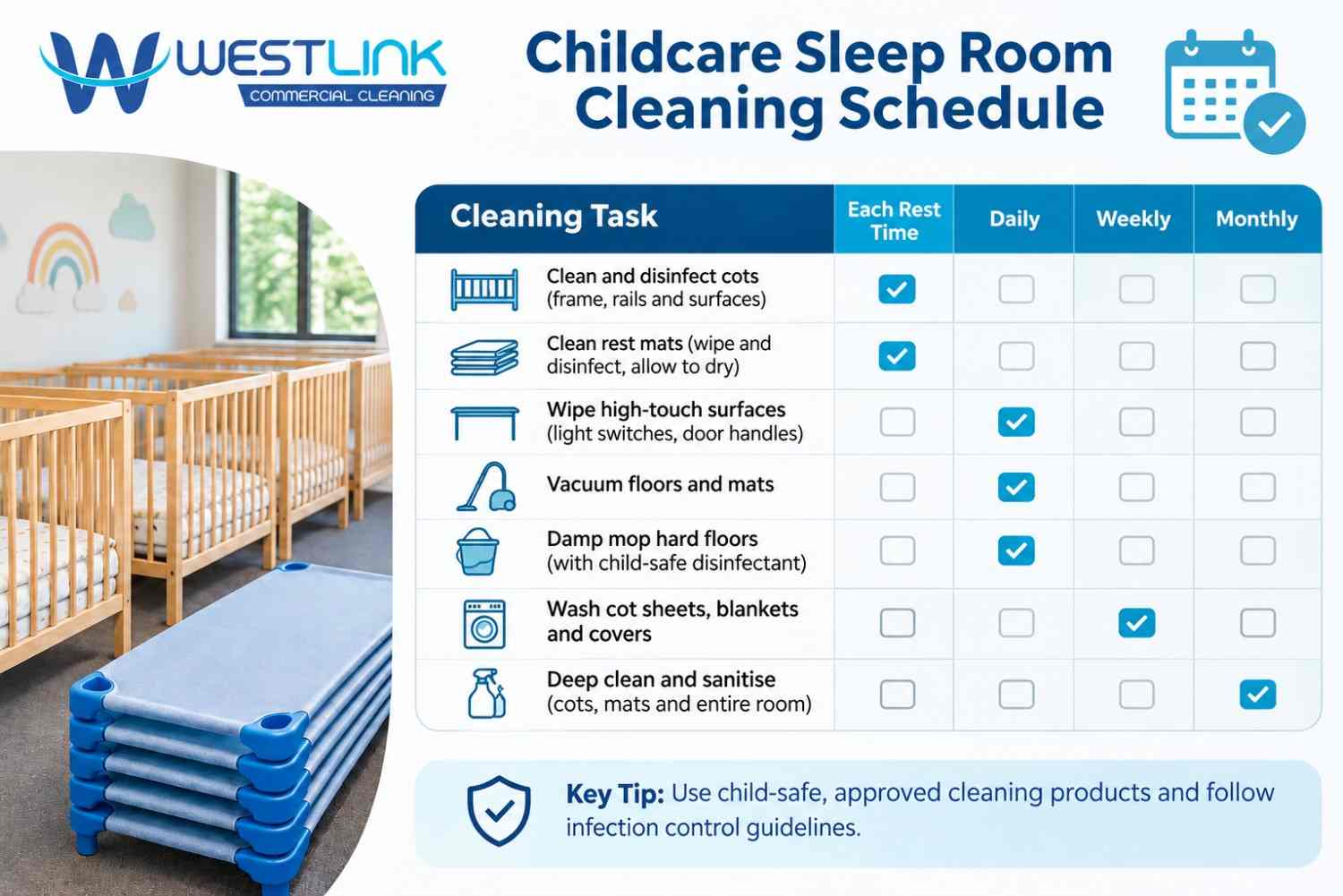
A childcare sleep room follows the NHMRC schedule: daily cleaning of frequently touched surfaces, daily or weekly washing of bedding, weekly floor cleaning, and daily vacuuming of carpets and mats. The NHMRC publishes the core schedule as Table 3.1 of A Healthy Environment and asks services to pass the table to any external cleaning staff.
| Sleep room item | Cleaning frequency or trigger | Basis |
| Cots, cot rails, door handles, light switches and other frequently touched surfaces | Daily and whenever visibly dirty | NHMRC Table 3.1 and section 3.2 |
| Beds, stretchers, linen and mattress covers used by different children | Daily and whenever visibly dirty | NHMRC Table 3.1 |
| Beds, stretchers, linen and mattress covers used by the same child every day | Weekly and whenever visibly dirty | NHMRC Table 3.1 |
| Hard floors | Weekly and whenever visibly dirty | NHMRC Table 3.1 |
| Carpets and mats | Vacuum daily; steam clean at least every 6 months; spot-clean when visibly dirty. | NHMRC special considerations |
| Curtains | Wash every 6 months and whenever visibly dirty. | NHMRC special considerations |
| Any item or surface contaminated with body fluids | Clean immediately, then disinfect. | NHMRC spill procedure |
| Shared rest mats or cots reassigned to another child | Clean before the next child uses the equipment. | Service procedure |
This schedule is a baseline. The service’s risk assessment, state or territory requirements, manufacturer instructions and public health unit advice during an outbreak take precedence over the baseline.
Why does cleaning childcare sleep rooms matter?
Cleaning matters because harmful germs survive on surfaces such as cot rails, mattress covers and rest mats, and children transfer germs to those surfaces through their hands, respiratory secretions and body fluids. The NHMRC states that survival time depends on the type of germ, the surface, temperature, humidity and cleaning frequency. Regular cleaning reduces the number of germs in the environment and breaks the chain of infection. Infants and young children spend long periods in contact with mattresses, cot rails, rest mats and linen, so these items carry a higher exposure than most room surfaces.
A childcare sleep room holds five surface types, and each type needs its own method:
- Cot frames and rails: frequently touched surfaces cleaned daily.
- Cot mattresses: sleep surfaces that need intact, cleanable covers.
- Rest mats and stretcher beds: equipment cleaned according to use, sharing and visible soiling.
- Bedding and fitted sheets: washable textiles that need hot laundering and hygienic storage.
- Floors, carpets and high-touch fixtures: environmental surfaces that collect dust and contamination.
How do you clean a childcare sleep room safely?
A childcare sleep room is cleaned in five steps: prepare the room, remove used bedding, clean high-touch surfaces, clean floors and carpets, and check the room before children return.
Step 1: How do you prepare the room and supplies?
Preparation means moving children away from the cleaning area and gathering supplies, so cleaning does not interfere with supervision or sleep routines. The room needs these supplies:
- Detergent labelled and intended for cleaning
- Warm water and disposable cloths, or cloths that can be machine-washed in hot water
- Paper towels
- Utility gloves
- A mop with a detachable, machine-washable head
- A vacuum cleaner, ideally fitted with a HEPA filter
- A lidded, plastic-lined laundry bin for soiled linen
- A spill kit holding disposable gloves, a scraper and pan, detergent and disinfectant
The NHMRC advises keeping this equipment on site even when an external provider usually cleans the service. The NHMRC also advises against vinegar and bicarbonate of soda because neither works as well against germs as a labelled cleaning product. Chemicals stay out of children’s reach, and product labels are read before use.
Step 2: How do you remove used bedding and inspect sleep equipment?
Used sheets and other washable linen come off before the mattress or rest mat underneath is cleaned. Educators carry soiled linen to the laundry in a basket or bag, never against clothing, and keep the linen away from clean bedding. Educators then inspect mattresses, cot frames and mat covers for visible soil, loose components and damaged surfaces. Damaged equipment stays out of use until the service assesses it and repairs or replaces it.
Step 3: How do you clean high-touch surfaces?
High-touch surfaces are cleaned with detergent and warm water, rinsed with clean water and dried with a clean paper towel. The NHMRC calls this method the best way to remove harmful germs from hard surfaces. A surface that is waterproof but feels soft, such as vinyl, counts as a hard surface for cleaning purposes. Five practices make the method effective:
- Mix fresh detergent solution daily in a clean, dry container, and label the container with the mixing time, date and detergent type.
- Do not top up the container during the day, because topping up dilutes the mixture.
- Rub the surface vigorously, because a fine mist wiped dry does not dislodge germs.
- Wipe again with a new cloth dampened in clean water to remove detergent residue, then dry the surface.
- Work from the cleanest areas to the dirtiest areas to avoid carrying germs into clean spaces.
The NHMRC recommends cleaning horizontal and frequently touched surfaces at least once a day and again when they are visibly dirty or contaminated with body fluids.
Step 4: How do you clean floors and carpets?
Hard floors are cleaned weekly and whenever visibly dirty, and carpets and mats are vacuumed daily. The NHMRC recommends steam cleaning carpets and mats at least every 6 months and spot-cleaning small visibly dirty areas. A vacuum with a HEPA filter is recommended. Without a HEPA filter, educators finish vacuuming before children enter the room so dust can settle. Services may clean more often based on foot traffic, room use and their own procedures.
Step 5: How do you check the room before children return?
The room is ready for children when cleaned surfaces are dry, chemicals are removed and the space is free from hazards. Before nap time, educators check that:
- Cots and rest mats are clean and ready for use.
- Each child’s bedding is available and hygienically stored.
- Cleaning supplies are out of children’s reach.
- Walkways and exits are unobstructed.
- Staff can supervise sleeping children effectively.
A clean room is ready for use only when the sleeping equipment and layout also meet the service’s safe sleep requirements.
How should childcare cots and mattresses be cleaned?
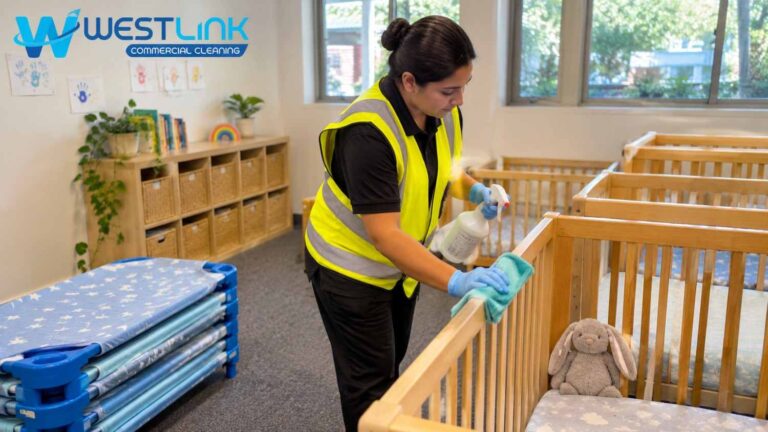
Childcare cots are cleaned with a surface-compatible detergent, warm water, rinsing and thorough drying. Cot frames, mattress covers and fitted sheets need separate attention because their materials and cleaning methods differ. The NHMRC’s cot procedure removes visible soiling from the cot and mattress with detergent and warm water, then makes up the cot with clean linen once the mattress is dry.
How do you clean cot frames and rails?
A cot frame is cleaned by wiping every cleanable component with detergent solution, rinsing and drying. Seven steps cover routine cot cleaning:
- Remove the fitted sheet and other permitted bedding.
- Put on utility gloves and prepare the detergent solution according to the product label.
- Wipe the cot rails, slats, end panels and other cleanable components.
- Wipe frequently touched areas and accessible joints where dirt collects.
- Rinse detergent residue away with a clean damp cloth, where appropriate.
- Dry the cot surfaces thoroughly.
- Inspect the cot for damage, loose fasteners and other hazards before reuse.
Cot frames are also checked against the manufacturer’s instructions and relevant safety requirements. Cleaning does not replace structural safety inspections.
How do you clean cot mattresses and protective covers?
A cot mattress is cleaned by wiping its intact cover with detergent and water, then rinsing and drying the cover according to the manufacturer’s instructions. A childcare cot mattress needs a firm, flat, well-fitting sleeping surface with a clean, intact cover. Five steps to clean a mattress:
- Remove the fitted cot sheet.
- Inspect the mattress cover, seams and edges for contamination or damage.
- Wipe the cleanable cover with detergent and water.
- Rinse and dry the cover according to the manufacturer’s instructions.
- Check that the surface is completely dry before fitting clean linen.
A waterproof cover with tears, split seams, damaged zippers or exposed foam lets liquid enter the mattress core and can prevent effective cleaning. A foam mattress is not soaked unless the manufacturer permits that method.
How do you clean rest mats and nap mats in childcare?
Childcare rest mats are cleaned with a method suited to the surface material and dried before reuse or storage. Foldable foam mats, vinyl-covered nap mats and stackable stretcher beds can need different cleaning procedures.
How do you clean wipe-clean rest mats?
A wipe-clean rest mat is cleaned with detergent and warm water, then dried completely, including seams and folds. Wipe-clean surfaces resist liquid penetration, and the NHMRC treats a waterproof surface that feels soft, such as vinyl, as a hard surface for cleaning. Six steps to clean the mat:
- Remove any fitted sheet or removable fabric cover.
- Inspect the top surface, underside, seams and fold lines.
- Wipe the cleanable surfaces with detergent and warm water.
- Remove detergent residue according to the manufacturer’s directions.
- Dry the entire mat, including seams and folds.
- Store the mat in a designated clean area.
Fold lines on foldable mats collect dirt and moisture, so educators give fold lines particular attention. A rest mat with a torn cover or exposed foam core is assessed for safe repair or replacement.
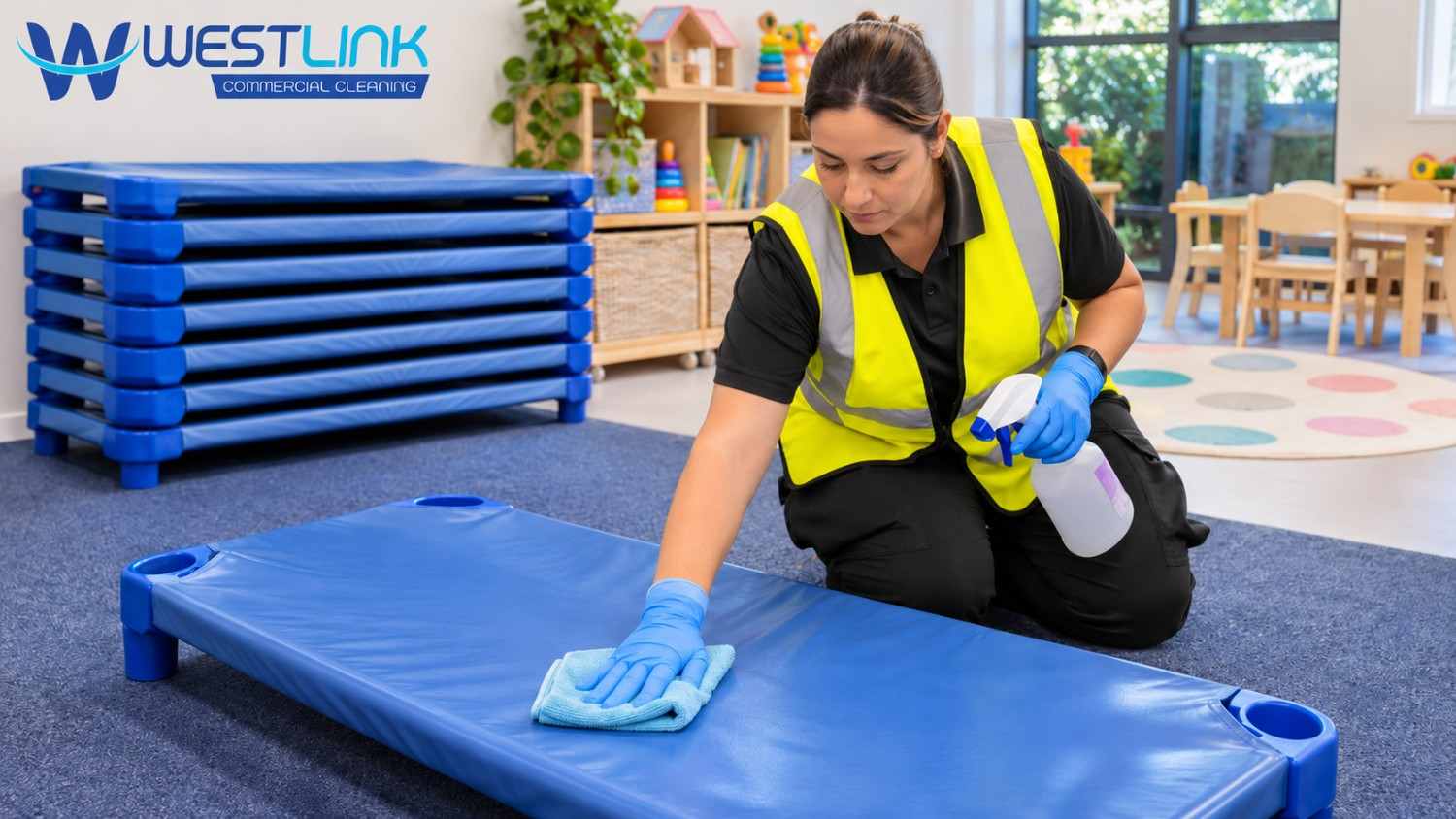
How do you clean stackable daycare cots?
A stackable daycare cot is cleaned by wiping the frame, corner feet and other wipeable components, then following the manufacturer’s instructions for the fabric sleeping deck. A stackable cot has a raised fabric sleeping deck on a frame. The fabric deck can need a different cleaning method from a waterproof surface. All components dry before stacking, and stored cots are arranged to avoid contaminating the sleeping surfaces.
How should childcare bedding be washed and stored?
Childcare bedding is laundered with detergent in a hot machine wash at least 60°C, dried completely and stored so clean linen never contacts used or contaminated bedding.
How do you wash sheets and other sleep linen?
Effective laundering combines detergent, a hot setting of at least 60°C, and complete drying in sunlight or in a tumble dryer on a hot setting of at least 40°C. These three requirements come from the NHMRC. Educators check textile care labels and the service’s laundering procedure before selecting a cycle. Five steps cover routine bedding hygiene:
- Collect used linen in a laundry basket or bag.
- Keep used linen apart from clean bedding.
- Wash items with detergent at 60°C or above.
- Dry bedding completely before storage or reuse.
- Inspect clean items before returning them to the sleep room.
The NHMRC states that contaminated cloth items, such as bed linen from a child with gastroenteritis, need not be washed separately when the water temperature and detergent amount are correct. Linen with faeces on it is rinsed to remove most of the contamination, washed in hot water with laundry detergent and dried in the sun or on a hot dryer cycle. Linen sent to a laundry service or to a child’s home travels in a plastic or waterproof bag. Gloves protect staff who handle linen with faeces on it.
How do you store child-specific bedding?
Individually assigned bedding keeps different children’s linen from mixing or cross-contaminating. Labelled storage compartments or bags identify each child’s sleep items. Clean bedding stays in a dry, protected location, and used bedding is stored apart until laundering. Clean sheets never touch dirty floors or contaminated equipment. A good storage system lets educators find one child’s linen without handling other children’s bedding.
What should staff do when body fluids contaminate a cot or rest mat?
Staff treat blood, vomit, urine, faeces and breastmilk as potentially infectious, clean the spill immediately, and then disinfect the cleaned surface. The NHMRC states that cleaning and disinfection follow any spill of body fluids, and that the process is the same on hard and soft surfaces. Eight steps cover a spill on a cot or rest mat:
- Attend to the child. Put on disposable gloves, clean the child, remove the gloves, dress the child and wash everyone’s hands.
- Keep others away. Place a safety sign around the spill and keep other children away from the affected equipment.
- Remove the spill. Wipe it up with a damp cloth or paper towel, or cover a larger spill with an absorbing agent or disposable pads and scoop it up with a disposable scraper and pan. Seal everything in a plastic bag and put the bag in the bin.
- Separate the linen. Place soiled linen in a plastic-lined, lidded laundry bin.
- Clean the surface. Put on clean utility gloves, wash the surface with detergent and warm water, and dry it with paper towels.
- Disinfect the surface. Wipe the cleaned, dry surface with disinfectant and let the disinfectant dry.
- Finish. Remove the utility gloves and wash hands with soap and water.
- Remake the bed. Once the mattress is dry, make up the cot with clean linen.
How do the cot procedure and the disinfection step fit together?
The NHMRC’s cot procedure lists cleaning with detergent and warm water, and the NHMRC’s general spill procedure adds a disinfectant step after cleaning. The general rule is that body fluid spills receive both steps. The manufacturer’s instructions for the mattress or cover decide which disinfectant the material tolerates, and the service’s written spill procedure records the decision. A cot mattress or foam rest mat that cannot be cleaned effectively after liquid penetration stays out of use until a safety assessment clears it.
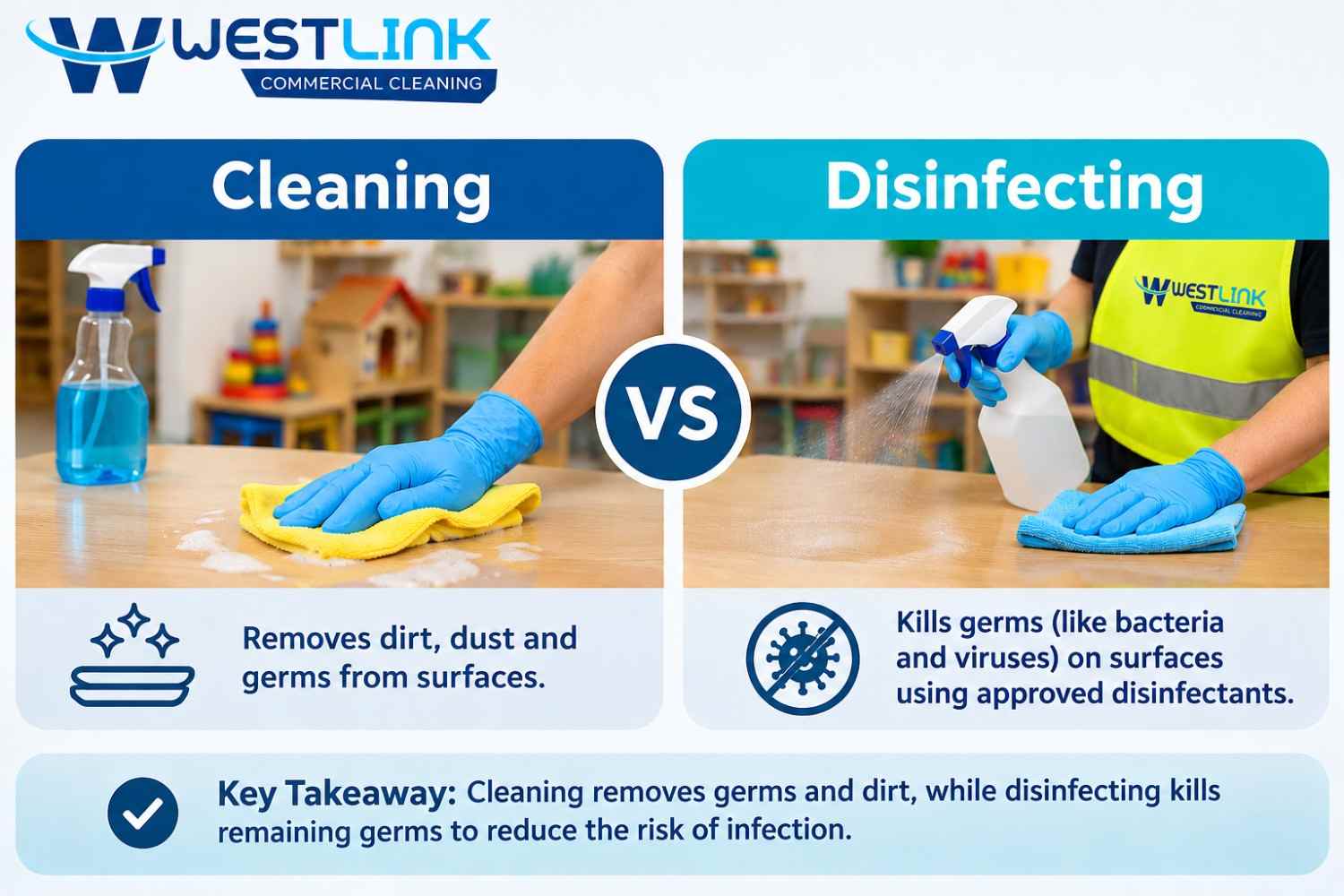
What is the difference between cleaning and disinfecting?
Cleaning removes dirt and many germs with detergent, water and physical wiping, and disinfecting uses a chemical product to destroy the germs that remain. Cleaning always comes first. A disinfectant works only at the right concentration, against the right germs, on a surface already cleaned with detergent and water and dried. Some products combine detergent and disinfectant, and those products can be used without a separate detergent wash. Routine cleaning is the primary process, and chemical disinfection of every cot or mat after every nap is not part of routine cleaning.
When is disinfection necessary?
Disinfection is necessary after any body fluid spill, during certain disease outbreaks, and when the service’s procedures require it. The NHMRC accepts a general-purpose disinfectant labelled hospital-grade, or bleach. The disinfectant label sets the dilution, and diluted disinfectant is made up just before use and is not stored in spray bottles. Seven rules make bleach safe to use:
- Wear gloves and eye protection when preparing bleach.
- Check the use-by date, because stored bleach loses strength.
- Dilute bleach with water in a clean container according to the manufacturer’s instructions, and never with hot water.
- Make up a fresh batch each time, because diluted bleach loses strength quickly.
- Never put bleach in a spray bottle.
- Never mix bleach with any other chemical.
- Keep bleach off metals other than stainless steel, because bleach is corrosive.
Vinegar and other domestic kitchen products are not disinfectants.
What should a service do during a disease outbreak?
During a disease outbreak, the local public health unit advises on cleaning, and the service may need a thorough process that goes beyond routine cleaning. The NHMRC directs services with 2 or more cases of gastroenteritis to the state or territory public health guidelines for gastroenteritis outbreaks in education and care services, or to the local public health unit. Disinfectants may be needed for more intense cleaning, and all items are laundered as soon as possible. Outbreak cleaning is an escalation from the routine in this guide, and the public health unit’s instructions replace the routine schedule for the duration of the outbreak.
Who cleans what: educators or cleaning contractors?
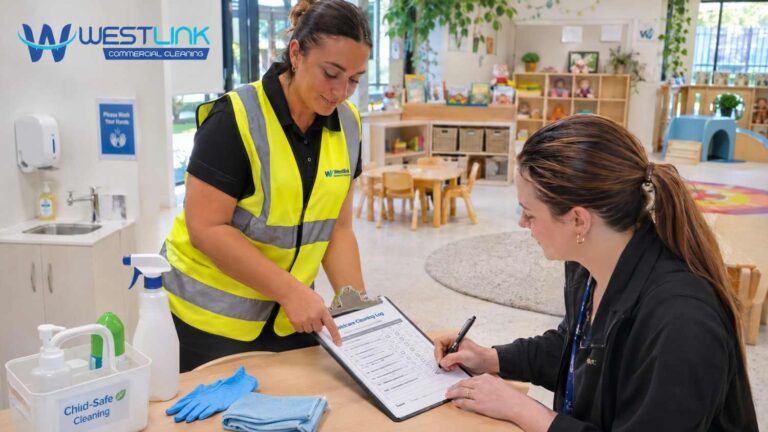
A childcare service decides in writing which sleep room tasks educators perform and which an external cleaner performs, and the approved provider stays responsible for the service’s sleep and rest policies and procedures. The NHMRC asks services to give external cleaning staff the requirements in Table 3.1 and to keep cleaning equipment ready even when a contractor usually cleans. The table below shows one example allocation for a written cleaning scope. The service’s own procedure decides the final split.
| Task | Educators | Cleaning contractor |
| Spill response and child care during operating hours | Yes | Not on site |
| Removing used linen and storing child-specific bedding | Yes | If written into the scope |
| Daily wipe of cot rails, door handles and light switches | If written into the scope | If written into the scope |
| Daily vacuuming of carpets and mats and weekly floor cleaning | No | Yes, if written into the scope. |
| Steam cleaning of carpets and mats at least every 6 months | No | Yes, if written into the scope. |
| Inspection of cots and mattresses and removal of damaged equipment | Yes | Reports damage to the service |
| Sleep and rest risk assessment and policies | Approved provider | No |
| Signing the cleaning log | Named in the service procedure | Named in the service procedure |
A written contractor scope states the rooms, surfaces, task frequencies, exclusions and the evidence of completion, such as a signed log.
How should a childcare sleep room be set up for safe cleaning?
A childcare sleep room set up for safe cleaning has cleanable surfaces, accessible storage and enough space for educators to supervise children and maintain equipment without creating hazards. A baby sleeping room in a childcare centre must support both infection prevention and safe sleep practices. Six features support cleaning:
- Accessible cot placement: cots are arranged so staff can clean around them and supervise sleeping children.
- Cleanable flooring: floor materials can be maintained with the service’s cleaning procedures.
- Separate linen storage: designated areas hold clean bedding and used linen.
- Suitable ventilation: airflow and temperature follow safe sleep requirements.
- Unobstructed walkways: clear pathways support supervision and emergency access.
- Minimal clutter: fewer objects mean fewer cleaning difficulties and sleeping hazards.
An infant sleep room needs a safe cot with a firm, clean, flat and well-fitting mattress. Recognised safe sleep guidance covers positioning, head and face covering, and loose bedding. Decorative items must not introduce hazards such as accessible cords or unstable furniture in an infant’s sleeping space.
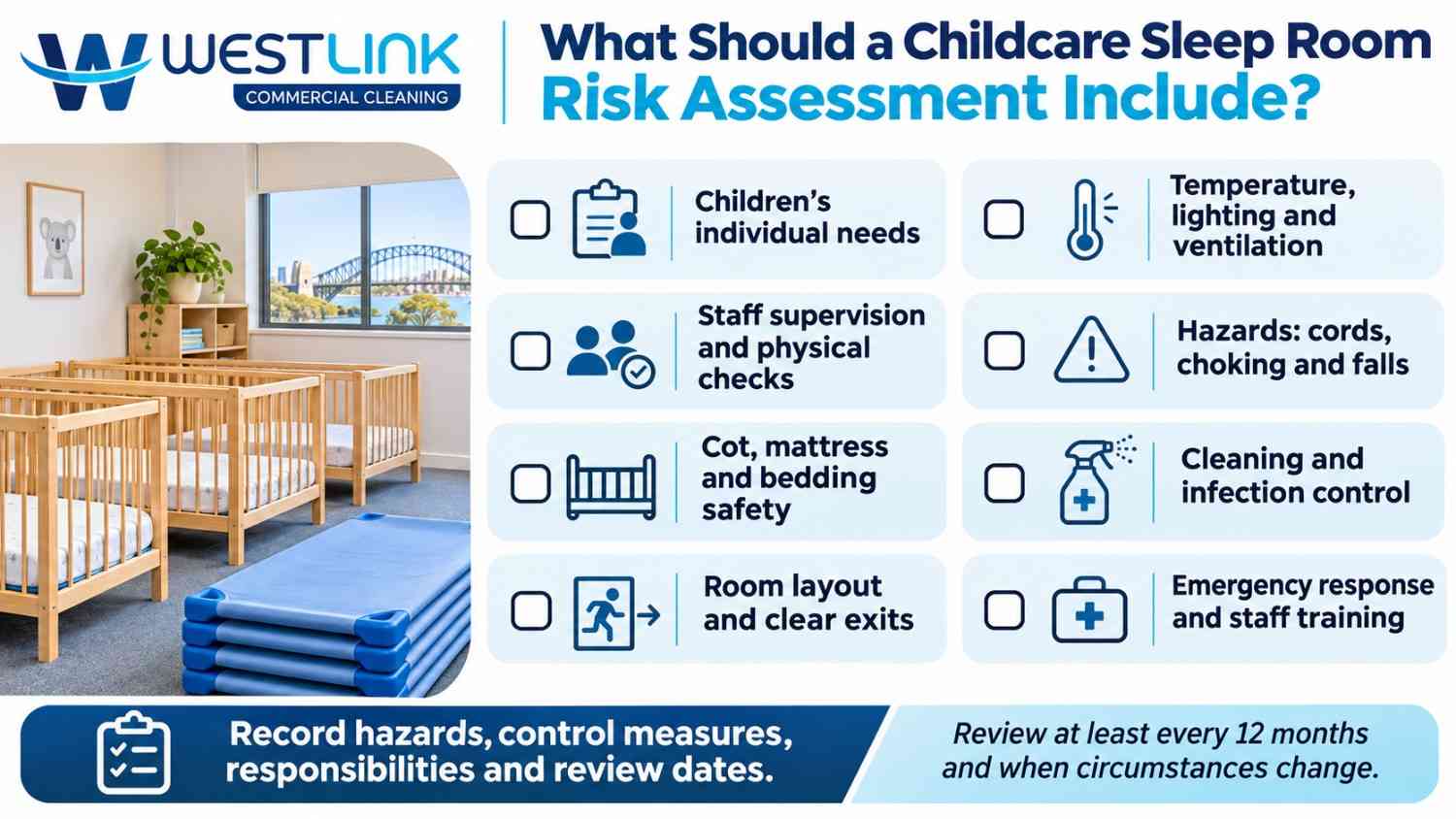
What should a childcare sleep room risk assessment include?
A childcare sleep room risk assessment identifies hazards in sleeping equipment, room conditions, supervision and cleaning procedures, and documents how the service manages each risk. Regulation 84C of the Education and Care Services National Regulations require approved providers to ensure a sleep and rest risk assessment is conducted at least once every 12 months and as soon as practicable after the provider becomes aware of a circumstance that may affect children’s safety, health or wellbeing during sleep and rest. Regulations 84C(3) and 84C(4) require the provider to keep a record of each assessment, and regulation 84B requires the service’s policies to address the identified risks. The ACECQA information sheet sets out these requirements, and ACECQA released an updated sleep and rest risk assessment template in August 2026. NSW services can also use the NSW Department of Education’s safe sleep compliance guidance.
Hygiene is one part of the assessment. Regulation 84C also covers matters such as the number, ages and development stages of the children, supervision, staffing, ventilation, temperature and equipment suitability. Cleaning also supports National Quality Standard element 3.1.2, Upkeep, which requires premises, furniture and equipment to be safe, clean and well maintained. The table below lists the hygiene and equipment risks.
| Risk area | What to check | Possible control measure |
| Cot mattress condition | Torn covers, damaged seams or exposed foam | Remove unsuitable equipment from use. |
| Rest with hygiene. | Soil, moisture and contamination | Use a defined cleaning and drying procedure. |
| Shared equipment | Cross-contamination between children | Clean equipment before reassignment and provide fresh linen. |
| Bedding storage | Contact between clean and used linen | Provide separate, labelled storage. |
| Cleaning products | Chemical exposure or incorrect dilution | Secure chemicals and follow labels. |
| Sleep room arrangement | Restricted supervision or unsafe access | Review cot placement and room layout. |
| Cleaning records | Missed tasks or unclear responsibilities | Keep a cleaning checklist and assign staff. |
What should educators do with damaged sleep equipment?
Educators remove damaged sleep equipment from use until the service assesses the damage and repairs or replaces the item. The manufacturer’s instructions and the service’s procedure decide between repair and replacement.
| Finding | Action |
| Torn cover, split seam, damaged zipper or exposed foam | Remove from use; assess for repair or replacement. |
| Liquid has penetrated a mattress or foam mat, and cleaning cannot remove the contamination. | Keep out of use until a safety assessment clears the item. |
| Loose fasteners or loose cot components | Remove from use until the cot is repaired or replaced. |
| Visible soil on an intact surface | Clean, dry and inspect before reuse. |
How can childcare centres keep a consistent cleaning routine?
A childcare sleep room cleaning checklist helps staff complete routine hygiene tasks consistently and records the completed work. The checklist runs in three stages.
Before sleep time, educators complete these tasks:
- Check cot and rest mat cleanliness.
- Confirm that bedding is clean and correctly assigned.
- Inspect mattresses and equipment for visible damage.
- Check the sleeping area for hazards.
- Confirm that cleaning chemicals are secured.
After sleep time, educators complete these tasks:
- Remove bedding due for laundering.
- Check sleep equipment for visible contamination.
- Clean shared equipment before reassignment.
- Dry and store rest mats appropriately.
- Record any damage, contamination or cleaning concerns.
At the end of the day, staff complete these tasks:
- Clean frequently touched room surfaces.
- Vacuum carpets and mats, and complete scheduled floor cleaning.
- Transfer used linen for laundering.
- Check that clean equipment is dry and stored hygienically.
- Record completed cleaning tasks and unresolved issues.
A cleaning log records the date, time, room, equipment identifier, completed task, staff initials and supervisor sign-off. The sample below shows the format.
| Date | Time | Room | Equipment | Task completed | Staff initials | Supervisor sign-off |
| (date) | (time) | Sleep room 1 | Cot 4 | Rails and frame cleaned, mattress cover wiped and dried, fitted sheet changed | (initials) | (initials) |
Questions about childcare sleep room cleaning
Questions about childcare sleep room cleaning cover rest mat storage, bedding frequency, outbreaks, damaged covers, daily cot cleaning, disinfectant use, shared mats and contractor roles.
How do you store childcare rest mats hygienically?
Rest mats are cleaned and dried before storage in designated racks, compartments or another system that protects the sleeping surfaces from contamination. The manufacturer’s stacking and storage instructions apply.
How often should childcare bedding be washed?
Bedding used by different children is washed daily, and bedding used by the same child every day is washed weekly, and both are washed whenever visibly dirty. Contaminated linen is changed immediately. Stricter service or local requirements take precedence.
How should a centre respond to a gastroenteritis outbreak?
A centre with 2 or more cases of gastroenteritis follows the state or territory public health guidelines or contacts the local public health unit. The NHMRC adds that more intense cleaning and disinfection may be needed.
What should happen if a cot mattress cover is damaged?
A cot with a damaged mattress cover is removed from use until the service assesses the damage and repairs or replaces the cover. A damaged cover can let liquid enter the mattress core and block effective cleaning.
Should childcare cots be cleaned every day?
Yes, cots and other frequently touched surfaces are cleaned daily and whenever visibly dirty. Bedding and mattress covers follow the daily or weekly rule in the schedule above, and contamination triggers extra cleaning.
Is disinfectant needed after every nap?
No, routine cleaning with detergent and water does not require disinfectant after every nap. Disinfection follows body fluid spills, applies during certain outbreaks and applies when service procedures require it.
Can you use disinfectant on childcare rest mats?
Yes, a compatible disinfectant can be used on cleanable rest mats after the mat is cleaned and dried. The product instructions set the concentration, contact time, rinsing and drying, and the disinfectant must suit the mat material.
Can different children share the same rest mat?
Yes, a rest mat can be reassigned to another child when the mat is hygienically prepared and the arrangement complies with the service’s requirements. Educators use fresh, child-specific linen and clean the shared surface before reassignment. Assigning each child their own sleeping equipment reduces the need for reassignment.
Can educators and external cleaners share sleep room cleaning?
Yes, educators and external cleaners can share the work when the service’s written procedure assigns each task and names who signs the cleaning log. The NHMRC asks services to give external cleaning staff the Table 3.1 requirements.
What does safe childcare sleep room cleaning depend on?
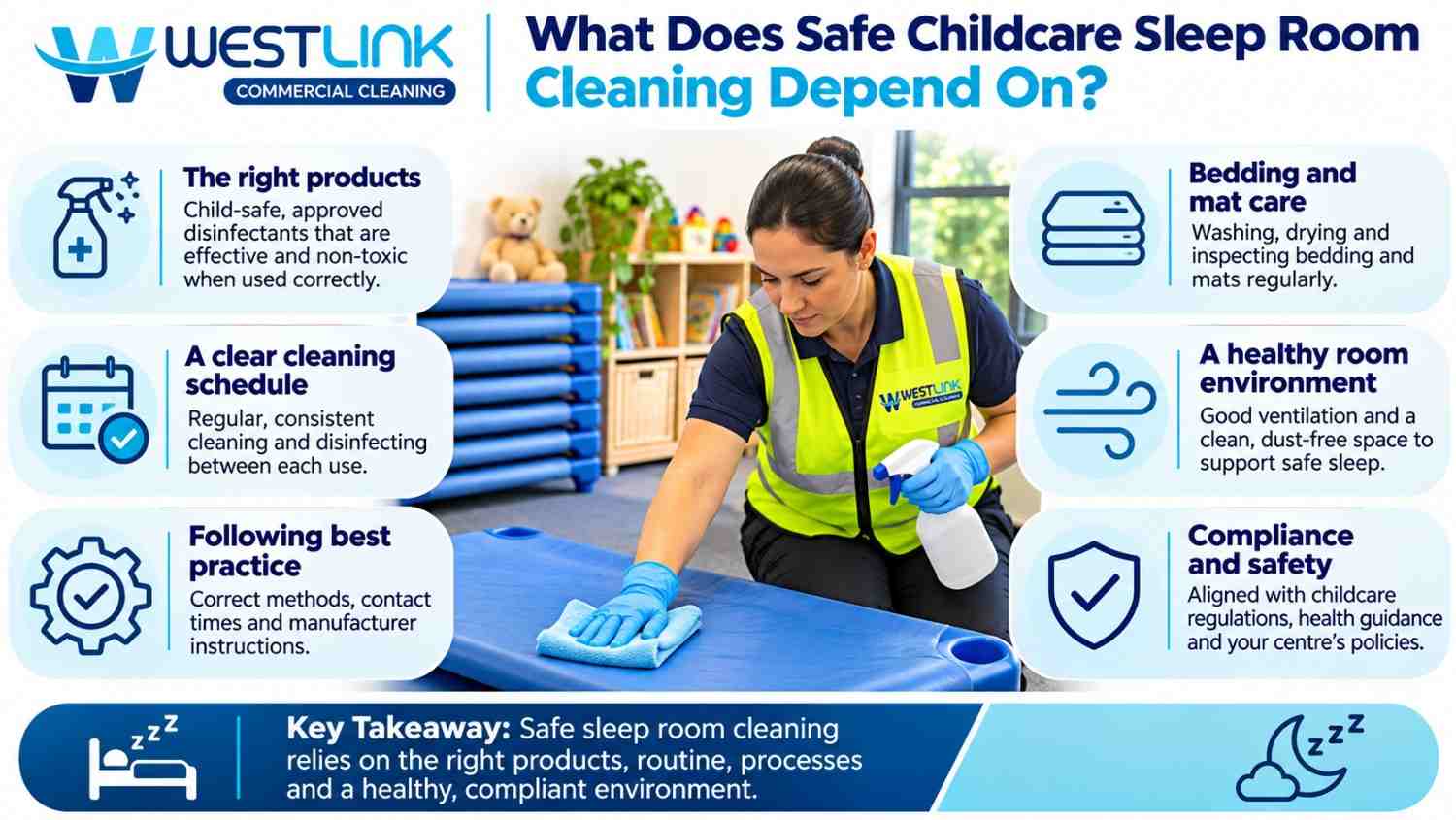
Safe childcare sleep room cleaning depends on the sleeping space, the equipment children use and the procedures educators and cleaners follow working together. Cot frames need daily attention to frequently touched surfaces. Rest mats need methods suited to their materials. Bedding needs hot laundering and separate storage. Body fluid spills need cleaning followed by disinfection. A childcare centre documents these activities in its sleep and rest policy, routine cleaning schedule, equipment inspections and staff records.
Need a written childcare cleaning scope?
Westlink Commercial Cleaning provides childcare cleaning services across Sydney. Ask for a site assessment and a written cleaning scope covering agreed rooms, tasks, frequencies, exclusions and quality checks.
Sources
| Issuer | Document | Edition or date | Supports |
| NHMRC | Staying healthy: A Healthy Environment | 6th edition, 2024 | Schedule, cleaning methods, laundering, carpets, spills, disinfection, outbreaks |
| ACECQA | Safe sleep and rest practices information sheet | Current ACECQA page | Regulations 84A to 84C, 12-month risk assessment |
| ACECQA | Sleep and rest risk assessment template | August 2026 | Matters to consider under regulation 84C |
| NSW Department of Education | Compliance focus: safe sleep requirements | Current NSW page | NSW implementation of the sleep and rest requirements |
| ACECQA | National Quality Standard, element 3.1.2 Upkeep | Current NQS | Safe, clean and well-maintained equipment |
This article uses Australian early childhood education and care guidance as its primary framework. Individual services should also check state or territory requirements, service policies, current public health advice and equipment manufacturer instructions.