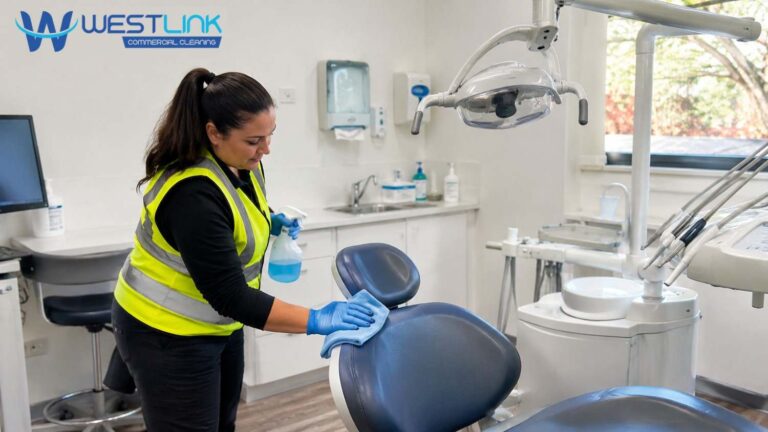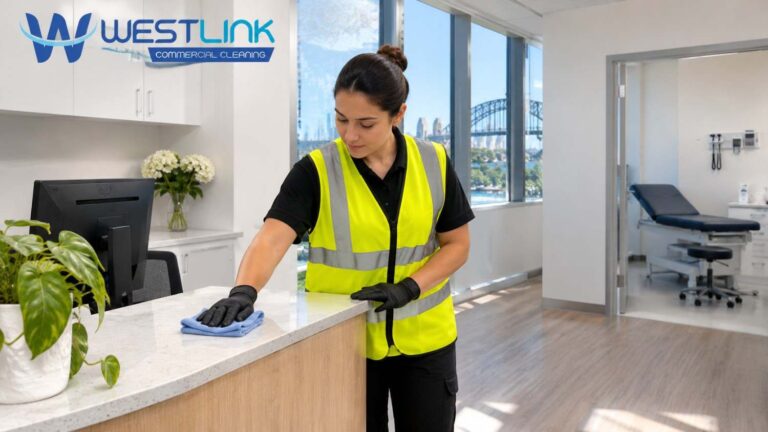
A dental clinic environmental cleaning checklist helps Sydney dental practices maintain hygienic treatment areas, manage cross-contamination risks and document essential cleaning activities. Our team provides professional dental clinic cleaning services across Sydney, NSW, helping local practices keep their surgeries clean, compliant and ready for patients.
Unlike general medical centres, dental surgeries contain treatment chairs, operating lights, instrument trays, suction systems and other clinical contact surfaces that may be exposed to saliva, blood, droplets and splatter during procedures.
These environments require cleaning procedures that distinguish between clinical surface disinfection, between-patient treatment room turnover, instrument reprocessing and routine environmental housekeeping.
This guide provides a practical dental clinic cleaning checklist covering treatment rooms, instrument reprocessing areas, daily cleaning responsibilities, dental-specific infection prevention guidance and cleaning verification.
What Is a Dental Clinic Environmental Cleaning Checklist?
A dental clinic environmental cleaning checklist is a documented set of tasks identifying which dental surgery surfaces require cleaning, the appropriate method, the required frequency and the person responsible.
It forms part of a practice’s broader infection prevention and control (IPC) programme.
A dental-specific checklist should address:
- Clinical contact surfaces: Dental chair controls, light handles, instrument trays and delivery units.
- Instrument reprocessing areas: Contaminated instrument receiving benches, cleaning sinks and clean packaging workstations.
- General environmental surfaces: Floors, reception counters, waiting areas and bathrooms.
- Cleaning procedures: Detergent cleaning, disinfection and protective barrier replacement.
- Verification: Completion records, staff responsibilities and corrective actions.
Environmental cleaning supports infection prevention but does not replace hand hygiene, instrument sterilisation or other clinical IPC procedures.
Dental Treatment Room Cleaning Checklist
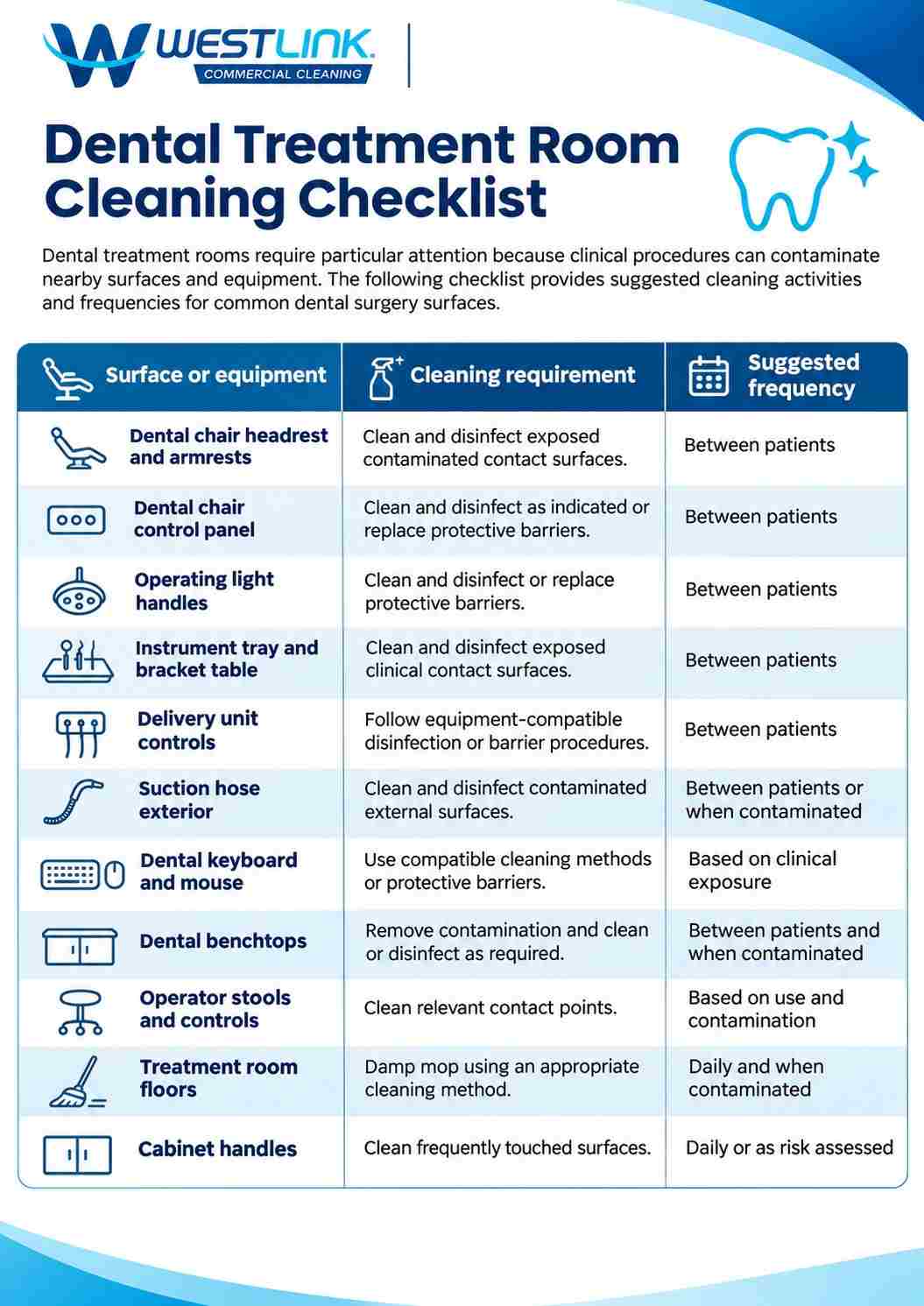
Dental treatment rooms require particular attention because clinical procedures can contaminate nearby surfaces and equipment.
The following checklist provides suggested cleaning activities and frequencies for common dental surgery surfaces.
| Surface or equipment | Cleaning requirement | Suggested frequency |
| Dental chair headrest and armrests | Clean and disinfect exposed contaminated contact surfaces. | Between patients |
| Dental chair control panel | Clean and disinfect as indicated or replace protective barriers. | Between patients |
| Operating light handles | Clean and disinfect or replace protective barriers. | Between patients |
| Instrument tray and bracket table | Clean and disinfect exposed clinical contact surfaces. | Between patients |
| Delivery unit controls | Follow equipment-compatible disinfection or barrier procedures. | Between patients |
| Suction hose exterior | Clean and disinfect contaminated external surfaces. | Between patients or when contaminated |
| Dental keyboard and mouse | Use compatible cleaning methods or protective barriers. | Based on clinical exposure |
| Dental benchtops | Remove contamination and clean or disinfect as required. | Between patients and when contaminated |
| Operator stools and controls | Clean relevant contact points. | Based on use and contamination |
| Treatment room floors | Damp mop using an appropriate cleaning method. | Daily and when contaminated |
| Cabinet handles | Clean frequently touched surfaces. | Daily or as risk assessed |
Clinical contact surfaces generally require more frequent attention than low-touch housekeeping surfaces.
The exact method depends on the surface material, likelihood of contamination, protective barrier arrangements and manufacturer instructions.
How Should Dental Clinics Clean Between Patients?
Between-patient cleaning is one of the most important differences between a dental surgery cleaning checklist and a general medical centre cleaning schedule.
Treatment room turnover should follow the practice’s documented IPC procedures.
Step 1: Remove used instruments and disposable materials.
Trained clinical staff should remove contaminated instruments and disposable items using safe handling procedures.
Reusable instruments must be transferred to the designated reprocessing area. Sharps must be placed in appropriate sharps containers.
Step 2: Remove contaminated protective barriers.
Remove and replace designated barriers on dental chair controls, light handles, keyboards and other protected surfaces as required.
Assess exposed surfaces for contamination and clean or disinfect where indicated.
Step 3: Clean exposed clinical contact surfaces.
Remove visible soil and organic material using an appropriate detergent or a suitable combined cleaning-disinfection product.
Work systematically to reduce cross-contamination between surfaces.
Step 4: Disinfect surfaces where required
Apply a suitable disinfectant according to the product instructions, including the required concentration, application method and contact time.
Ensure the product is compatible with the dental equipment.
Step 5: Prepare and inspect the treatment area
Install fresh protective barriers where required, confirm that clean supplies are available and check that necessary cleaning tasks are complete.
Any unresolved contamination or equipment concern should be addressed before the next patient.
A simple turnover record can include the treatment room number, completion time, responsible staff member and any outstanding issues.
Sterilisation and Instrument Reprocessing Area Cleaning Checklist
Dental instrument reprocessing areas require environmental cleaning procedures that maintain separation between contaminated instruments and clean or sterile items.
These areas commonly contain instrument receiving benches, cleaning sinks, ultrasonic cleaners, washer-disinfectors, packaging workstations, sterilisers and storage cabinets.
| Area or equipment | Environmental cleaning task | Suggested frequency |
| Contaminated instrument receiving bench | Clean and disinfect as indicated. | After processing activities and when contaminated |
| Instrument cleaning sinks | Clean sinks and surrounding surfaces | After use |
| Ultrasonic cleaner exterior | Clean accessible external surfaces | Daily or as required |
| Washer-disinfector exterior | Follow manufacturer cleaning instructions. | As specified |
| Packaging workstation | Maintain a clean preparation surface | Before use when required and whenever contaminated |
| Steriliser exterior | Clean using manufacturer-approved methods | As specified |
| Clean instrument storage cabinets | Clean handles and accessible external surfaces | Daily or as risk assessed |
| Reprocessing room floors | Clean using an appropriate method. | Daily and when contaminated |
Environmental Cleaning vs Instrument Sterilisation
Environmental cleaning and instrument reprocessing are different responsibilities.
Environmental cleaning addresses work surfaces, floors, fixtures and equipment exteriors.
Instrument reprocessing involves procedures such as cleaning, inspection, packaging, sterilisation and appropriate storage of reusable dental instruments.
In Australia, AS/NZS 5369:2023 addresses the reprocessing of reusable medical devices and other devices in healthcare and related settings.
Instrument reprocessing must follow applicable requirements and remain under appropriately trained and authorised personnel.
A general cleaning contractor should not undertake dental instrument sterilisation unless specifically qualified, trained and authorised for those responsibilities.
Daily and Periodic Dental Clinic Cleaning Checklist
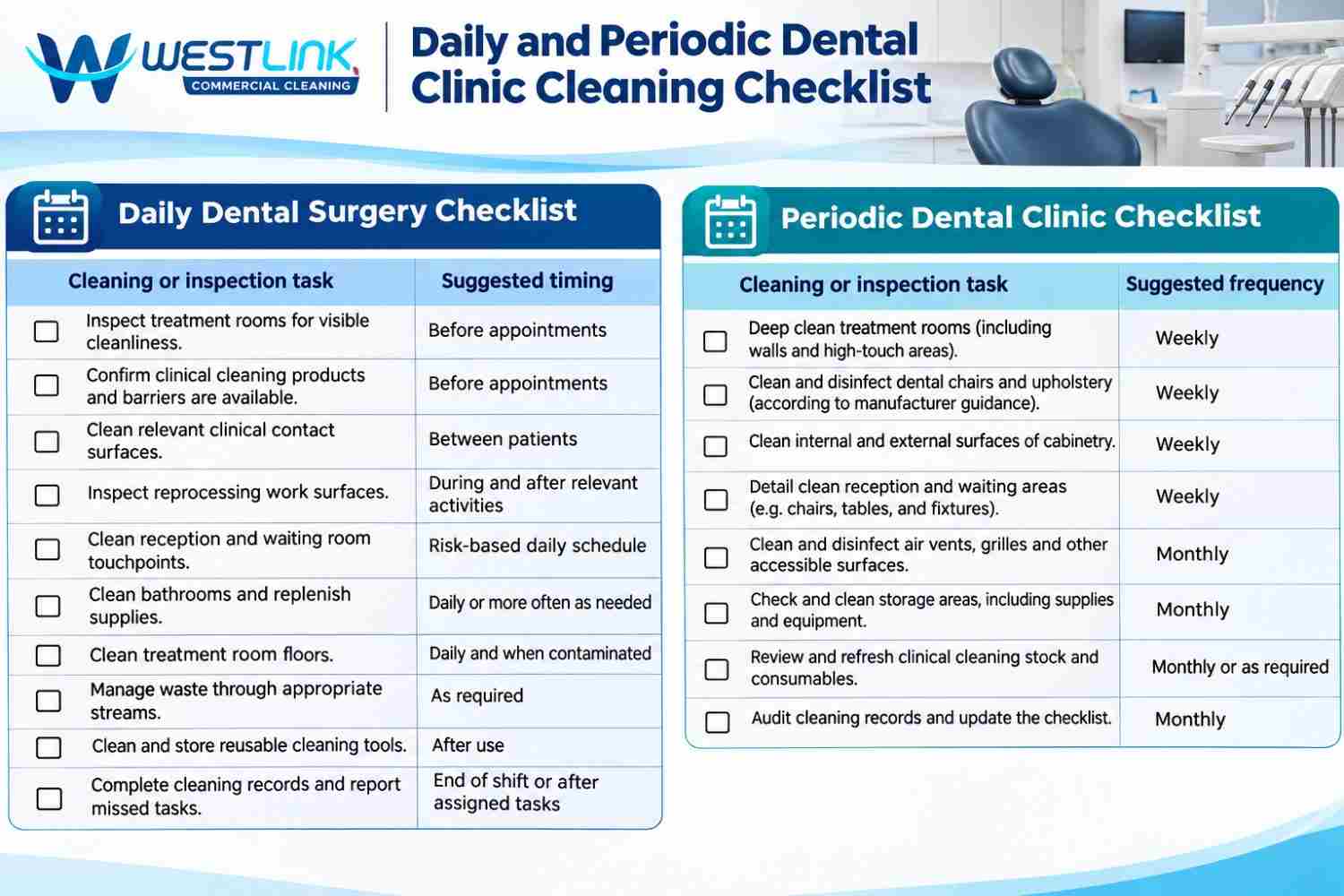
Daily dental surgery cleaning combines general housekeeping with tasks that are specific to the clinical environment.
Between-patient surface management remains a separate requirement throughout the treatment day.
Daily Dental Surgery Checklist
| Cleaning or inspection task | Suggested timing |
| Inspect treatment rooms for visible cleanliness. | Before appointments |
| Confirm clinical cleaning products and barriers are available. | Before appointments |
| Clean relevant clinical contact surfaces. | Between patients |
| Inspect reprocessing work surfaces. | During and after relevant activities |
| Clean reception and waiting room touchpoints | Risk-based daily schedule |
| Clean bathrooms and replenish supplies. | Daily or more often as needed |
| Clean treatment room floors | Daily and when contaminated |
| Manage waste through appropriate streams. | As required |
| Clean and store reusable cleaning tools. | After use |
| Complete cleaning records and report missed tasks. | End of shift or after assigned tasks |
Reception and Bathroom Cleaning
Dental clinic reception areas and bathrooms generally follow risk-based housekeeping procedures similar to those used in other healthcare facilities.
Reception cleaning should cover counters, check-in terminals, seating, door handles, shared equipment and floors.
Bathroom cleaning should cover toilets, basins, taps, dispensers, door handles, waste bins and floors.
Cleaning frequency should reflect patient traffic, usage and contamination risk.
Bathroom cleaning tools should remain separate from equipment used in clinical treatment and clean instrument storage areas.
Weekly and Monthly Cleaning
Periodic cleaning may include:
- Cleaning accessible low-touch shelving, fixtures and cabinet exteriors.
- Removing accumulated dirt from suitable floor edges and corners.
- Inspecting dental chair upholstery and equipment exteriors for damage.
- Checking reusable cleaning tools for wear or contamination.
- Reviewing chemical storage, product labels and available safety information.
- Reviewing incomplete cleaning tasks and corrective actions.
Weekly and monthly intervals are planning categories, not universal regulatory cleaning frequencies.
Contaminated surfaces must be addressed sooner whenever clinical activities or the practice’s risk assessment require it.
Which Cleaning Products Are Suitable for Dental Clinics?
Dental clinics must select cleaning products according to the intended surface, contamination risk, manufacturer instructions and relevant Australian requirements.
Detergent Cleaning
Neutral detergents are commonly used to remove ordinary soil from general environmental surfaces.
Routine detergent cleaning may be suitable for lower-risk housekeeping areas where disinfection is not indicated.
Clinical Surface Disinfectants
Clinical contact surfaces requiring disinfection should be treated with products suitable for the intended application.
Before use, staff should confirm:
- Intended use and relevant regulatory status.
- Effectiveness for the required application.
- Manufacturer-specified contact time.
- Correct dilution and application instructions.
- Compatibility with dental chairs, plastics, upholstery and sensitive equipment.
- Appropriate personal protective equipment and safety precautions.
The Therapeutic Goods Administration (TGA) regulates relevant disinfectants according to their intended use and claims. Not every commercial cleaning product requires inclusion in the Australian Register of Therapeutic Goods.
Dental Equipment Compatibility
Dental chairs, light controls, imaging equipment and delivery systems may contain materials damaged by incompatible cleaning chemicals.
Use products permitted by equipment manufacturers and the practice’s IPC procedures.
Combined detergent-disinfectant products may be suitable where their instructions support the intended cleaning and disinfection process.
Substantial visible soil may still require separate preliminary cleaning.
Staff should also follow relevant Safety Data Sheets and workplace chemical handling procedures.
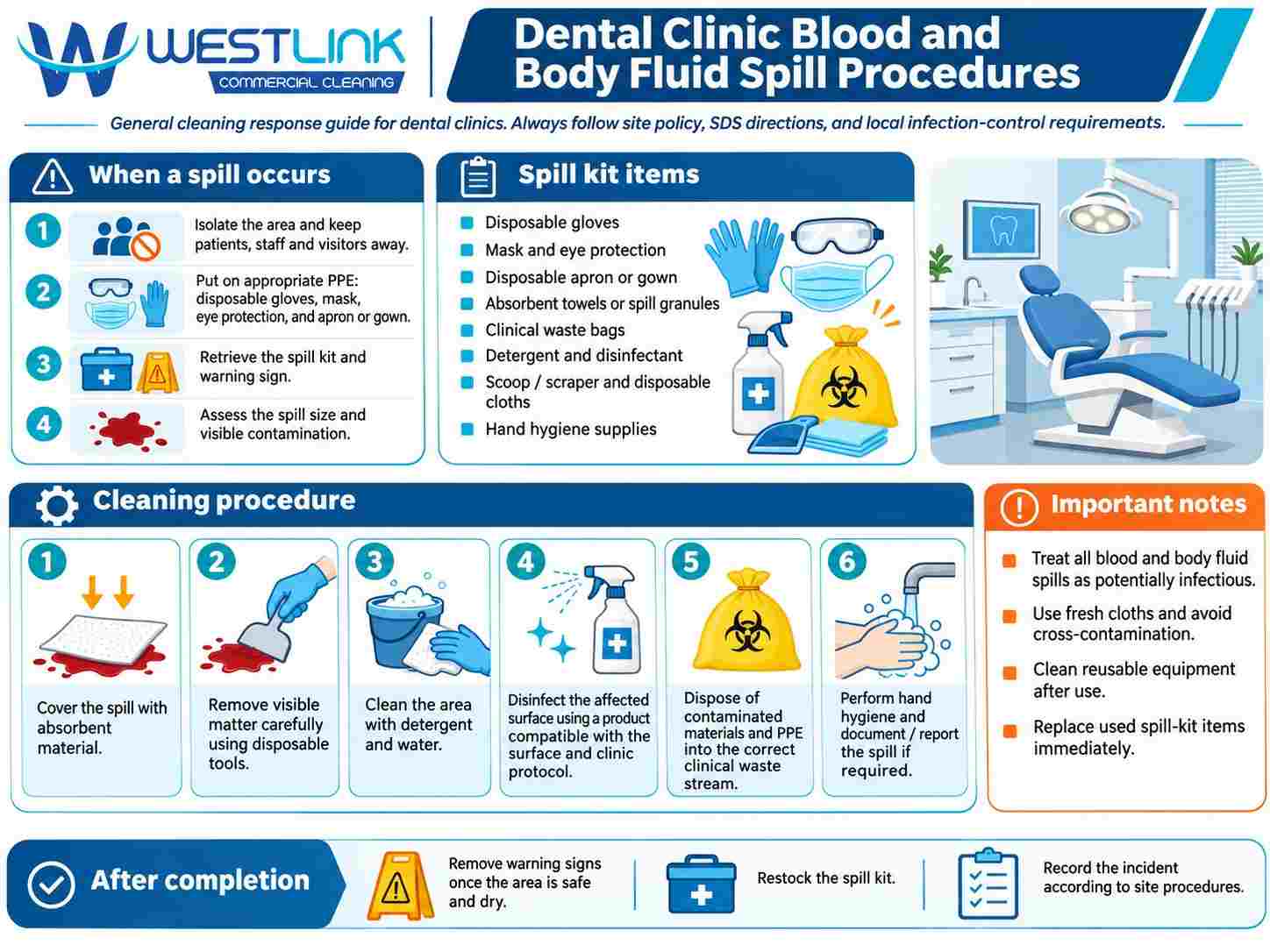
Dental Clinic Blood and Body Fluid Spill Procedures
Dental procedures may generate spills or contamination involving blood and other body fluids.
Such incidents require a documented biological spill-response process rather than an ordinary housekeeping routine.
The practice’s procedure should address:
- Restricting access to the contaminated area.
- Assessing biological and sharps hazards.
- Using appropriate personal protective equipment.
- Safely containing and removing spill material.
- Cleaning and disinfecting affected surfaces as indicated.
- Following disinfectant contact time instructions.
- Disposing of contaminated materials appropriately.
- Performing hand hygiene and documenting the incident where required.
Staff must not directly handle contaminated sharps during spill cleanup.
Only trained and authorised personnel should perform spill-response tasks within their assigned responsibilities.
Dental Clinic Cleaning Requirements in Sydney and NSW
Sydney dental practices should develop environmental cleaning procedures that reflect applicable professional obligations, infection prevention guidance and workplace requirements.
Several authoritative Australian resources are particularly relevant.
Dental Board of Australia
The Dental Board of Australia sets professional expectations for registered dental practitioners, including infection prevention and control.
Dental professionals should refer to current Board guidance when establishing practice-specific IPC procedures.
Australian Dental Association Guidelines
The Australian Dental Association Infection Control Library provides dental-specific IPC guidance, including the Guidelines for Infection Prevention and Control, Fifth Edition – Amended and environmental cleaning resources.
These materials help dental practices distinguish clinical surface management from general housekeeping and other infection prevention activities.
AS/NZS 5369:2023
AS/NZS 5369:2023 addresses reusable medical device reprocessing.
It is relevant to dental instrument reprocessing, which must be distinguished from routine environmental cleaning.
NSW Health Environmental Cleaning Guidance
NSW Health policy PD2023_018, Cleaning of the Healthcare Environment, establishes requirements for facilities and organisations within its defined NSW Health scope.
Private dental clinics can consult relevant NSW Clinical Excellence Commission environmental cleaning guidance, but should not assume that every public healthcare policy requirement automatically applies to their practice.
Dental clinics must also manage relevant NSW work health and safety risks, including chemical exposure, biological contamination, sharps and cleaning equipment.
Who Is Responsible for Dental Clinic Cleaning?
Dental practice cleaning responsibilities should be assigned according to staff competency, contamination risk and clinical duties.
| Cleaning activity | Typical responsible personnel |
| Between-patient dental chair and treatment surface cleaning | Trained dental assistant or clinical staff |
| Instrument reprocessing | Authorised clinical or reprocessing personnel |
| Instrument reprocessing area environmental cleaning | Appropriately trained and authorised staff |
| Reception and waiting room cleaning | Designated cleaner or support staff |
| Bathroom and general floor cleaning | Designated cleaning personnel |
| Clinical waste handling | Trained authorised personnel |
| Dental unit waterline maintenance | Trained designated personnel |
| Cleaning performance review | Practice manager or assigned IPC lead |
An external cleaning provider may assist with agreed environmental cleaning activities, including designated clinical areas where staff are appropriately trained and authorised.
However, the practice retains responsibility for ensuring its infection prevention arrangements are appropriately managed.
Clinical instrument reprocessing and specialised equipment maintenance should not be assigned to untrained general cleaners.
How Should Dental Practices Document and Audit Cleaning?
Dental clinic cleaning records should show which tasks were completed, who performed them and whether any issues require corrective action.
A practical cleaning log may use the following format.
| Date/time | Area | Task | Staff initials | Issue or corrective action |
| ____ | Treatment room | Clinical surface cleaning | ____ | ____ |
| ____ | Reprocessing room | Work surface cleaning | ____ | ____ |
| ____ | Reception | High-touch surface cleaning | ____ | ____ |
| ____ | Bathroom | Scheduled cleaning | ____ | ____ |
| ____ | Shared area | Floor cleaning | ____ | ____ |
Dental Cleaning Audit Checklist
A dental practice manager or assigned IPC lead can review:
- Completion of required between-patient cleaning tasks.
- Appropriate cleaning and disinfection of clinical contact surfaces.
- Correct replacement and management of protective barriers.
- Separation of clean and contaminated work areas.
- Proper use of products and contact times.
- Cleaning equipment condition and storage.
- Accuracy of cleaning records.
- Follow-up of previously identified deficiencies.
Visual inspections help identify missed cleaning and visible contamination, but cannot independently establish microbiological cleanliness.
Where a practice uses fluorescent markers or ATP monitoring, results should be assessed according to the method’s limitations and the practice’s evaluation procedures.
When Should Sydney Dental Clinics Use Professional Cleaning Services?
Professional dental clinic cleaning services can support general environmental cleaning, scheduled housekeeping and agreed periodic cleaning tasks.
External services may be useful for practices requiring after-hours cleaning, structured documentation or routine support across several treatment and shared areas.
Before selecting a provider, confirm:
- Experience with dental or comparable healthcare environments.
- Appropriate staff training and cleaning procedures.
- Clearly defined clinical and non-clinical cleaning responsibilities.
- Suitable products and equipment.
- Agreed cleaning frequencies and access arrangements.
- Appropriate documentation, inspection and reporting.
- Clear exclusions for clinical tasks and specialised equipment.
Dental and Medical Cleaning Services in Sydney
Westlink Commercial Cleaning’s medical cleaning services in Sydney offer a starting point for practices seeking professional support with agreed environmental cleaning tasks.
Dental practice managers should prepare a cleaning scope covering treatment room numbers, reception spaces, bathrooms, operating hours, required frequencies and any site-specific infection prevention arrangements.
A site-specific assessment can help establish which tasks belong in the cleaning contract and which must remain with the clinical team.
Frequently Asked Questions
How Often Should a Dental Chair Be Cleaned?
Dental chair clinical contact surfaces should be appropriately managed between patients using cleaning, disinfection or protective barriers, depending on the surface, contamination risk and practice procedures.
Do Dental Light Handles Need Disinfection After Each Patient?
Dental light handles are clinical contact surfaces. They require appropriate between-patient cleaning and disinfection or protective barrier management, in accordance with the practice’s IPC procedures and equipment instructions.
Is Dental Instrument Sterilisation Part of General Cleaning?
No. Dental instrument reprocessing is a separate clinical process that includes appropriate cleaning, inspection, sterilisation and related procedures.
It must be performed by appropriately trained and authorised personnel.
Can Professional Cleaners Clean Dental Treatment Rooms?
Trained and authorised cleaners may perform designated environmental cleaning tasks in dental treatment rooms.
Clinical surface decontamination responsibilities and specialised procedures must be clearly allocated in the practice’s IPC program.
Do Private Dental Clinics Have to Follow NSW Health Policy PD2023_018?
The policy applies within its defined NSW Health scope and is not automatically mandatory for every private dental clinic.
Private practices must meet their applicable professional, legal and workplace requirements while using relevant guidance to inform their procedures.
What Should a Dental Clinic Cleaning Audit Check?
A dental clinic cleaning audit should review clinical surface cleaning, protective barrier management, task completion, cleaning methods, documentation, staff responsibilities and corrective actions.
Conclusion
A dental clinic environmental cleaning checklist helps Sydney practices maintain structured cleaning procedures for treatment rooms, instrument reprocessing areas and general facilities.
Effective dental clinic cleaning requires particular attention to between-patient surface management, equipment-compatible disinfection, protective barriers and clear separation between environmental cleaning and clinical instrument reprocessing.
Practices should align their cleaning procedures with current ADA guidance, Dental Board of Australia expectations, applicable NSW requirements and equipment manufacturer instructions.
Clear staff responsibilities, appropriate training and routine cleaning audits help maintain consistent environmental hygiene practices.
For professional assistance with scheduled environmental cleaning, Sydney dental practices can explore Westlink Commercial Cleaning’s medical cleaning services.
Authoritative References
- Australian Dental Association — Infection Control Library
- Dental Board of Australia — Codes and Guidelines
- Standards Australia — AS/NZS 5369:2023
- NSW Clinical Excellence Commission — Environmental Cleaning
- Therapeutic Goods Administration — Regulation of Cleaners and Disinfectants
- SafeWork NSW — Hazardous Chemicals
Practice note: This checklist provides general environmental cleaning guidance. Dental practices must adapt it to their own infection prevention procedures, clinical risk assessments, applicable obligations and manufacturer instructions. A suitably qualified practitioner should review practice-specific clinical procedures before implementation.