A medical centre cleaning checklist is a documented task register that names each surface, its frequency, its method and the person responsible. The daily checklist covers frequently touched surfaces, patient care areas, bathrooms, waste and floors. The weekly checklist covers lower-touch surfaces and fixtures, and the monthly checklist covers deep cleaning and audits. Cleaning frequency depends on surface contact, infection risk level, patient traffic and clinical activity. Neutral detergent and water handle routine cleaning, and an ARTG-listed disinfectant follows between patients and after contamination. Cleaning records separate the completion record, the supervisor inspection, the incident record and the internal audit. Trained personnel manage blood spills and clinical waste, and ordinary cleaners do not. As of 19 November 2026, accreditation under the National General Practice Accreditation Scheme still uses the RACGP 5th edition Standards, although the 6th edition is published.
What is a medical centre cleaning checklist?
A medical centre cleaning checklist is a documented task register that plans, performs and verifies environmental cleaning, naming each surface, its frequency, its method and the person responsible. The Royal Australian College of General Practitioners (RACGP) states that a practice must have a cleaning schedule that cleans the premises systematically and appropriately (RACGP: Scheduled cleaning). A practice manager uses the completed register to find missed tasks.
The checklist suits Sydney GP clinics, specialist practices and other primary healthcare facilities. Every frequency in this post is an illustrative starting point. Each medical centre sets its final frequencies from its own risk assessment, and a checklist alone does not certify or guarantee accreditation.
What does a one-page medical centre cleaning checklist look like?
A one-page medical centre cleaning checklist gives every task a frequency, a responsible role, a method and a sign-off box. The sample below is an illustrative layout, not a prescribed national standard.
| Task | Frequency | Responsible role | Method | Sign-off |
| Reception counter and check-in desk | Daily, more often than not, by risk | Assigned cleaner | Neutral detergent and water | ☐ |
| Consultation room door handles | At least daily | Assigned cleaner | Neutral detergent and water, damp wipe | ☐ |
| Examination couch | After each patient | Clinical team | Detergent clean, then ARTG-listed disinfectant | ☐ |
| Treatment bench | After each procedure, plus daily | Trained clinical staff | Detergent clean, then ARTG-listed disinfectant | ☐ |
| Toilet door handles | Twice daily, and after use by a patient with a suspected relevant infection | Assigned cleaner | Neutral detergent and water, wipe | ☐ |
| Lower-touch shelving and ledges | Weekly where appropriate | Assigned cleaner | Neutral detergent and water | ☐ |
| Cleaning equipment inspection | Monthly, as an example | Supervisor | Condition and contamination-control check | ☐ |
A working register also records the date, time, location, product used, exceptions, inspection outcome and corrective action for each row. The records section below sets out those fields.
What areas does a medical centre cleaning checklist cover?
A medical centre cleaning checklist covers five areas: reception and waiting rooms, consultation and examination rooms, treatment and procedure rooms, bathrooms and amenities, and waste and cleaning equipment.
The five areas are listed below:
- Reception and waiting rooms: counters, seating, door handles and shared touchpoints.
- Consultation and examination rooms: examination couches, worktops, sinks and patient-contact surfaces.
- Treatment and procedure rooms: clinical work surfaces, treatment trolleys and equipment exteriors.
- Bathrooms and amenities: toilets, basins, taps, dispensers and floors.
- Waste and cleaning equipment: waste segregation, bins, cleaning tools and storage areas.
What should a daily medical centre cleaning checklist include?
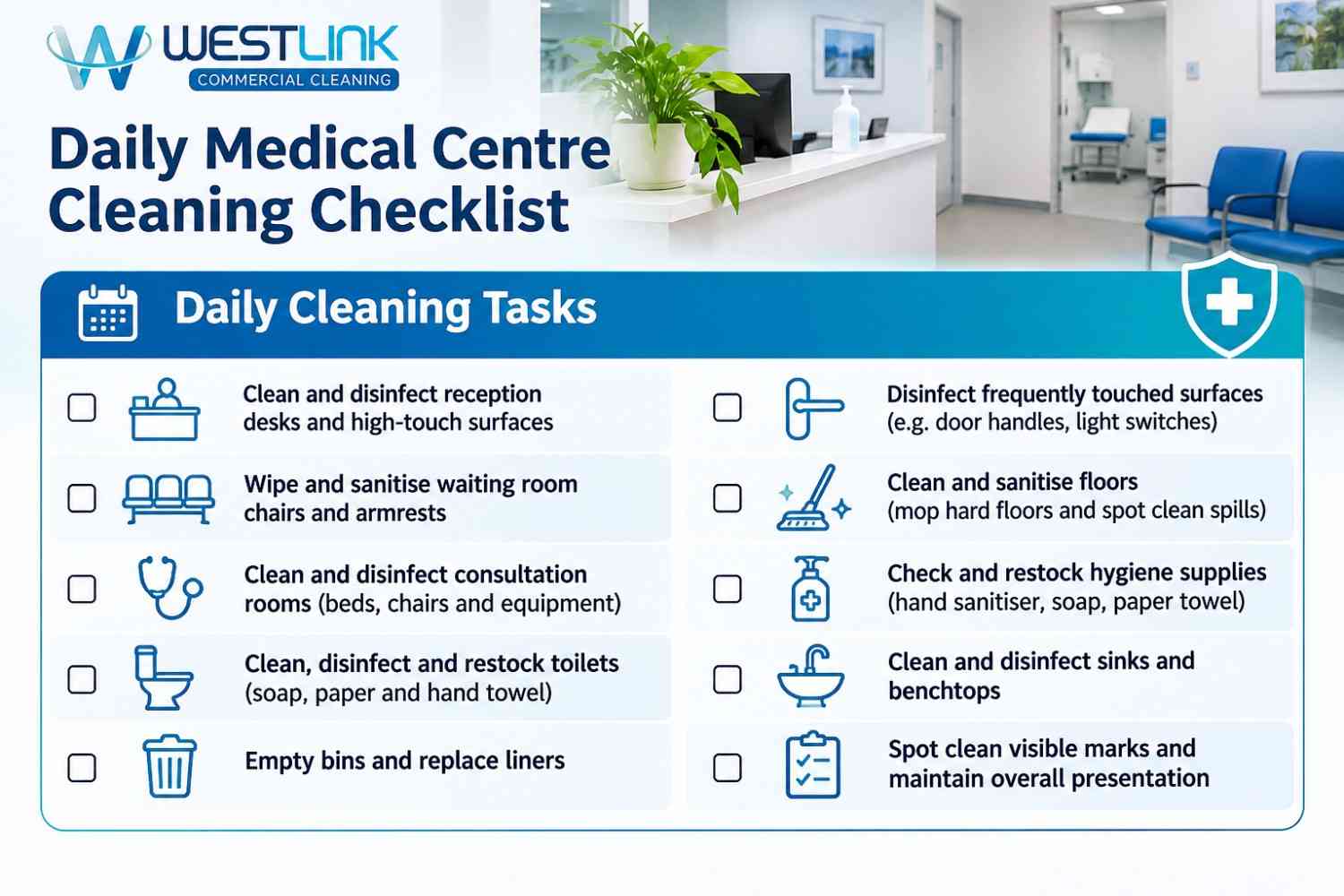
A daily medical centre cleaning checklist covers frequently touched surfaces, patient care areas, bathrooms, waste and floors. RACGP guidance says to clean frequently touched surfaces at least daily and to clean twice daily or more often during an outbreak, as health authorities advise. Cleaners clean any visibly dirty surface straight away, whatever the schedule says.
What does the daily reception and waiting room checklist include?
The daily reception and waiting room checklist covers frequently touched objects, shared devices, bins, floors and visible contamination. Patients, visitors and administrative staff share the reception area, so the schedule targets touchpoints first.
The daily reception and waiting room tasks are listed below:
- Clean reception counters and check-in desks.
- Wipe door handles, push plates and light switches.
- Clean waiting room chairs, armrests and tables.
- Clean shared EFTPOS terminals, touchscreens and keyboards with compatible products.
- Check hand sanitiser dispensers and replenish supplies.
- Empty general waste bins and replace liners.
- Vacuum or damp-mop floors on the medical centre’s risk-based schedule.
- Remove visible marks from entrance doors and glass.
- Inspect waiting areas for spills and contamination.
High-traffic waiting areas need additional cleaning during the day.
What does the daily consultation and examination room checklist include?
The daily consultation and examination room checklist covers patient-contact surfaces, handwashing facilities, supplies, waste and floors. Patient-contact surfaces need regular cleaning and, where indicated, cleaning between patients.
The daily consultation and examination room tasks are listed below:
- Clean examination couches and reusable patient seating.
- Clean desks, worktops and other frequently touched surfaces.
- Wipe cabinet handles, door handles and light switches.
- Clean handwashing sinks and tap fittings.
- Replenish soap, hand sanitiser and paper towels.
- Empty appropriate waste containers.
- Clean floors on the documented schedule.
- Check for visible blood or body fluid contamination.
Clinical staff clean shared diagnostic equipment, such as blood pressure cuffs, thermometers and stethoscopes, following the manufacturer’s instructions and the medical centre’s infection prevention procedures.
What does the daily treatment room checklist include?
The daily treatment room checklist covers treatment surfaces, equipment exteriors, clinical waste receptacles, hand hygiene areas and incident records. The Australian Commission on Safety and Quality in Health Care (ACSQHC) lists outpatient clinics with treatment or procedural rooms as high infection risk, so treatment rooms need more intensive controls than consulting rooms (ACSQHC: Environmental cleaning, information for cleaners).
The daily treatment room tasks are listed below:
- Clean treatment tables and procedure chairs.
- Clean treatment trolley surfaces.
- Clean preparation benches and worktops.
- Clean frequently touched equipment exteriors.
- Inspect clinical waste receptacles.
- Check sharps container fill levels without handling the contents.
- Clean sinks and hand hygiene areas.
- Clean floors with the approved method.
- Record contamination incidents and completed cleaning tasks.
Reusable medical device reprocessing is a separate clinical procedure. Reprocessing follows the applicable reprocessing requirements, not the environmental cleaning checklist.
What does the daily bathroom checklist include?
The daily bathroom checklist covers toilets, basins, door fittings, dispensers, supplies, waste bins and floors. The RACGP example schedule cleans toilet door handles twice daily, and again after use by a patient with a suspected relevant infection.
The daily bathroom tasks are listed below:
- Clean toilet bowls, seats, lids and flush buttons.
- Clean washbasins, taps and surrounding surfaces.
- Wipe door handles, locks and grab rails.
- Clean soap and paper towel dispenser exteriors.
- Replenish soap, paper towels and toilet tissue.
- Empty sanitary and general waste bins using appropriate procedures.
- Damp mop bathroom floors.
- Check for leaks, spills and persistent odours.
The bathroom schedule scales with patient numbers and toilet usage.
What should a weekly medical centre cleaning checklist include?
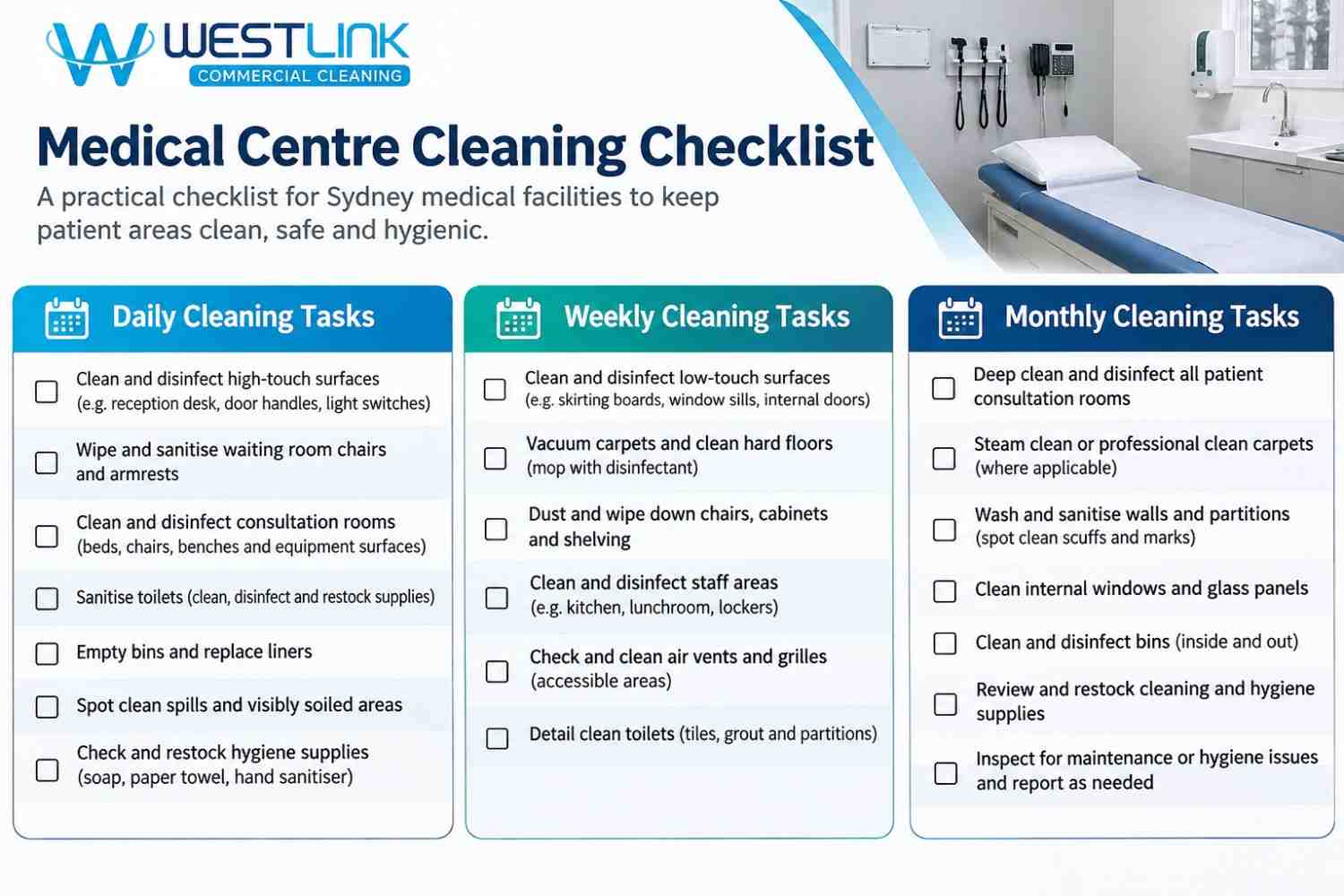
A weekly medical centre cleaning checklist covers detailed cleaning of lower-touch surfaces, furniture, fixtures, storage areas and cleaning equipment. Weekly tasks complement daily cleaning and never replace more frequent cleaning that the medical centre’s risk assessment requires. The table below is illustrative.
| Area | Suggested weekly cleaning task |
| Reception | Clean accessible shelving, brochure holders and furniture edges. |
| Waiting rooms | Detail-clean chairs and suitable upholstery. |
| Consultation rooms | Clean skirting boards, door frames and accessible ledges. |
| Treatment rooms | Clean lower-touch surfaces and accessible cupboard exteriors. |
| Bathrooms | Detail-clean accessible grout, splash zones and fixtures. |
| Offices | Clean non-clinical workstations and storage surfaces. |
| Floors | Clean edges, corners and accessible areas beneath furniture. |
| Cleaning equipment | Inspect mop heads, buckets, trolleys and storage conditions. |
| Waste storage | Clean accessible waste storage surfaces and inspect waste segregation. |
A practice manager reviews the weekly cleaning log to confirm completion of assigned tasks and to document corrective actions.
What should a monthly medical centre cleaning checklist include?
A monthly medical centre cleaning checklist covers scheduled deep cleaning, cleaning equipment inspections, product reviews and cleaning performance audits. Monthly tasks cover the maintenance and quality assurance work that daily cleaning does not reach. Monthly cleaning is a planning category, not a universal standard, so higher-risk areas need some of these tasks more often.
| Area | Suggested monthly task |
| Floors | Perform detailed cleaning and assess floor finish condition. |
| Furniture | Clean accessible furniture undersides and concealed surfaces. |
| Windows | Clean internal glass and reachable window ledges. |
| Storage rooms | Detail-clean accessible shelving and storage surfaces. |
| Ventilation | Clean accessible external grilles where permitted and safe. |
| Cleaning equipment | Inspect condition, maintenance needs and replacement requirements. |
| Cleaning chemicals | Review stock, labels, expiry dates and Safety Data Sheets. |
| Waste management | Review waste segregation procedures and contractor arrangements. |
| Cleaning records | Audit task completion, incidents and outstanding actions. |
| Staff competency | Review cleaning instructions and identify training needs. |
How often should each area of a Sydney medical centre be cleaned?
Cleaning frequency depends on surface contact, infection risk level, patient traffic and clinical activity. ACSQHC separates frequently touched surfaces, which need cleaning daily or more often, from minimally touched surfaces such as floors, walls and administrative areas, which need cleaning daily or less often as the schedule sets. Both categories need cleaning immediately after spills or contamination with blood or body fluids.
ACSQHC also gives examples of infection risk levels by area, which a medical centre uses to rank its own rooms.
| Area | ACSQHC example risk level |
| Outpatient clinics with treatment or procedural rooms | High |
| Outpatient clinic consulting rooms and ambulatory care | Medium |
| Offices in patient and clinical areas | Medium |
| Office and administration areas | Low |
The table below marks the basis of each frequency, so a reader can tell guidance from the illustration. The infection prevention and control (IPC) coordinator approves the final frequency for each area.
| Surface or area | Suggested frequency | Basis |
| Frequently touched surfaces (door handles, light switches, taps, handrails) | Daily or more often | ACSQHC guidance |
| Patient areas and patient equipment | After each patient use, and immediately after contamination or spills | ACSQHC guidance |
| Consultation room door handles | Daily, with detergent and water | RACGP example schedule |
| Toilet door handles | Twice daily, and after use by a patient with a suspected relevant infection | RACGP example schedule |
| Frequently touched surfaces during an outbreak | Twice daily or more often, as health authorities advise | RACGP guidance |
| Floors, walls and administrative areas | Daily or less often, as the schedule sets | ACSQHC guidance |
| Treatment benches | Daily, and after procedures or contamination | Illustrative suggestion |
| Lower-touch ledges and skirting boards | Weekly where appropriate | Illustrative suggestion |
| Detailed floor maintenance | Monthly, or as assessed | Illustrative suggestion |
| Cleaning audits | At planned intervals | Medical centre policy decision |
Who cleans what in a medical centre: clinical staff or cleaners?
A responsibility matrix assigns each cleaning task to one role: the clinical team, an assigned cleaner, a supervisor, a specialist contractor or the IPC coordinator. The RACGP guidelines ask each practice to name its IPC coordinator and the staff member who implements the cleaning policy (RACGP: Policy and responsibilities). The matrix below is a suggested allocation, and each medical centre records its final assignments in its own schedule.
| Task | Suggested owner | Reason |
| Between-patient cleaning of couches and shared equipment | Clinical team | The task happens during consultations, before an after-hours cleaner arrives. |
| Daily cleaning of reception, bathrooms and floors | Assigned cleaner, in-house or contracted | The task is routine environmental cleaning. |
| Blood and body fluid spill response | Trained staff following the documented procedure | The task needs specific training, equipment and authorisation. |
| Reusable medical device reprocessing | Clinical team, under reprocessing requirements | The task is a clinical procedure, not environmental cleaning. |
| Sharps container checks and clinical waste handling | Trained clinical staff | Cleaners never retrieve or compress sharps by hand. |
| Log sign-off and inspections | Supervisor or practice manager | The role separates doing the task from checking the task. |
| Approval of frequencies and products | IPC coordinator | The role holds responsibility for infection prevention decisions. |
Ordinary cleaning staff do not carry out clinical waste or spill-handling duties beyond their training, documented role and authorisation.
What cleaning methods and products should a medical centre use?
A medical centre cleans with neutral detergent and water first, then adds an ARTG-listed disinfectant between patients and after contamination. ACSQHC states that a disinfectant is always needed on surfaces and equipment between patients, even when the surface looks clean. Disinfectants used on hard surfaces in healthcare must be listed on the Australian Register of Therapeutic Goods (ARTG), and neutral detergents need no ARTG listing (ACSQHC fact sheet).
Not every surface needs disinfectant every day. NSW Health’s cleaning policy for its own facilities recommends routine disinfectant only in extreme-risk areas and during outbreak or cluster management (CEC: ECSOP Module 4).
| Step | Purpose | When it applies | Product |
| Neutral detergent cleans. | Physically removes dirt, dust, blood, body fluids and germs | All routine cleaning | Neutral detergent and water |
| Disinfection | Inactivates germs on a cleaned surface | Between patients, after contamination, during outbreaks and where risk assessment indicates | ARTG-listed disinfectant, used to the label |
| Combined clean and disinfect | Completes both steps in one wipe | Where the site procedure approves a combined product | Detergent –disinfectant product |
The cleaning method follows the steps below:
- Clean the surface with neutral detergent and water, wiping in an S-shaped motion.
- Let the surface dry completely.
- Disinfect with an ARTG-listed product where the table above calls for disinfection.
- Let the surface dry completely again.
Cleaners follow the product label for surface compatibility, dilution, application and wet contact time. Cleaners never mix cleaning chemicals unless the manufacturer explicitly permits it.
The cleaning supplies of a medical centre may include the items below:
- Neutral detergent and suitable cleaning solutions.
- ARTG-listed disinfectants where indicated.
- Microfibre or disposable cleaning cloths.
- Separate or colour-coded cleaning equipment to limit cross-contamination.
- Appropriate mops and buckets.
- HEPA-filtered vacuum cleaners where suitable.
- Protective gloves and other task-specific PPE.
- Clearly labelled cleaning chemicals.
- Spill response equipment.
How do you keep medical centre cleaning records?
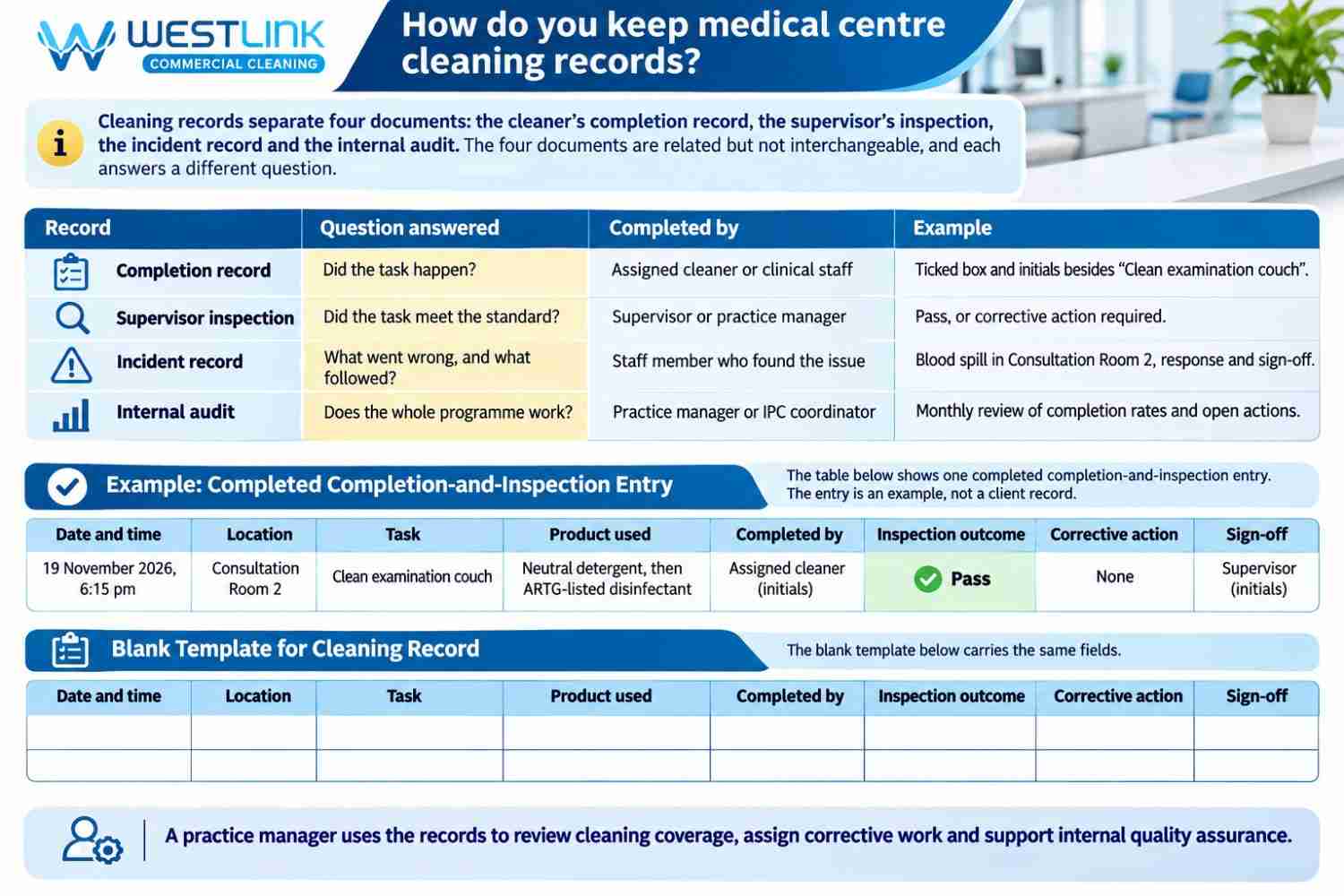
Cleaning records separate four documents: the cleaner’s completion record, the supervisor’s inspection, the incident record and the internal audit. The four documents are related but not interchangeable, and each answers a different question.
| Record | Question answered | Completed by | Example |
| Completion record | Did the task happen? | Assigned cleaner or clinical staff | Ticked box and initials besides “Clean examination couch” |
| Supervisor inspection | Did the task meet the standard? | Supervisor or practice manager | Pass, or corrective action required. |
| Incident record | What went wrong, and what followed? | Staff member who found the issue | Blood spill in Consultation Room 2, response and sign-off |
| Internal audit | Does the whole programme work? | Practice manager or IPC coordinator | Monthly review of completion rates and open actions |
The table below shows one completed completion-and-inspection entry. The entry is an example, not a client record.
| Date and time | Location | Task | Product used | Completed by | Inspection outcome | Corrective action | Sign-off |
| 19 November 2026, 6:15 pm | Consultation Room 2 | Clean examination couch | Neutral detergent, then ARTG-listed disinfectant | Assigned cleaner (initials) | Pass | None | Supervisor (initials) |
The blank template below carries the same fields.
| Date and time | Location | Task | Product used | Completed by | Inspection outcome | Corrective action | Sign-off |
A practice manager uses the records to review cleaning coverage, assign corrective work and support internal quality assurance.
How should a medical centre manage blood spills and clinical waste?
Trained personnel manage blood and body fluid spills promptly, under the medical centre’s documented infection prevention procedure. Staff restrict access to the contaminated area, select appropriate PPE, follow the approved spill management process and document reportable incidents.
Cleaning contractors do not carry out specialised clinical spill responses unless they hold the required training, equipment and authorisation.
Clinical waste management separates general waste, infectious waste, sharps and other regulated waste categories. Sharps go into approved puncture-resistant containers, and staff never retrieve or compress discarded sharps by hand.
What cleaning requirements apply to Sydney medical centres?
Sydney medical centres follow risk-based cleaning procedures drawn from RACGP and national guidance, and the NSW Health cleaning policy binds NSW public health organisations. Four sources of guidance and obligation apply.
The four sources are listed below:
- RACGP Infection Prevention and Control Guidelines: the guidelines give practical recommendations for general practices and other office-based healthcare facilities, covering scheduled cleaning, methods, spills, waste management and monitoring.
- ACSQHC and NHMRC guidance: ACSQHC publishes the environmental cleaning risk levels and frequencies used in this post, and the National Health and Medical Research Council (NHMRC) publishes the Australian Guidelines for the Prevention and Control of Infection in Healthcare.
- NSW Health Cleaning of the Healthcare Environment policy: Policy Directive PD2023_018, published on 3 August 2023, requires NSW public health organisations to run routine environmental cleaning programmes (PD2023_018).
- Work Health and Safety requirements: a medical centre maintains chemical labelling, Safety Data Sheets, equipment training and PPE procedures to protect cleaning workers.
PD2023_018 directly addresses NSW Health organisations. A privately operated Sydney GP clinic does not assume that every requirement of the directive applies to its business and assesses its own legal, accreditation and clinical obligations instead.
Which RACGP standard edition applies to accreditation in 2026?
As of 19 November 2026, accreditation under the National General Practice Accreditation (NGPA) Scheme still uses the 5th edition of the RACGP Standards for general practices. The RACGP released the 6th edition on 26 August 2026. ACSQHC encourages general practices to begin implementing the 6th edition and will publish transition arrangements in due course (ACSQHC: RACGP Standards 6th edition). A cleaning checklist supports a medical centre’s infection prevention system, and the checklist alone does not certify accreditation.
How do you put a medical centre cleaning checklist into practice?
A Sydney medical centre puts the checklist into practice in six steps, from risk assessment to monthly review. ACSQHC asks each workplace to identify high-risk and low-risk areas, train staff, and develop a cleaning schedule that the cleaning team receives.
The six steps are listed below:
- Rank each room by infection risk with the IPC coordinator, using the ACSQHC example levels.
- List every surface and set a frequency for each, marking the basis of each frequency.
- Assign one owner to each task with the responsibility matrix.
- Set the method and product for each task, check the ARTG listing of each disinfectant, and train the staff who use them.
- Start the cleaning log, and book the supervisor inspection and the monthly audit.
- Review the log monthly, record corrective actions and adjust frequencies when risk changes.
When should a Sydney medical centre hire a professional cleaning service?
A Sydney medical centre hires a professional cleaning service when routine environmental cleaning needs dedicated staff, specialised equipment or after-hours scheduling. Professional services commonly cover reception areas, bathrooms, floors, office spaces and other agreed environmental surfaces.
Before engaging a contractor, a medical centre confirms the points below:
- The exact clinical and non-clinical areas that the service covers.
- The cleaning frequencies and after-hours availability.
- The staff training in healthcare environmental cleaning.
- The cleaning products, including the ARTG listing of each disinfectant.
- The responsibility for clinical equipment and specialised tasks.
- The cleaning documentation, inspections and corrective actions.
- The insurance, worker safety procedures and contractual responsibilities.
A written service agreement separates ordinary environmental cleaning from clinical responsibilities such as medical device reprocessing, sharps handling and specialised waste management.
Westlink scopes medical centre cleaning from the checklist and risk ranking above. To discuss a scope for a Sydney clinic, see medical centre cleaning services in Sydney or request a medical cleaning quote.
What affects medical centre cleaning cost in Sydney?
Medical centre cleaning cost in Sydney depends on the size of the centre, cleaning frequency, operating hours, room types and the agreed scope of work. A small general practice with consultation rooms and one bathroom has different needs from a multidisciplinary facility with procedure rooms, pathology collection areas and several patient amenities. After-hours access, periodic deep cleaning and extra risk controls also change a quotation. A medical centre compares itemised proposals instead of choosing a contractor on an hourly or per-visit price alone.
Frequently asked questions about medical centre cleaning
How often should a medical centre be cleaned?
A medical centre follows a documented risk-based cleaning schedule, with frequently touched surfaces cleaned at least daily. Outbreaks call for twice-daily cleaning or more, as health authorities advise, and different rooms need different frequencies.
How often should medical centre bathrooms be cleaned?
Medical centre bathrooms are cleaned at a frequency based on patient traffic, usage and infection risk. The RACGP example schedule cleans toilet door handles twice daily, and again after use by a patient with a suspected relevant infection.
Is daily cleaning enough for a medical centre?
No, daily cleaning alone is not enough for a medical centre. Patient areas and shared equipment need cleaning and disinfection after each patient, and spills need cleaning immediately.
Does a medical centre need to disinfect every surface daily?
No, a medical centre does not disinfect every surface daily. Routine cleaning uses neutral detergent and water, and disinfectant follows between patients, after contamination, during outbreaks and where the risk assessment indicates.
Can a GP clinic use a general office cleaning checklist?
No, a GP clinic needs a medical centre checklist, because a general office checklist omits patient-contact surfaces, between-patient disinfection, spill response and clinical waste boundaries. ACSQHC rates consulting rooms medium risk and office areas low risk, so the two settings need different frequencies.
Who cleans examination couches between patients?
The medical centre’s cleaning schedule names the person, and the clinical team usually holds the task. Between-patient cleaning happens during consultations, so an after-hours cleaner cannot carry the task.
Are cleaning checklists mandatory for RACGP accreditation?
RACGP guidance states that a practice must have a cleaning schedule, and a completed log shows the schedule runs. The checklist alone does not certify accreditation, and each practice checks the current standards edition and its accrediting agency’s requirements.
What happens when a scheduled cleaning task is missed?
A missed task goes into the log as not completed, and a supervisor assigns corrective action. The practice manager reviews repeated misses at the monthly audit and adjusts the schedule or the staffing.
What is the next step?
A Sydney medical centre starts by ranking its rooms by infection risk and assigning one owner to each task. The one-page register, the responsibility matrix and the blank log above then turn the ranking into a working cleaning programme. Each medical centre adapts every frequency to its own risk assessment and keeps the log current.
Authors and reviewers
Written by: [author name and role]. Reviewed by: [reviewer name, role and what the reviewer checked]. Last updated: 19 November 2026.
References
- RACGP: Scheduled cleaning
- RACGP: Policy and responsibilities
- RACGP: Cleaning agents and methods (add link)
- ACSQHC: Environmental cleaning, information for cleaners
- ACSQHC: RACGP Standards for general practices, 6th edition
- NSW Health: Cleaning of the Healthcare Environment, PD2023_018
- NSW Clinical Excellence Commission: Environmental cleaning