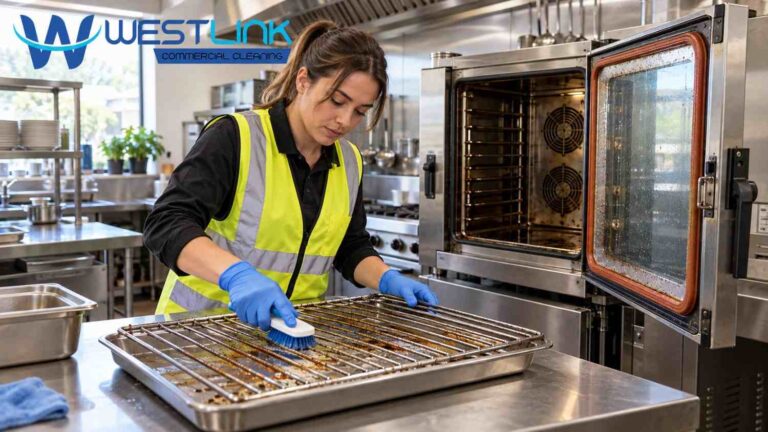
Commercial oven cleaning removes food residue, baked-on grease and carbon deposits from the cooking chamber, removable racks and door seals. Commercial oven cleaning requires a manufacturer-approved degreaser, non-damaging tools and personal protective equipment (PPE) matched to the product’s safety data sheet. The commercial oven cleaning procedure runs in eight steps: shutdown and cooling, debris removal, rack removal, rack washing, cavity degreasing, door glass and gasket care, residue removal, and drying with inspection. Commercial oven racks collect grease at wire intersections, rack supports and tray contact points, and kitchen staff clean them by soaking in a compatible solution and scrubbing with a non-scratch tool. Baked-on oven grease is cooking fat hardened onto heated surfaces, and a surface-compatible degreaser loosens it during the label’s specified contact time. A commercial oven door gasket seals the gap between the door and the oven body, and kitchen staff clean it by gentle wiping with manufacturer-permitted products only. A commercial convection oven circulates hot air with a fan, so cleaning protects the fan, vents and air passages from liquid and chemical spray. Restaurant oven cleaning frequency depends on the manufacturer’s maintenance schedule, cooking volume and food type. For businesses seeking professional cleaning support, Westlink Commercial Cleaning provides commercial cleaning services. The most damaging commercial oven cleaning mistakes involve incompatible chemicals, excess water and aggressive tools.
What Is Commercial Oven Cleaning, and How Does the Procedure Change by Oven Type?
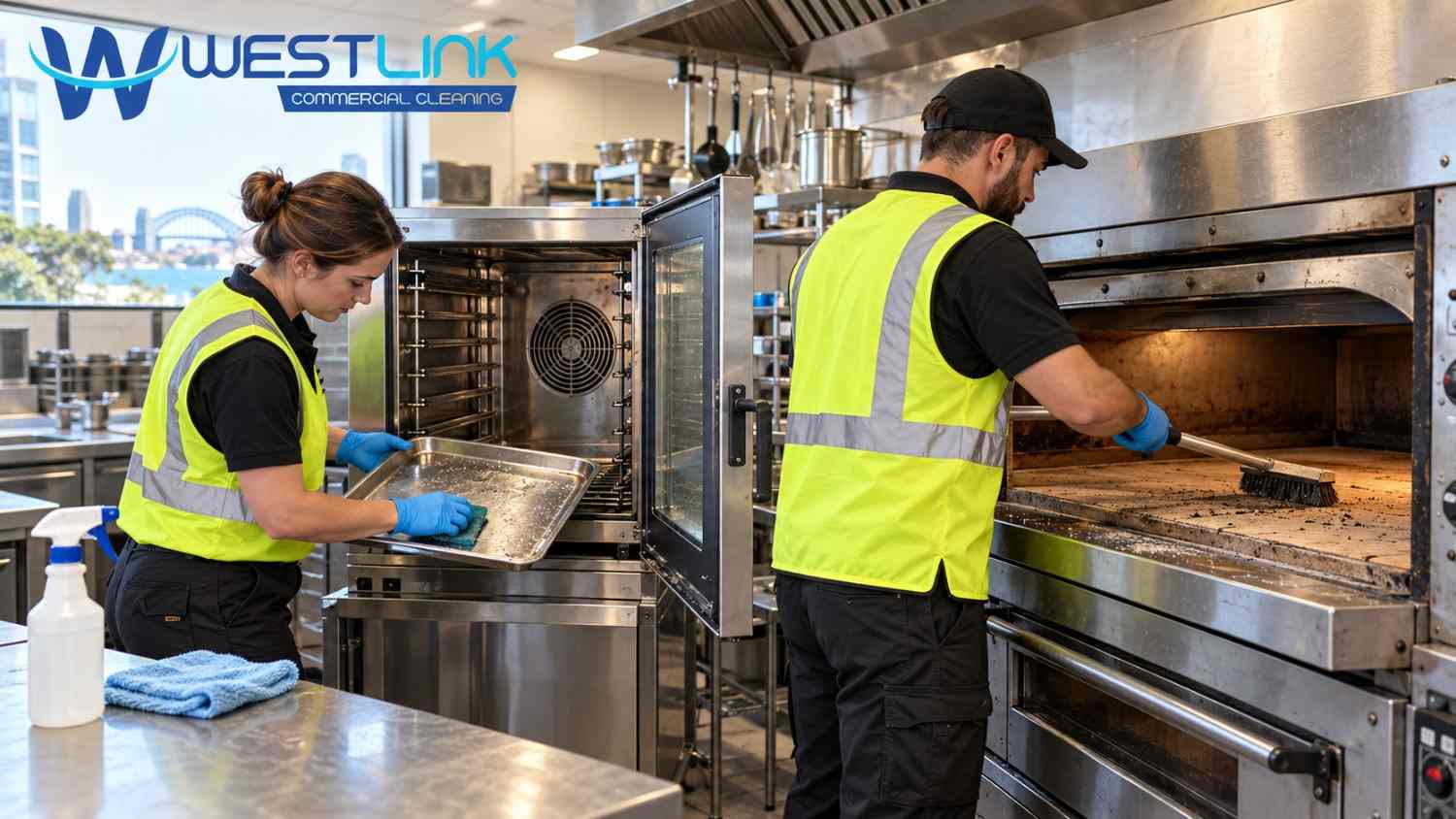
Commercial oven cleaning removes food residue, baked-on grease and carbon deposits from the cooking chamber, removable racks and door seals. The standard sequence has six parts: shut the oven down, let it cool to the temperature the manufacturer specifies, remove washable components, loosen grease with an approved cleaner, rinse or wipe away residue as instructed, and dry and inspect the oven before restarting it.
The correct procedure depends on the oven’s construction. A conventional commercial gas or electric oven may allow manual degreasing. A commercial convection oven requires additional care around its fan and air passages. A combi oven with an automatic wash system may require a dedicated cleaning cycle and specified chemicals. These oven-specific procedures are an important part of commercial kitchen cleaning, helping businesses maintain hygienic cooking equipment and food preparation environments. The operating manual for the specific model overrides any general cleaning advice, including the advice in this guide.
What Do You Need to Clean a Commercial Oven Safely?
Commercial oven cleaning requires compatible cleaning products, non-damaging tools and appropriate personal protective equipment (PPE). Kitchen staff gather every item before taking the oven out of service, so food preparation does not restart halfway through the cleaning process.
| Item | Purpose | Important limitation |
| Manufacturer-approved oven degreaser | Softens grease and carbonised food deposits | Check permitted surfaces, dilution and dwell time. |
| Mild dish detergent and warm water | Washes removable racks and lightly soiled surfaces | Do not immerse electrical components. |
| Nylon brush, soft pad or non-scratch sponge | Lifts softened residue. | Avoid scratching coated or polished surfaces. |
| Plastic scraper, where permitted | Removes thick, loosened deposits | Do not scrape heating elements, sensors or gaskets |
| Soft cloths and clean rinse water | Removes detergent and loosened soil | Keep water out of controls, motors and electrical openings. |
| Chemical-resistant gloves and eye protection | Reduces contact with cleaning chemicals | Select PPE from the product label and safety data sheet. |
The cleaner’s label and safety data sheet define the required ventilation and protective equipment, so staff read both before use. Staff never combine cleaning products, including bleach, ammonia, acids or oven degreasers. OSHA’s cleaning-chemical guidance explains these precautions.
Restaurant staff should follow OSHA’s cleaning chemical safety guidelines when using commercial oven degreasers to prevent chemical exposure and workplace injuries.
How Do You Clean a Commercial Oven Step by Step?
The commercial oven cleaning procedure separates removable-part washing from interior degreasing and gasket care. This sequence limits chemical contact with sensitive parts and lets staff confirm that no cleaner remains in the oven.
Stop cooking and shut the oven down. Follow the equipment’s shutdown and isolation procedure. Allow the chamber, racks and door glass to cool to the cleaning temperature stated in the manual. Some automated cleaning programmes specify a different starting temperature.
Remove loose crumbs and food debris. Once the oven is safe to touch, collect loose material from the oven floor and accessible corners with a soft brush or cloth. Keep debris out of fan openings and burner passages.
Remove approved detachable parts. Take out oven racks, trays and rack guides only if the manufacturer identifies them as user-removable. Note each part’s position for reinstallation.
Wash racks separately. Soak and scrub compatible racks using the method in the rack section below. Keep chemical baths away from food preparation areas and label them.
Degrease the oven cavity. Apply an oven-safe cleaner only to permitted surfaces, leave it for the label’s specified contact time and gently remove softened residue.
Clean the door glass and gasket separately. Use compatible products and light pressure. A gasket is not a metal surface and needs different handling.
Remove cleaning residue. Rinse or wipe cleaned surfaces exactly as the product and equipment instructions require. Repeat if a visible cleaner, foam or grease remains.
Dry, inspect and reassemble. Refit dry racks and guides, check that the gasket is seated properly, and verify that the door closes normally. Return the oven to service according to the manufacturer’s instructions.
An oven with a built-in wash cycle follows its programmed cleaning and rinsing steps instead of a separate manual chemical process.
How Do You Clean Commercial Oven Racks With Baked-On Grease?
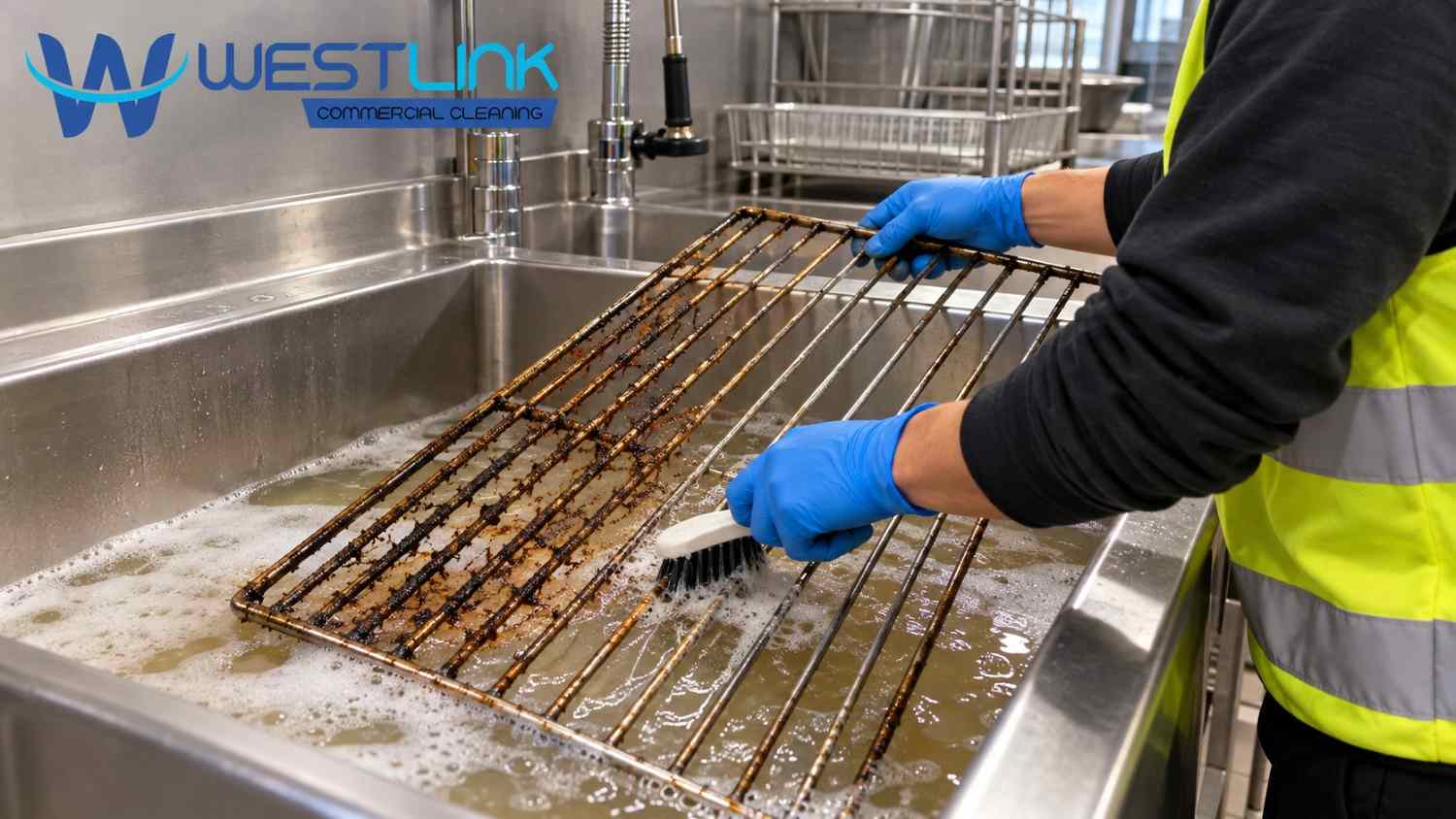
Commercial oven racks collect grease at wire intersections, rack supports and the contact points where cooking trays rest. The easiest way to clean oven racks is to remove them when the manufacturer permits, soften the deposits in a suitable wash solution and scrub the loosened material without damaging the rack finish.
Remove and Soak the Oven Racks
Kitchen staff remove cool, detachable racks and place them in a sink or container large enough for safe washing. The wash solution is warm water with a compatible detergent or a manufacturer-approved rack cleaner. The product’s stated dilution, soak time and temperature set the limits. Overnight soaking is not automatically safe, because prolonged exposure to aggressive cleaners can damage certain rack coatings or finishes.
Scrub Rack Bars and Supports
A nylon brush or non-scratch pad cleans oven racks without scoring the finish, especially around corners and welded joints. Staff reapply the approved cleaner to hardened deposits instead of forcing them off with a sharp metal tool. Removable rack guides get their channels and attachment points cleaned separately.
Rinse, Dry and Inspect the Racks
Staff rinse racks as the cleaning-product instructions require and dry them fully before reinstalling. The inspection checks for peeling coatings, corrosion, sharp edges and bent bars. A damaged rack goes to repair or replacement assessment, not back into service after more aggressive scrubbing.
Removable oven shelves and cooking trays follow similar principles, but cleaning oven trays differs from cleaning oven racks. Aluminium trays, non-stick pans and coated accessories react differently to strong alkaline oven cleaners, so each item’s material and care instructions decide the method.
How Do You Remove Baked-On Grease From a Commercial Oven?
Baked-on oven grease is cooking fat that has hardened onto heated surfaces, and repeated heating can leave darker carbonised deposits. Commercial oven degreasing works by giving a surface-compatible cleaner enough contact time to loosen this soil before gentle mechanical removal.
- Identify the surface. Determine whether the chamber has stainless steel, porcelain enamel, a coated liner or another finish. Check the manufacturer-approved cleaner list.
- Remove dry debris. Lift loose crumbs and flakes with a soft brush or permitted plastic scraper before applying liquid.
- Apply cleaner precisely. Use the quantity and application method on the product label. Keep spray and foam away from exposed heating elements, fans, motors, sensors, ignition components and door gaskets unless the manual explicitly allows contact.
- Observe the dwell time. Let the degreaser work for the duration printed on its label. No universal five-, ten- or thirty-minute contact time exists.
- Lift softened deposits. Wipe with a cloth or a compatible non-abrasive pad. Repeat a permitted treatment for remaining carbon deposits instead of grinding against the oven liner.
- Remove chemicals completely. Follow both the oven and cleaner instructions for rinsing, wiping and drying. Do not heat the oven to burn off residual cleaning solution unless the manufacturer expressly directs that step.
Severe, recurring deposits point to the cooking process as well as the cleaning method. Overflowing trays, splashing fat and delayed spill removal continually replenish the buildup. Heavy smoke, unusual odours or inaccessible deposits mean the oven should come out of use and a qualified service provider should be contacted.
How Do You Clean Commercial Oven Door Seals Without Damaging Them?
A commercial oven door gasket seals the gap between the door and the oven body to help retain heat. Gaskets may use silicone, fibreglass or other high-temperature materials, so a product suitable for metal racks may be inappropriate for the seal.
- Let the door and gasket cool according to the manual.
- Wipe accessible food residue with a soft, damp cloth. Add a small amount of mild detergent only if the manufacturer permits it.
- Clean gently along the gasket without pulling, stretching, soaking or scrubbing its fibres or edges.
- Remove detergent with a lightly dampened clean cloth as directed, then let the seal dry.
- Inspect the full perimeter for cracks, tears, fraying, hardening, flattening, looseness or sections that no longer meet the door evenly.
Caustic oven degreasers, sharp scrapers and abrasive pads damage door seals unless the manufacturer explicitly authorises them for that gasket material. A damaged gasket needs a model-compatible replacement, not chemical treatment or adhesive improvisation. Heat escaping at the door, poor closure or uneven cooking can signal a gasket or door-alignment issue. Hobart notes that loose or damaged door gaskets can cause heat loss and uneven temperatures.
How Do You Clean a Commercial Convection Oven?
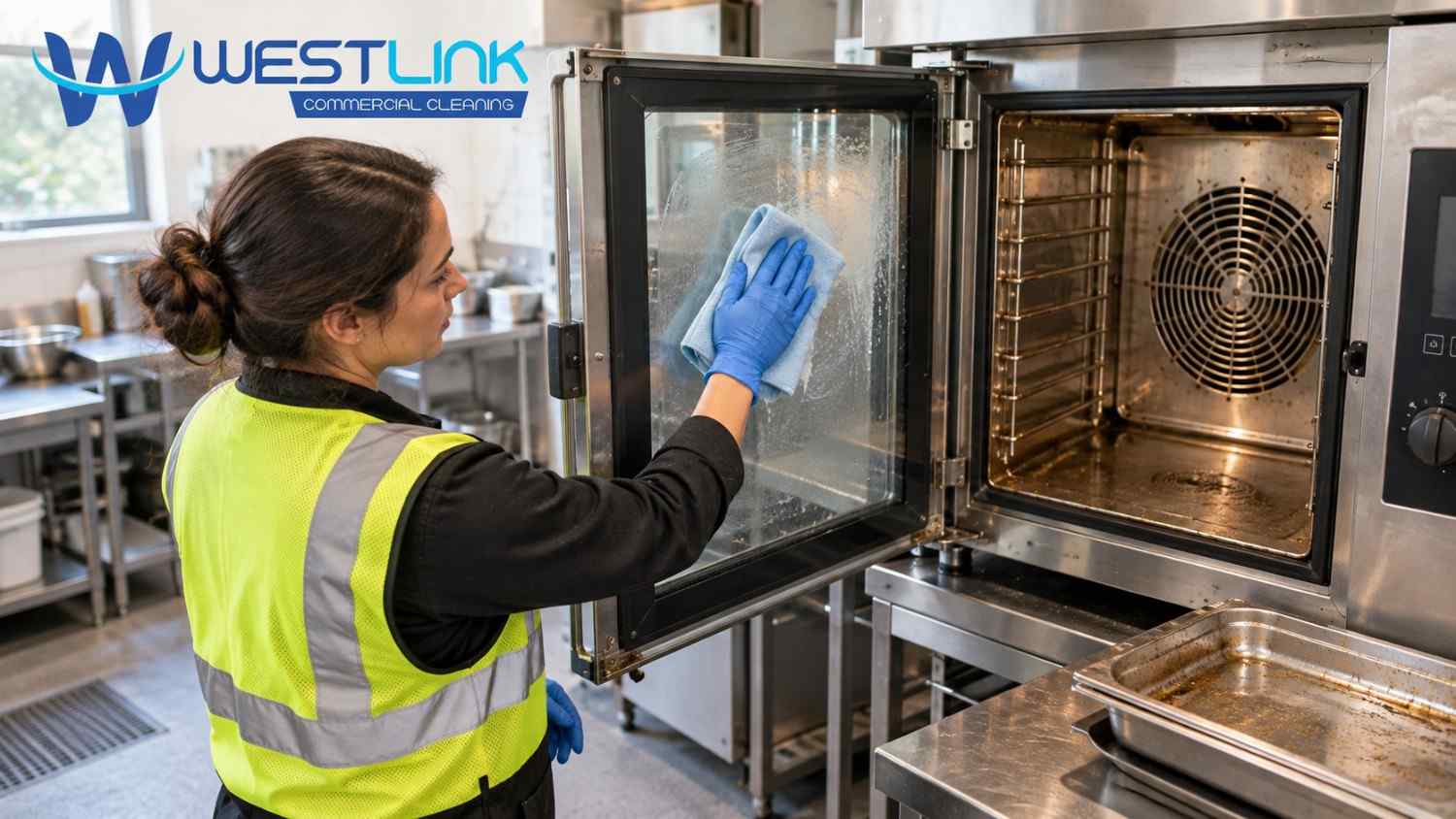
A commercial convection oven circulates hot air with a fan, which makes clean airflow paths important for cooking consistency. Routine cleaning covers the same racks, chamber and door as a conventional oven, but fan guards, vents and accessible air passages need particular caution.
- Wipe the cavity and removable rack guides according to the model’s cleaning instructions.
- Remove food debris from accessible fan-guard surfaces without spraying liquid into the fan motor or electrical openings.
- Leave protective panels and fan covers in place unless the operator manual specifically allows removal.
- Keep temperature probes, sensors and heating components free of direct chemical spray.
- Use the designated wash programme and detergent if the appliance is a self-cleaning combi oven.
Vulcan’s VC4 convection-oven resources provide model-specific cleaning instructions, and UNOX’s cleaning guidance covers automated combi-oven washing and gasket care. Each manufacturer’s procedure applies only to its own models and does not transfer to unrelated ovens.
How Often Should Restaurant Ovens Be Cleaned?
Restaurant oven cleaning frequency depends on the manufacturer’s maintenance schedule, cooking volume and the type of food produced. A kitchen roasting fatty meats needs more frequent degreasing than a kitchen using covered baking trays.
| Interval | Practical inspection or cleaning task |
| After spills, when safely accessible | Remove food residue before repeated heating, which carbonises it. |
| Daily or after the final cooking shift | Clean approved accessible surfaces; wipe door glass and gasket as directed; check racks and the oven floor. |
| Weekly, or as soil accumulates | Wash removable rack guides and inspect corners, supports and accessible airflow areas. |
| At the manufacturer-specified deep-clean interval | Perform approved degreasing or automatic cleaning cycles and inspect gasket condition. |
| Whenever damage or performance changes appear | Arrange appropriate service for loose seals, unusual smoke, poor closure or airflow problems. |
This table is a planning template. The appliance’s own cleaning schedule and the kitchen’s documented food-safety procedures take priority. Vulcan recommends consulting the oven manual for model-specific cleaning practices.
Which Commercial Oven Cleaning Mistakes Should You Avoid?
The most damaging commercial oven cleaning mistakes involve incompatible chemicals, excess water and aggressive tools. A cleaner that removes burnt-on grease from a steel rack can still harm a gasket, liner, aluminium tray or electrical component.
- Cleaning before safe shutdown or cooling: hot parts and chemical vapours injure staff.
- Mixing products: chemical combinations release hazardous gases or cause violent reactions.
- Ignoring dwell time or dilution: overly concentrated products and extended exposure damage finishes.
- Spraying fans, burners or electrical parts: liquid reaches components not designed for washing.
- Scraping liners with sharp metal tools: scratches and damaged coatings make future cleaning harder.
- Treating door seals with heavy-duty degreaser: gaskets require material-specific care.
- Leaving cleaner behind: residual chemicals contaminate equipment and food-contact accessories.
- Restarting with loose racks or damaged seals: incomplete reassembly creates operating hazards.
Commercial Oven Cleaning Checklist
This checklist documents a restaurant oven cleaning procedure, and a trained staff member verifies each item against the manufacturer’s instructions.
- Confirm the oven is shut down, isolated as required and safe to clean.
- Read the equipment instructions and the cleaning-product label.
- Put on appropriate PPE and provide required ventilation.
- Remove loose food and approved detachable racks or guides.
- Soak, scrub, rinse and dry compatible racks and trays.
- Degreasing permitted cavity surfaces without wetting protected components.
- Clean door glass and gently wipe the gasket.
- Remove chemical residue and dry the oven as directed.
- Inspect the door seal, rack supports and accessible components.
- Reassemble parts correctly and complete the prescribed restart checks.
- Record the date, cleaner used, findings and any service request.
Frequently Asked Questions
What is the best way to clean oven racks easily?
The best method for compatible commercial oven racks is controlled soaking with an approved detergent, followed by nylon-brush scrubbing, thorough rinsing and complete drying. Rack material and cleaner instructions determine the soak time.
Can you use a heavy-duty oven cleaner on stainless steel?
Some commercial degreasers are approved for certain stainless-steel oven surfaces, while others stain or damage specific finishes and adjacent components. The oven manual and chemical label state what is permitted, and spot testing happens only where the manufacturer allows it.
How do you clean an electric commercial oven?
Cleaning an electric commercial oven follows the same rack, cavity and gasket sequence as other ovens, with extra care to keep liquids away from heating elements, electrical connections and controls. The manufacturer’s isolation procedure applies before any manual cleaning.
Can you soak commercial oven racks overnight?
Overnight soaking is appropriate only if both the rack manufacturer and the detergent label permit extended immersion. A shorter, specified soaking period is safer for unknown coatings and metal finishes.
When should a commercial oven door gasket be replaced?
A commercial oven door gasket needs a replacement assessment when it is torn, brittle, badly flattened, loose or unable to maintain an effective seal. The replacement must be specified for the exact oven model, and the manufacturer’s service procedure governs installation.
When should you hire a professional oven-cleaning or service technician?
Professional service is appropriate when carbon deposits cannot be reached safely, cleaning requires dismantling protected components, grease buildup repeatedly produces smoke, or the door and fan systems show faults. Equipment with a suspected safety defect stays out of use until a technician clears it.