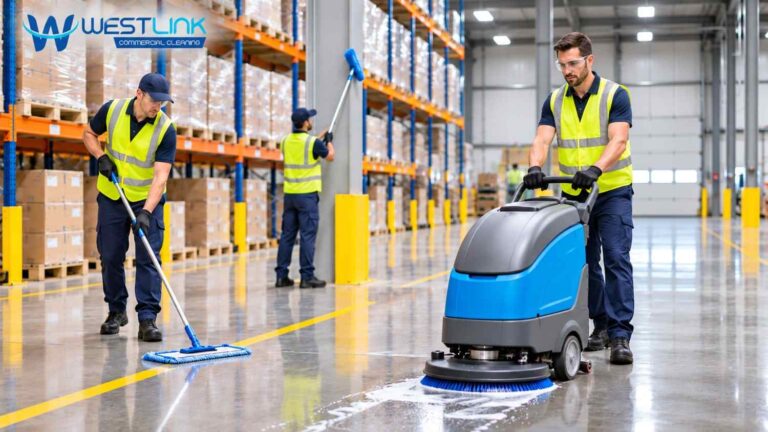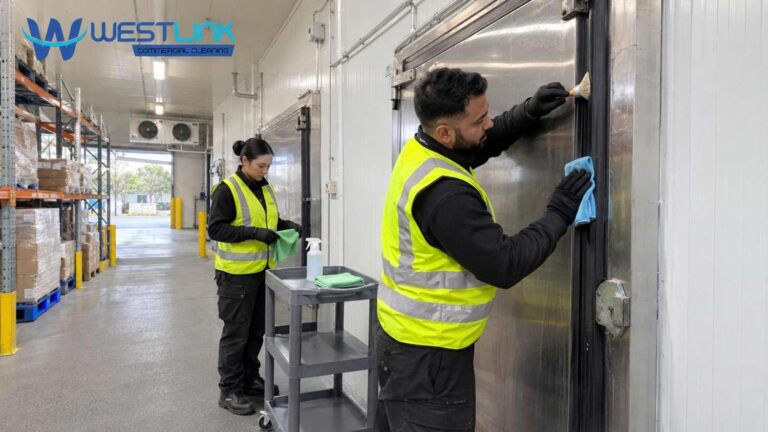
A warehouse cleaning contract checklist lists the cleaning tasks, service frequencies, performance indicators, exclusions, and responsibilities that a warehouse cleaning service agreement must document. A warehouse cleaning scope of work assigns cleaning tasks, zones, frequencies, and acceptance standards to the contractor. A warehouse cleaning schedule sets a frequency and a service window for each task according to contamination risk and traffic. Warehouse cleaning KPIs measure task completion, cleaning quality, response times, and corrective actions. A warehouse cleaning inspection process verifies completed work through scheduled inspections, service logs, and defect records. Warehouse cleaning contract exclusions name the tasks, materials, and locations that fall outside the contractor’s duties. A warehouse cleaning service agreement divides operational responsibilities between the contractor and the client. Warehouse cleaning safety requirements define the risk controls, competencies, and chemical procedures that protect workers. A warehouse cleaning equipment schedule names the machinery, products, consumables, and PPE for the contracted services. Warehouse cleaning contract pricing separates recurring charges from variable and additional-charge services. Warehouse cleaning contract renewal rests on documented performance, safety compliance, and commercial terms.
What Should a Warehouse Cleaning Contract Include?
A warehouse cleaning contract should include the service scope, cleaning schedule, performance standards, exclusions, contractor obligations, client responsibilities, pricing terms, and contract management procedures. Each component sets one requirement for delivering, inspecting, and maintaining the cleaning service.
The cleaning service agreement identifies the contracting parties, warehouse location, commencement date, contract duration, and authorised representatives. Supporting schedules describe operational requirements in enough detail for both parties to verify completed work.
| Contract component | Required information | Purpose |
| Contract details | Parties, site address, start date, and duration | Identifies the agreement and service location |
| Scope of work (SOW) | Cleaning zones, tasks, methods, and deliverables | Establishes included cleaning activities |
| Cleaning schedule | Task frequencies, shift patterns, and access windows | Determines when cleaning occurs |
| KPI schedule | Performance targets, measurement methods, and reporting periods | Measures contractor performance |
| Service level agreement (SLA) | Response times, inspection requirements, and escalation rules | Defines service delivery expectations |
| Exclusion schedule | Excluded services, inaccessible areas, and specialist tasks | Establishes responsibility boundaries |
| Safety requirements | Risk assessments, training, PPE, and site procedures | Controls cleaning-related workplace risks |
| Commercial terms | Contract price, payment terms, and additional work rates | Establishes financial obligations |
| Contract management | Reporting, service reviews, variations, and termination | Governs ongoing service delivery |
A master services agreement, a cleaning service specification, and supporting schedules can carry these details. The contract also states which document takes priority when two provisions conflict.

Which Details Should a Facility Manager Confirm Before Signing?
A facility manager confirms the following details before appointing an industrial cleaning provider:
- Legal names and contact details of both contracting parties.
- Warehouse address and the boundaries of the serviced premises.
- Total cleanable floor area and designated cleaning zones.
- Contract commencement date, duration, and renewal provisions.
- Number of cleaning visits, work shifts, and service hours.
- Equipment, chemicals, and consumables supplied by each party.
- Agreed service charges and payment conditions.
- Insurance coverage and liability provisions.
- Procedures for requesting additional cleaning.
- Contract notice periods and termination conditions.
These details form the commercial foundation of the warehouse cleaning agreement. The scope of work then converts the agreement into operational tasks.
How Should a Warehouse Cleaning Scope of Work Be Defined?
A warehouse cleaning scope of work specifies the cleaning tasks assigned to a contractor, the zones where each task applies, the required frequency, and the standard expected after completion. A detailed specification removes ambiguity by linking each task to a location, method, schedule, and measurable result.
The scope divides the warehouse into cleanable areas instead of treating the building as one zone. A distribution centre, for example, may require daily cleaning of forklift traffic routes but only periodic cleaning of accessible racking beams.
Which Warehouse Cleaning Zones Should the Scope Identify?
A warehouse cleaning specification divides the facility into operational zones because contamination levels, access conditions, and cleaning needs differ across the building. Common zones include:
- Main warehouse floors and storage aisles.
- Pallet racking and shelving areas.
- Picking and packing stations.
- Goods receiving and despatch areas.
- Loading bays and dock leveller areas.
- Forklift traffic routes and pedestrian walkways.
- Mezzanine floors and conveyor areas.
- Battery charging stations.
- Waste collection and recycling points.
- Staff washrooms, changing rooms, and canteens.
- Warehouse offices and security reception areas.
- External service yards and vehicle parking areas.
Each zone receives a unique reference in the cleaning task matrix. The contract also names restricted areas, inaccessible locations, and zones that need an operational shutdown before cleaning.
Which Cleaning Tasks Should the Scope Assign to Each Zone?
A warehouse cleaning task matrix connects each zone with cleaning activities, service frequencies, and acceptance criteria. The table below shows an illustrative scope. A site survey and an operational risk assessment set the actual frequencies.
| Warehouse zone | Cleaning tasks | Example frequency | Completion standard |
| Main warehouse floors | Machine sweeping and floor scrubbing | Daily or per shift | Accessible surfaces free from visible loose debris and cleaning residue |
| Storage aisles | Sweeping and accessible floor cleaning | Daily | No avoidable debris accumulation or cleaning-related obstruction |
| Loading docks | Packaging debris removal, sweeping, and localised cleaning | Per shift | Accessible dock surfaces are free from loose waste and avoidable contamination. |
| Picking and packing stations | Surface wiping and packaging waste collection | Daily | Agreed, surfaces are free from visible debris and dust. |
| Racking and shelving | Accessible beam and shelf dusting | Monthly or quarterly | Designated surfaces cleaned to the agreed inspection standard |
| Pedestrian walkways | Sweeping, spot cleaning, and safety marking cleaning | Daily | Walkways free from cleaning equipment and residue |
| Staff washrooms | Fixture cleaning, sanitisation, and consumable replenishment | Daily or more frequently | Fixtures hygienically cleaned and agreed supplies replenished |
| Waste collection points | Bin emptying and accessible surrounding area cleaning | Daily | Waste placed in approved containers without avoidable overflow |
| External service yards | Litter removal and accessible hardstanding sweeping | Weekly or as specified | Agreed areas are free from loose litter and debris. |
The cleaning contractor performs each task with an approved method that suits the floor surface, warehouse activity, and potential contamination. Epoxy-coated floors, for example, need different chemicals and machinery from untreated concrete. The specification names prohibited chemicals, equipment restrictions, and manufacturer maintenance instructions where relevant.
How Should the Scope Separate Routine and Specialist Cleaning?
Routine warehouse cleaning covers recurring housekeeping activities, while specialist cleaning covers tasks that need extra equipment, access arrangements, training, or operational controls.
Routine warehouse cleaning includes:
- Sweeping and scrubbing accessible floors.
- Removing pallet debris and packaging waste.
- Cleaning pedestrian walkways and entrances.
- Emptying designated waste bins.
- Cleaning washrooms and welfare facilities.
- Wiping accessible surfaces and touchpoints.
Periodic or specialist warehouse cleaning includes:
- High-level dust removal.
- Overhead pipework and ventilation grille cleaning.
- Loading dock pressure washing.
- Intensive floor degreasing.
- Forklift tyre mark removal.
- Scheduled shutdown cleaning.
- Approved contamination-control cleaning.
The contract states whether specialist cleaning sits inside the fixed service fee, follows a separate schedule, or carries an approved additional charge.

How Should Warehouse Cleaning Frequency and Schedules Be Set?
A warehouse cleaning schedule assigns a frequency and a service window to each cleaning task based on contamination risk, warehouse traffic, operating hours, and hygiene requirements. The schedule reflects the activity in each zone instead of applying one frequency across the whole facility. A high-traffic fulfilment centre, for example, may need per-shift waste collection, while a low-traffic storage area may need less frequent floor cleaning.
Which Cleaning Frequencies Do Warehouse Contracts Use?
Warehouse cleaning contracts classify tasks into the following service intervals:
| Cleaning frequency | Typical application |
| Continuous or on-demand | Approved response to recurring debris and non-hazardous contamination |
| Per shift | Busy picking areas, loading zones, and waste points |
| Daily | General floor cleaning, walkways, washrooms, and shared facilities |
| Weekly | Selected low-traffic areas and accessible equipment exteriors |
| Monthly | Scheduled detailed cleaning and approved racking dust removal |
| Quarterly | Periodic deep cleaning and selected high-level surfaces |
| Annual or shutdown-based | Extensive specialist cleaning that requires restricted operations |
The facility manager reviews each frequency whenever the warehouse layout, operating hours, stock volume, or traffic pattern changes.
How Should Cleaning Fit Around Warehouse Operations?
Warehouse cleaning service windows minimise interference with forklift movements, goods handling, loading operations, and pedestrian activity. The contract specifies:
- Cleaning start and finish times.
- Permitted cleaning shifts.
- Areas that need temporary isolation.
- Access arrangements for restricted zones.
- Responsibility for moving pallets or stock.
- Equipment storage and charging locations.
- Procedures for postponing inaccessible tasks.
- Requirements for returning areas to operatio nal use.
Cleaning during operating hours requires coordination between the cleaning supervisor and the warehouse operations team. Floor-cleaning activities must not create uncontrolled pedestrian or vehicle hazards.
Which KPIs Should a Warehouse Cleaning Contract Include?
Warehouse cleaning KPIs measure whether a contractor completes the agreed tasks, reaches the required cleaning standards, responds to service issues, and corrects identified defects. An effective KPI schedule defines the metric, calculation method, target, reporting frequency, and consequence of underperformance.
The warehouse cleaning SLA links each KPI to an approved service standard. This lets the facility manager evaluate cleaning quality from documented evidence instead of subjective impressions.
What Does an Example Warehouse Cleaning KPI Scorecard Look Like?
A warehouse cleaning KPI scorecard lists each metric with its measurement method and target. The targets below are illustrative contract values, not industry benchmarks or statutory requirements. The parties select targets after reviewing the warehouse’s operational risks and service requirements.
| Cleaning KPI | Measurement method | Example target |
| Scheduled task completion | Completed scheduled tasks ÷ eligible scheduled tasks × 100 | At least 98% monthly |
| Cleaning inspection pass rate | Passed inspections ÷ completed inspections × 100 | At least 95% monthly |
| Corrective action closure | Actions closed by deadline ÷ actions due × 100 | At least 95% |
| Repeat defect rate | Repeated defects ÷ recorded defects × 100 | No more than 5% |
| Staff training compliance | Required trained personnel ÷ personnel assigned × 100 | 100% before assignment |
| Monthly reporting compliance | Reports submitted by deadline ÷ reports due × 100 | 100% |
| Routine complaint acknowledgement | Complaints acknowledged within the agreed time ÷ complaints received × 100 | At least 95% |
The contract defines an eligible task, a passed inspection, a repeated defect, and an accepted corrective action. The contractor’s records log tasks postponed by documented client access restrictions separately, and those tasks do not count automatically as completed work.
How Is the Scheduled Task Completion Rate Calculated?
The scheduled task completion rate measures the share of eligible cleaning tasks that a contractor completes during a reporting period.
Formula: Scheduled task completion = (Completed scheduled tasks ÷ Eligible scheduled tasks) × 100
A contractor that completes 196 of 200 eligible tasks in one month scores (196 ÷ 200) × 100 = 98%. That score meets a 98% monthly target. Completed tasks must still satisfy the separate cleaning quality criteria.
How Is the Cleaning Inspection Pass Rate Calculated?
The cleaning inspection pass rate measures the percentage of completed inspections that meet the agreed cleanliness standards.
Formula: Inspection pass rate = (Passed inspections ÷ Total completed inspections) × 100
An inspection evaluates predefined conditions such as visible debris, dust accumulation, spill residue, waste bin condition, and surface cleanliness. The inspection checklist separates minor defects from conditions that need immediate safety intervention. A satisfactory overall score never overrides an unresolved critical safety hazard.
How Is the Corrective Action Closure Rate Measured?
The corrective action closure rate measures how consistently a contractor resolves recorded cleaning defects within approved deadlines. Each corrective action record states the defect location, description, severity, assigned person, required completion date, and verification evidence.
Repeated failures trigger an escalation process. The agreement separates minor cleaning defects from hazardous conditions that require immediate control, notification, or suspension of work.
How Is Cleaning Response-Time Compliance Measured?
Cleaning response-time KPIs measure the interval between a recorded service request and the contractor’s agreed response milestone. A warehouse cleaning SLA separates four milestones:
- Acknowledgement time: the time to confirm receipt of a cleaning request.
- Attendance time: the time for an authorised person to reach the location.
- Containment time: the time to put permitted initial controls in place.
- Resolution time: the time to complete the authorised cleaning activity.
Routine spill cleaning and hazardous-material remediation never share one automatic response requirement. Workers follow site emergency procedures and never handle unknown or hazardous substances without authorisation and controls.
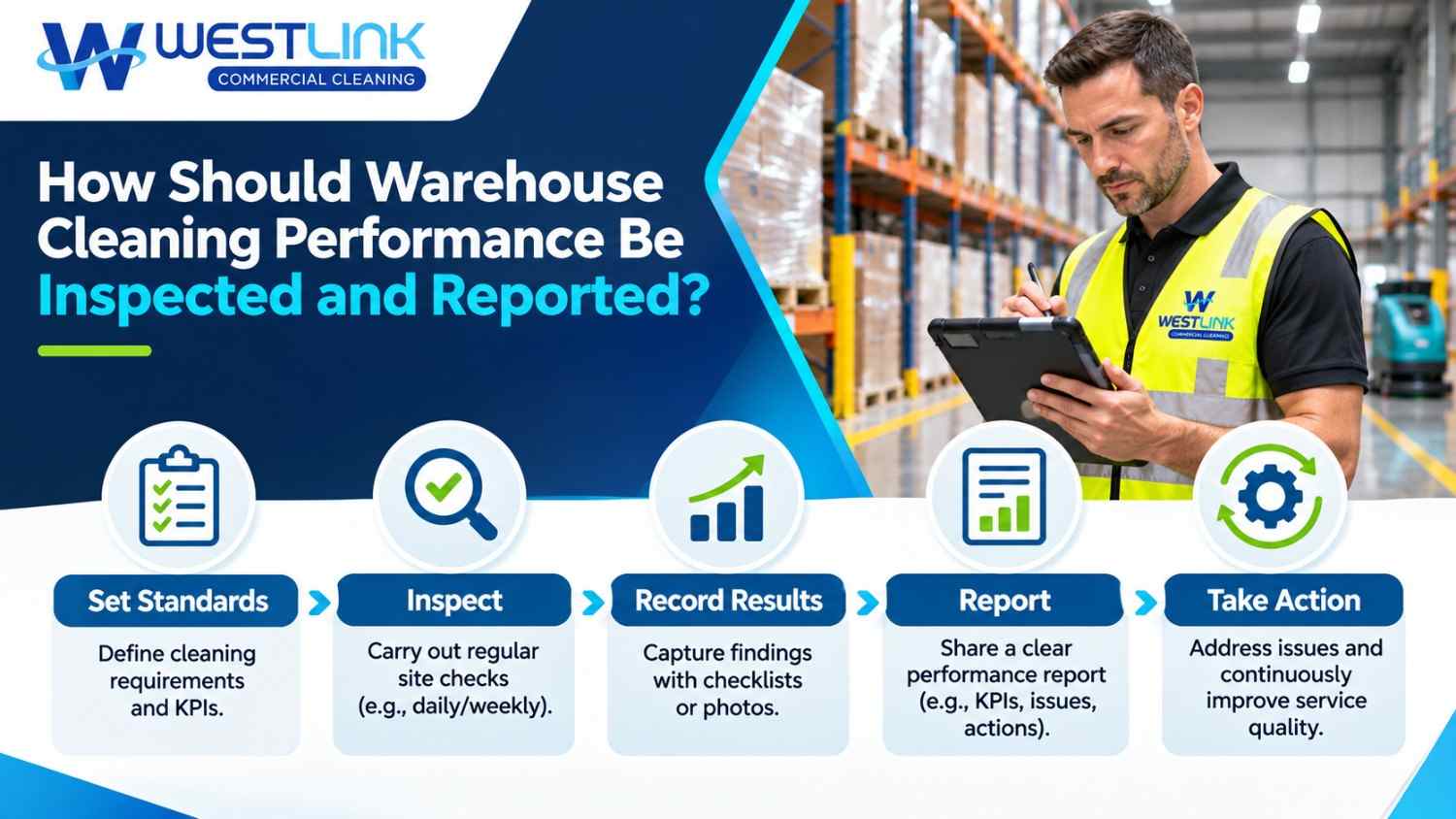
How Should Warehouse Cleaning Performance Be Inspected and Reported?
A warehouse cleaning quality assurance process verifies completed work through scheduled inspections, service logs, defect records, and contractor performance reviews. The inspection method matches the standards written into the scope of work. A facility manager assesses contractor performance through daily task verification, periodic cleaning audits, and monthly KPI scorecards.
What Should a Warehouse Cleaning Inspection Form Capture?
A warehouse cleaning inspection form records the following items:
- Inspection date, time, and warehouse zone.
- Cleaning task reference and expected cleanliness standard.
- Inspector name and cleaning supervisor.
- Floor cleanliness and visible debris.
- Dust accumulation on specified surfaces.
- Spill residue and signs of contamination.
- Waste collection and bin condition.
- Cleaning-related walkway obstructions.
- Equipment condition and safe storage.
- Defect severity and photographic evidence.
- Corrective action owner and deadline.
- Reinspection result and client sign-off.
Inspection records name the precise location and nature of each failure. A record such as “Iisle B4: packaging debris remained besides the approved waste collection point after scheduled cleaning” gives the contractor more to act on than a general comment that the warehouse was not clean.
How Should a Warehouse Cleaning Contract Escalate Defects?
A warehouse cleaning contract establishes an escalation procedure for missed tasks, failed inspections, unresolved complaints, and repeated service failures. A practical procedure has four stages:
- Record the defect: document the affected zone, failed requirement, evidence, and severity.
- Assign corrective action: name the responsible contractor representative and set a deadline.
- Verify completion: reinspect the corrected task and retain supporting evidence.
- Escalate repeated failures: require a corrective action plan or apply contractual remedies once the agreed conditions are met.
The SLA sets the intervals for reviewing audit results. Monthly contractor performance meetings examine inspection scores, missed visits, repeat defects, staffing issues, and outstanding corrective actions.
What Should a Warehouse Cleaning Contract Exclude?
Warehouse cleaning contract exclusions name the tasks, materials, locations, and services that the cleaning contractor is not authorised or required to perform. An exclusions schedule separates routine cleaning obligations from hazardous remediation, specialist maintenance, inventory handling, and emergency restoration.
An excluded activity can still require action from another authorised party. The contract names who is responsible for notification, area isolation, specialist attendance, and approval of additional work.
Which Exclusions Do Warehouse Cleaning Contracts Commonly Contain?
| Exclusion category | Examples of excluded activities | Responsibility or approval requirement |
| Hazardous materials | Asbestos removal, lead dust remediation, hazardous chemical spill cleanup | Authorised specialist or designated site emergency procedure |
| Biological contamination | Infectious waste handling, biohazard decontamination, specialist mould remediation | Competent specialist contractor |
| Mechanical maintenance | Conveyor repairs, forklift servicing, machinery dismantling | Maintenance provider or equipment owner |
| Structural maintenance | Racking repairs, roof repairs, drainage infrastructure repairs | Approved maintenance contractor |
| Inventory handling | Stock relocation, product repackaging, damaged goods disposal | Warehouse operator or authorised logistics personnel |
| Restricted access | Confined-space cleaning, unauthorised high-level work, secured storage areas | Separate access authorisation and safe system of work |
| Specialist building services | HVAC duct cleaning, fire suppression servicing, electrical maintenance | Qualified specialist provider |
| Exceptional restoration | Post-fire cleaning, flood restoration, major construction debris removal | Separate scope and approved quotation |
| External maintenance | Landscaping, grounds maintenance, snow and ice clearance | Separately appointed provider unless expressly included |
| Out-of-hours requests | Unscheduled emergency call-outs outside contracted service hours | Agreed emergency service terms or separate approval |
The facility manager tailors the exclusions list to the actual warehouse. A cold storage facility, food-grade warehouse, or pharmaceutical distribution centre adds limitations for temperature control, product protection, hygiene validation, and controlled access.
How Should a Contract Define High-Level Cleaning Exclusions?
A warehouse cleaning contract sets a defined access limit for high-level cleaning instead of a vague statement that overhead work is excluded. The cleaning specification states:
- The maximum working height covered by routine services.
- The surfaces included in scheduled high-level cleaning.
- Whether access platforms are supplied.
- Who may operate specialist access equipment.
- Whether permits or additional supervision are required.
- Which activities need a separate quotation.
Accessible low-level shelving, for example, can sit inside monthly cleaning, while high-bay racking and overhead pipework need a separately authorised task. Any work-at-height arrangement meets applicable safety requirements, and a contractual height limit never proves that the work is safe.
How Should a Contract Define Spill Response Exclusions?
A warehouse spill response clause separates ordinary non-hazardous spills from substances that need specialist containment or remediation. The contract lists the spill types the contractor is trained and authorised to clean, along with the procedures, equipment, and response arrangements that apply.
Unknown chemicals, suspected hazardous substances, and materials outside the contractor’s competence trigger site notification and emergency control procedures instead of routine cleaning. Excluding hazardous spill remediation does not remove the duties to report a hazard, avoid exposure, and follow the site’s emergency arrangements.
How Should a Warehouse Cleaning Contract Allocate Contractor and Client Responsibilities?
A warehouse cleaning service agreement divides operational responsibilities between the cleaning contractor and the client. The contractor controls delivery of the agreed cleaning services, while the warehouse operator controls site access, operational information, and activities outside the cleaning scope. The contract and applicable law set the exact allocation.
| Responsibility | Cleaning contractor | Warehouse client |
| Cleaning personnel | Recruits, trains, supervises, and replaces assigned personnel | Grants agreed access and arranged site induction. |
| Cleaning tasks | Completes specified cleaning services. | Confirms scope and communicates operational changes |
| Equipment | Supplies and maintains equipment where contracted | Allocates agreed storage, charging, and utility access |
| Cleaning chemicals | Selects, controls, and uses approved chemicals | Communicates site restrictions and relevant hazards |
| Site safety | Follows approved procedures and controls risks from cleaning work | Coordinates site-wide traffic, access, and operational risks |
| Waste management | Collects and segregates specified waste | Designates approved disposal routes and retains assigned waste responsibilities |
| Quality assurance | Maintains cleaning records and corrects defects | Performs agreed inspections and reviews service reports |
| Additional services | Submits scope variations and quotations | Approves or rejects proposed additional work |
A responsibility matrix matters most in shared operating environments, where cleaning teams work alongside forklift drivers, stock handlers, maintenance contractors, and delivery personnel.
What Safety Requirements Should a Warehouse Cleaning Contract Specify?
Warehouse cleaning safety requirements define the risk controls, worker competencies, chemical handling procedures, and site arrangements that make cleaning work safe. Cleaning work exposes personnel to moving vehicles, wet floors, chemicals, dust, machinery, and elevated surfaces. The contract requires task-specific risk assessments and safe working procedures before cleaning begins.
Which Risk Assessments and Method Statements Should the Contract Require?
Risk assessments and method statements (RAMS), where used, identify the hazards of each cleaning activity and specify controls. A warehouse cleaning safety plan addresses:
- Forklift and pedestrian segregation.
- Cleaning equipment operation and maintenance.
- Safe handling and storage of cleaning chemicals.
- Personal protective equipment (PPE).
- Wet-floor controls and warning arrangements.
- Working at height and access equipment.
- Machinery isolation and lockout/tagout where applicable.
- Emergency exits and evacuation routes.
- Site-specific permit-to-work requirements.
- Incident reporting and emergency escalation.
Cleaning personnel complete a site induction before starting work. Only trained and authorised people operate specialist equipment.
Which Chemical Safety Controls Should the Contract Require?
Cleaning chemical controls identify approved products, dilution procedures, storage arrangements, safety information, and disposal requirements. In UK workplaces, the Health and Safety Executive’s Control of Substances Hazardous to Health (COSHH) framework governs the assessment and control of exposure to hazardous substances. In US workplaces, OSHA’s Hazard Communication Standard (29 CFR 1910.1200) sets requirements for chemical hazard information, labels, Safety Data Sheets (SDS), and training. The jurisdiction and the activity determine which requirements apply.
Which Housekeeping Standards Should the Contract Reference?
Warehouse housekeeping standards keep working areas safe, unobstructed, and in suitable surface condition. For US facilities subject to OSHA, 29 CFR 1910.22 covers walking-working surface conditions, including cleanliness, foreseeable hazards, and necessary inspection and maintenance. A warehouse cleaning agreement therefore coordinates cleaning activities with the site’s workplace safety arrangements and treats cleanliness as more than an appearance requirement.
How Should a Warehouse Cleaning Contract Specify Equipment and Consumables?
A warehouse cleaning equipment schedule identifies the machinery, cleaning products, consumables, and PPE required for the contracted services. The schedule also establishes ownership, maintenance responsibility, supply arrangements, and site restrictions. Common equipment includes:
- Walk-behind and ride-on floor scrubbers.
- Industrial sweepers.
- Industrial vacuum cleaners.
- HEPA-filtered vacuum equipment where specified.
- Wet and dry vacuum systems.
- Microfibre cleaning equipment.
- Approved chemical dispensing systems.
- Spill containment and cleaning materials.
- Authorised access equipment.
- Task-appropriate PPE.
The contractor uses equipment suited to the warehouse’s floor surfaces and operational environment. The contract also states whether the client or the contractor supplies washroom consumables, bin liners, cleaning chemicals, machine batteries, and other recurring materials. An equipment schedule prevents disputes over charges for supplies that one party assumed the service price covered.
How Should Warehouse Cleaning Contract Pricing Be Structured?
Warehouse cleaning contract pricing reflects the agreed scope, service frequency, labour requirements, equipment, consumables, and specialist tasks. The pricing schedule separates recurring services from variable and additional-charge activities. A warehouse cleaning provider can offer fixed-price, hourly, per-visit, task-based, area-based, or hybrid pricing.
Which Pricing Models Do Warehouse Cleaning Contracts Use?
| Pricing model | How charges are calculated | Suitable application |
| Fixed monthly fee | Agreed recurring charge for defined services | Predictable routine cleaning |
| Hourly rate | Approved labour hours multiplied by contracted rates | Variable or supplementary services |
| Per-visit pricing | A set fee for each scheduled attendance | Periodic cleaning visits |
| Area-based pricing | Rate applied to an agreed cleanable area | Clearly defined cleaning programmes |
| Task-based pricing | Price assigned to specific deliverables | Specialist or periodic cleaning |
| Hybrid pricing | Fixed routine fee plus approved variable charges | Warehouses with changing cleaning demand |
Area-based pricing needs assessment alongside task frequency and site conditions. Two warehouses with identical floor areas can need different cleaning resources because of traffic volume, storage density, access restrictions, and contamination levels.

How Can a Contract Prevent Hidden Cleaning Costs?
A warehouse cleaning contract lists additional chargeable services before anyone requests them. The pricing schedule states:
- Standard labour rates and overtime rates.
- Weekend, holiday, and out-of-hours charges.
- Specialist machinery and access equipment costs.
- High-level cleaning charges.
- Unscheduled deep cleaning rates.
- Consumable supply costs.
- Waste collection and disposal charges.
- Emergency cleaning charges.
- Approved price adjustment procedures.
The client also confirms whether the contracted price includes travel, mobilisation, equipment delivery, and supervision costs.
How Should a Contract Approve Scope Changes?
A cleaning contract change order procedure requires written approval before the contractor performs and charges for non-emergency services outside the agreed scope. A variation request names the additional work, affected warehouse zones, proposed cleaning method, price, timing, and operational restrictions. A practical provision reads:
Any additional cleaning service outside the agreed scope of work must be described and priced in writing and authorised by the client’s designated representative before commencement, except where an existing emergency procedure or contractual provision expressly applies.
The contract names the approval authority and the handling of emergency requests. Written change control prevents scope creep and disputes over additional cleaning invoices.
How Does Contractor Performance Affect Warehouse Cleaning Contract Renewal?
Warehouse cleaning contract renewal rests on documented service performance, safety compliance, commercial terms, and the warehouse’s changing cleaning requirements. The contractor’s quoted price alone never decides the renewal. A facility manager reviews KPI results, inspection records, complaints, recurring defects, approved variations, and service costs before agreeing to a new contract period.
Which Items Belong on a Warehouse Cleaning Contract Renewal Checklist?
Before renewing a cleaning service agreement, a facility manager assesses:
- Achievement of cleaning quality and task completion targets.
- Frequency and severity of recorded service failures.
- Corrective action completion and repeat defects.
- Cleaning staff availability and required training.
- Contractor supervision and reporting quality.
- Compliance with agreed safety procedures.
- Changes in warehouse layout, working hours, and operating conditions.
- Additional charges and overall contract cost.
- Continued suitability of cleaning equipment and methods.
- Outstanding scope changes and unresolved disputes.
The renewed contract incorporates approved changes to cleaning zones, tasks, frequencies, exclusions, and KPI targets. Termination and renewal provisions state notice requirements, expiry procedures, and each party’s responsibilities during handover.
What Does the Complete Warehouse Cleaning Contract Checklist Contain?
A warehouse cleaning contract checklist gives a facility manager a final verification process before service commencement. The checklist confirms that operational tasks, performance measures, commercial terms, and responsibility boundaries are documented and agreed. Each checked item corresponds to a documented contractual provision, never an informal assumption.
Contract Details
- Contracting parties and legal details are accurate.
- Warehouse location and service boundaries are identified.
- Contract start date, duration, and renewal terms are documented.
- Authorised contacts and escalation representatives are named.
Cleaning Scope and Schedule
- Every included cleaning zone is identified.
- Cleanable floor areas and site restrictions are recorded.
- Routine cleaning tasks are specified by zone.
- Task frequencies and cleaning windows are agreed.
- Deep cleaning and specialist cleaning requirements are defined.
- Equipment and consumable responsibilities are allocated.
- Procedures for restricted access and postponed tasks are established.
Cleaning KPIs and Service Levels
- Cleaning performance metrics have clear definitions.
- KPI targets and measurement formulas are documented.
- Inspection methods and reporting intervals are agreed.
- Response-time requirements identify the relevant milestones.
- Defect severity levels and corrective action deadlines are specified.
- Repeated service failures trigger defined escalation procedures.
Contract Exclusions
- Hazardous-material handling boundaries are documented.
- High-level cleaning limits and authorisations are specified.
- Restricted-access cleaning requirements are identified.
- Mechanical and structural maintenance activities are excluded or separately assigned.
- Inventory handling and stock relocation responsibilities are clear.
- Emergency call-outs and specialist services have agreed commercial terms.
Safety and Compliance
- Required risk assessments and safe working procedures are established.
- Site induction and employee competency requirements are documented.
- Chemical safety information and controls are available.
- PPE and cleaning equipment requirements are agreed.
- Forklift traffic and pedestrian segregation arrangements are established.
- Incident reporting and emergency procedures are defined.
- Applicable insurance requirements are verified.
Pricing and Contract Management
- Recurring cleaning fees are clearly stated.
- Additional service charges and approval rules are documented.
- Payment terms and price adjustment conditions are agreed.
- Performance reporting and contractor review intervals are established.
- Contract variation and dispute procedures are included.
- Renewal, termination, and service handover provisions are documented.
The facility manager completes this checklist alongside the site’s cleaning specification and a legal review.
What Does a Warehouse Cleaning Contract Example Look Like?
A warehouse cleaning contract example combines cleaning requirements, performance measures, and exclusions into one measurable service specification. The schedule below is a simplified illustration, not a complete legal contract.
- Facility: General distribution warehouse.
- Service area: 8,000 m² of designated cleanable space.
- Operating schedule: Two warehouse shifts per working day.
- Contract duration: 12 months.
- Cleaning arrangement: One agreed routine service period per working day, with additional tasks as scheduled.
Example Scope of Work
The cleaning contractor:
- Machine sweeps designated accessible warehouse floors daily.
- Scrubs specified floor zones with approved equipment on scheduled days.
- Removes ordinary packaging debris from designated loading and picking areas each working day.
- Cleans accessible pedestrian walkways daily.
- Empties specified general waste bins and transfers waste to approved collection points.
- Cleans designated staff washrooms daily.
- Completes approved monthly detailed cleaning tasks.
- Records completed work in the agreed cleaning documentation system.
The final scope states the exact zones, quantities, frequencies, methods, and acceptance standards for each activity.
Example KPI Requirements
The contract assesses the contractor against these illustrative monthly targets:
- Scheduled task completion rate: at least 98%.
- Cleaning inspection pass rate: at least 95%.
- Corrective action closure within agreed deadlines: at least 95%.
- Required personnel training compliance: 100%.
- Monthly performance report submission: 100% by the agreed deadline.
The agreement defines how exceptions, disputed inspection findings, and inaccessible cleaning areas affect KPI calculations.
Example Service Exclusions
The routine cleaning fee excludes:
- Hazardous chemical spill remediation.
- Asbestos and other regulated hazardous-material removal.
- High-level cleaning outside specifically authorised tasks.
- Forklift, conveyor, and production machinery maintenance.
- Stock relocation and product handling.
- Structural repairs and specialist restoration.
- Unscheduled out-of-hours cleaning unless separately authorised.
The warehouse operator retains responsibility for coordinating access restrictions, operational shutdowns, and the appointment of separately required specialist contractors, subject to applicable legal duties.
Frequently Asked Questions
What Is a Warehouse Cleaning Contract Checklist?
A warehouse cleaning contract checklist is a structured set of requirements for reviewing a cleaning service agreement. It verifies that the cleaning scope, task frequency, KPIs, exclusions, safety obligations, pricing, and contractor responsibilities are documented before the contract starts.
What Do Warehouse Cleaning Services Include?
Warehouse cleaning services commonly include floor sweeping, machine scrubbing, debris removal, loading area cleaning, pedestrian walkway cleaning, waste collection, and staff facility cleaning. High-level dusting, deep cleaning, pressure washing, and specialist sanitation fall inside the service only when the agreed scope lists them.
Which KPIs Should a Cleaning Contractor Meet?
A warehouse cleaning contractor can be measured on scheduled task completion, inspection pass rate, corrective action closure, response-time compliance, training compliance, and reporting performance. Each KPI needs a defined calculation method, evidence requirement, reporting period, and negotiated target.
What Is the Difference Between a Cleaning Scope of Work and an SLA?
A cleaning scope of work defines the tasks, zones, methods, frequencies, and deliverables in a contract. A service level agreement defines measurable delivery requirements, including response times, quality targets, reporting obligations, and escalation procedures. The scope states what the contractor does, and the SLA states how the parties assess that performance.
What Does a Warehouse Cleaning Contract Usually Exclude?
Common exclusions include hazardous waste remediation, asbestos removal, equipment repairs, stock relocation, unauthorised high-level cleaning, structural maintenance, and emergency restoration. The contract must write each exclusion down, because separate agreements often cover specialist services.
Who Supplies Cleaning Chemicals and Equipment?
The agreed service specification decides who supplies cleaning equipment and consumables. A contractor may supply industrial floor scrubbers, chemicals, PPE, and cleaning tools, while the client supplies utilities, access, storage space, or designated consumables. The contract names the responsible party for each item.
How Often Should a Warehouse Be Cleaned?
Warehouse cleaning frequency depends on traffic volume, contamination risk, operating shifts, floor surface type, and hygiene requirements. High-traffic loading and picking areas may need cleaning every shift, while some storage surfaces need weekly or monthly attention. Site-specific requirements set the final frequency.
How Can Facility Managers Prevent Cleaning Contract Disputes?
Facility managers reduce cleaning contract disputes by defining measurable cleaning standards, documenting service exclusions, allocating responsibilities, recording inspection results, and requiring written approval for additional work. Clear KPI definitions and escalation rules make performance disagreements easier to investigate and resolve.
Conclusion
A warehouse cleaning contract checklist links the cleaning scope of work to measurable performance standards, service exclusions, and contractual responsibilities. A well-defined agreement identifies which warehouse areas need cleaning, when each task must be completed, how the client verifies performance, and which specialist activities need separate authorisation.
Facility managers review a warehouse cleaning contract with a zone-specific cleaning specification, a measurable KPI schedule, a documented exclusions list, and a written change control procedure. A cleaning agreement works best when both parties implement and assess it against the same documented requirements. Clear deliverables, realistic targets, and defined responsibility boundaries support consistent warehouse housekeeping and accountable contract management.