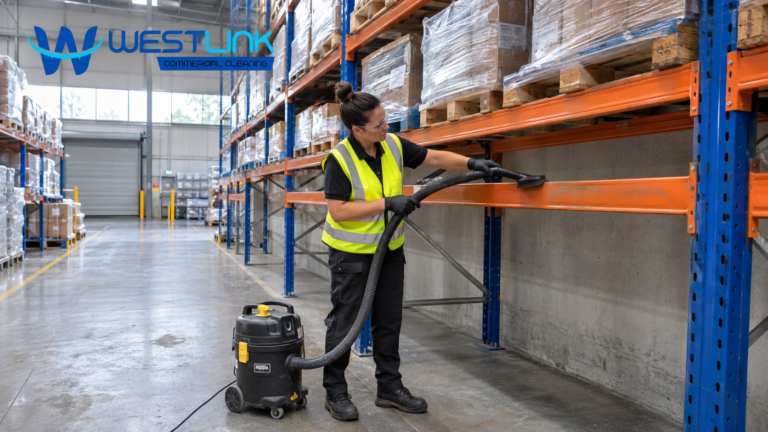
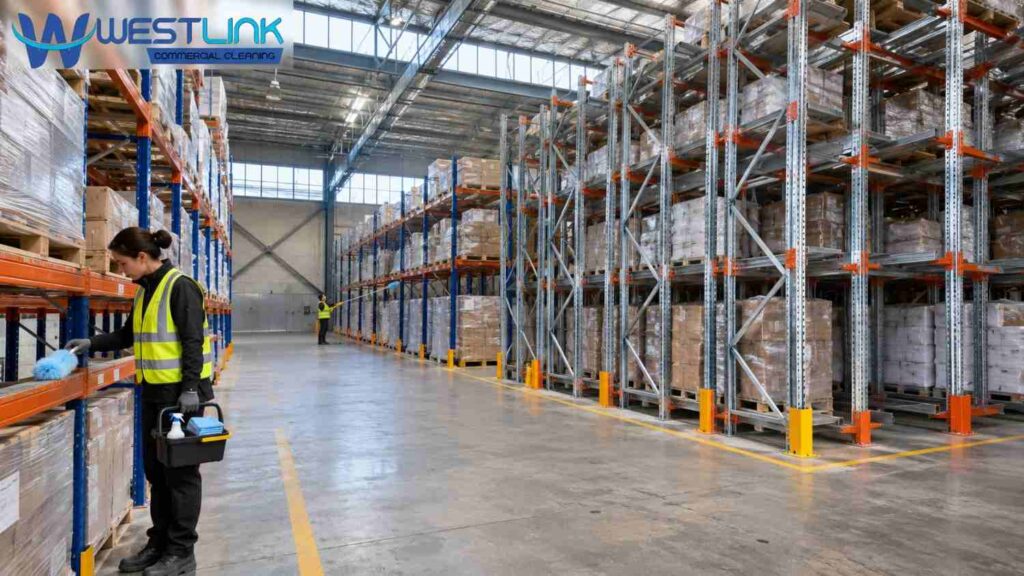
Professional warehouse pallet racking cleaning is a specialised commercial warehouse cleaning service that removes dust, packaging debris, spills, and residue from industrial storage racks and high shelving. Trained crews use industrial vacuum systems, telescopic reach tools, and mobile elevating work platforms (MEWPs) to clean beams, upright frames, bracing, and shelf decking without disturbing rack connections.
In-house housekeeping teams typically clean floors and lower surfaces. A professional service cleans the high-bay levels that require access equipment, trained operators, and a site-specific risk assessment.
Dust accumulation on racking affects inventory protection, warehouse hygiene, and working conditions. Cleaning also exposes visible damage, corrosion, and loose components that supervisors can refer for formal assessment.
What Does a Professional Racking Cleaning Service Include?
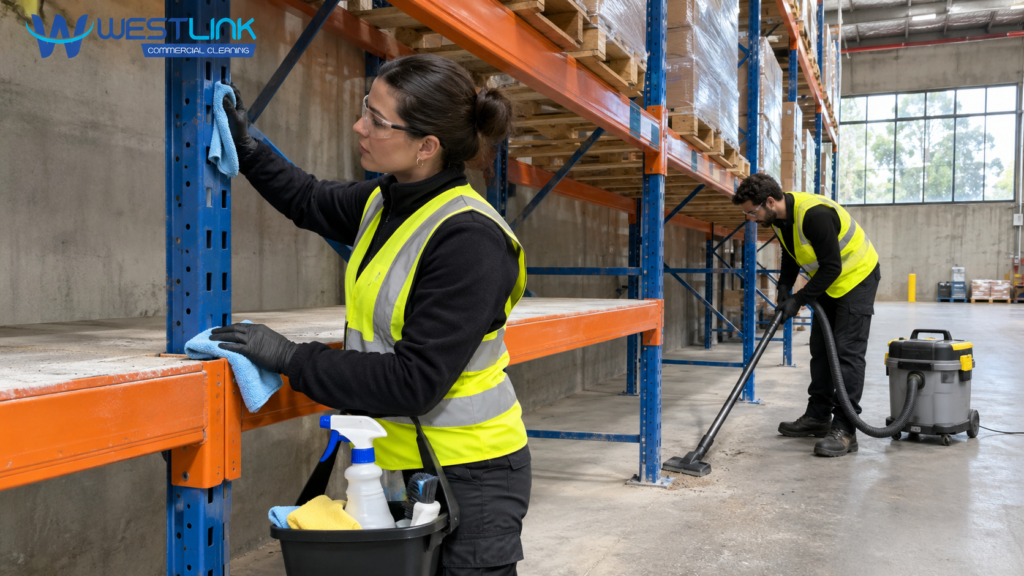
A professional warehouse racking cleaning service includes seven defined deliverables, each documented in the job record.
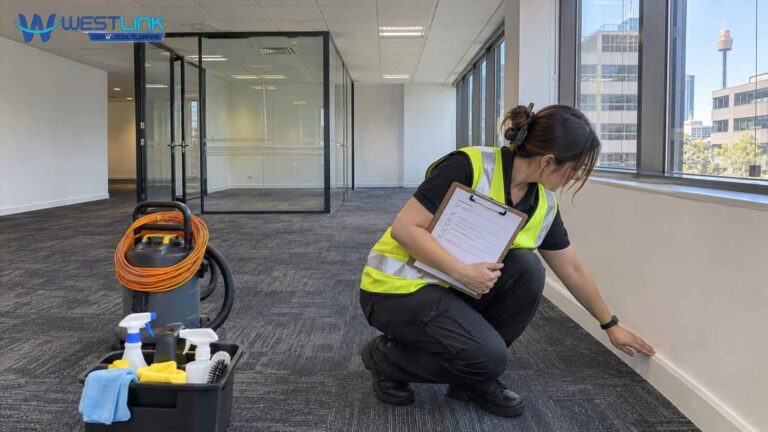
Pre-clean rack condition check: Crews note bent uprights, distorted beams, missing locking devices, damaged bracing, and corrosion before work starts.
Site risk assessment and method statement: The provider issues both documents before the first shift.
Controlled dust extraction: Crews use industrial, HEPA-filtered, or combustible-dust-rated vacuum systems matched to the dust type.
Top-to-bottom cleaning: Crews clean top beams, decking, uprights, and connections first, then lower levels, so falling dust is collected in sequence.
Low-moisture surface cleaning: Crews apply manufacturer-compatible solutions to cloths or pads, never directly into joints.
Debris collection and disposal: Crews remove collected waste according to the site’s waste handling procedure.
Defect report: The site supervisor receives a written record of visible rack damage.
Racking cleaning does not replace a formal pallet racking inspection. Crews report visible defects, and the facility’s competent person assesses structural condition.
Which Warehouses Need Professional High-Level Racking Cleaning?
Warehouses with high-bay storage, sensitive inventory, or elevated dust and contamination risk benefit most from professional racking cleaning.
These facility types schedule cleaning most often:
Distribution and logistics centres: High throughput generates packaging debris and carton dust on upper levels.
Food and beverage warehouses: Hygiene audits require clean storage surfaces and documented cleaning records.
Pharmaceutical distribution centres: Contamination control standards demand low-dust storage environments.
Facilities handling combustible materials: Combustible dust on elevated surfaces creates fire and explosion hazards, so vacuum equipment must be approved for that dust.
Cold-storage facilities: Moisture, ice, and condensation require low-temperature cleaning methods.
Pre-audit and post-incident sites: Facilities preparing for a client or regulator audit, or recovering from a spill or contamination event, need a one-off deep clean.
How Do Professional Crews Clean Pallet Racking Step by Step?
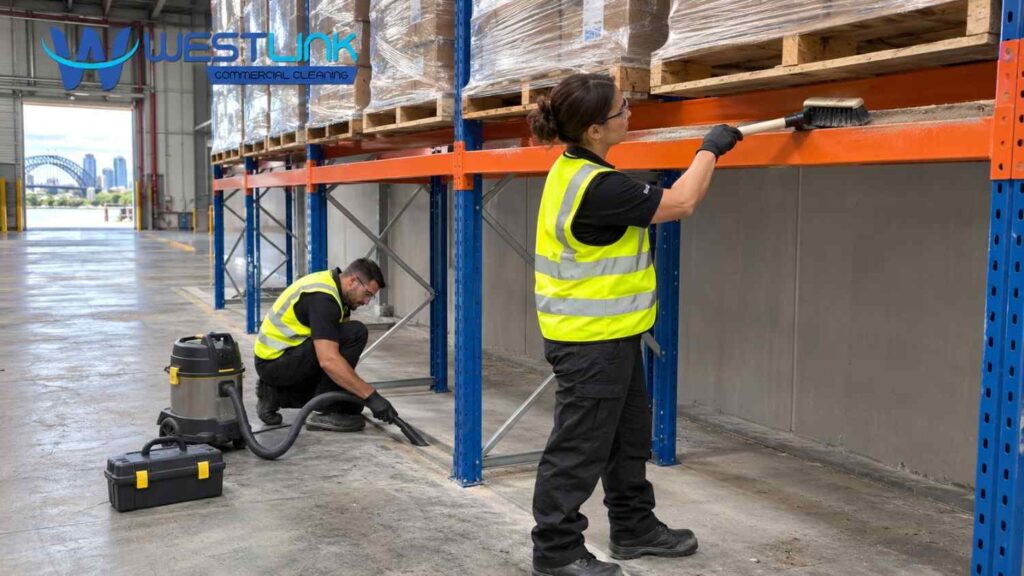
Professional crews clean pallet racking in eight steps that separate workers from forklift traffic and control falling objects.
Survey and plan. The provider visits the site, measures rack height and bay count, and identifies dust type and access constraints.
Inspect the racking. Crews check for visible damage and report any condition that makes a bay unsafe to work in.
Isolate the cleaning zone. Crews install barriers and signs and coordinate with the warehouse supervisor to keep forklifts out of the zone.
Secure or remove inventory. Trained operators relocate pallets where access requires it. Stable loads stay in place when the risk assessment allows.
Extract dust top to bottom. Crews capture dust at source with vacuum attachments and telescopic tools. Compressed air and uncontrolled dry brushing are not used.
Clean beams, uprights, and decking. Crews use soft brushes, microfiber cloths, and non-abrasive pads that protect powder-coated and galvanised finishes.
Collect debris and inspect. Crews vacuum shelf bases and floors, dispose of waste, and check for wet surfaces and left-behind equipment.
Verify and hand over. The cleaning supervisor confirms stable stock, dry surfaces, and clear aisles, then hands the aisle back to the site supervisor with the defect report.
What Equipment Is Used for High-Level Warehouse Cleaning?
Cleaning equipment is selected by rack height, dust characteristics, access restrictions, and the warehouse environment.
| Equipment | Function |
| Industrial vacuum | Removes dust and loose debris from rack surfaces |
| HEPA-filtered vacuum | Captures fine particles where HEPA filtration is appropriate |
| Combustible-dust-rated vacuum | Collects combustible dust where the hazardous-area classification requires it |
| Telescopic cleaning pole | Reaches elevated surfaces from floor level |
| MEWP | Provides controlled access to upper rack levels |
| Microfiber cloths and soft brushes | Remove surface dust without abrading coatings |
| Barriers and safety signs | Restrict access to active cleaning zones |
A HEPA-filtered vacuum is not automatically suitable for combustible dust. Equipment suitability is confirmed against the site’s dust assessment before work begins.
How Are Crews and Warehouse Staff Kept Safe During Racking Cleaning?
Professional crews control six hazards on every racking cleaning job: falls, falling objects, forklift traffic, dust exposure, chemicals, and equipment stability.
Working at height: Only trained operators use MEWPs, and they inspect the platform and verify floor suitability before use. Crews never climb racking, stand on beams, or use pallets as work platforms.
Falling objects: Crews set exclusion zones beneath elevated work and secure tools and attachments.
Forklift traffic: Forklifts stay out of cleaning zones unless the supervisor authorises and coordinates movement.
Dust exposure: Crews wear the PPE identified in the risk assessment, including respiratory protection selected for the actual exposure.
Chemicals: Crews use only manufacturer-compatible cleaning solutions.
Documentation: A qualified provider holds public liability and employer’s liability insurance and recognised health and safety contractor certifications, and supplies method statements on request.
How Often Should a Commercial Warehouse Schedule Racking Cleaning?
A commercial warehouse should set racking cleaning frequency through a documented risk assessment because no single interval suits every site. The schedule below is illustrative, not a regulatory requirement.
| Frequency | Activity |
| Daily or each shift | Warehouse staff remove spills, loose packaging, and debris from accessible areas |
| Weekly | Warehouse staff clean lower rack surfaces and check commonly affected areas |
| Monthly | Supervisors check upper shelving for dust build-up and book targeted cleaning |
| Quarterly | Professional crews perform planned detailed cleaning where dust build-up requires it |
| As required | Specialist high-level cleaning follows contamination, major dust build-up, or operational change |
Food warehouses, pharmaceutical facilities, and sites with combustible materials often need stricter controls and more frequent professional cleaning. Programmes run as one-off, scheduled, or contract engagements.
Which Pallet Racking Systems Can Be Professionally Cleaned?
Professional cleaning covers seven pallet racking system types, each with its own access and isolation requirements.
| Racking system | Cleaning consideration |
| Selective | Accessible beams and uprights allow zone-by-zone cleaning |
| Double-deep | Rear positions may require pallet removal for access |
| Drive-in | Narrow internal lanes require controlled entry and vehicle isolation |
| Pallet flow | Rollers and moving components require approved maintenance procedures |
| Shuttle | Automated equipment must be isolated before cleaning |
| High-density compact | Restricted access requires planning and suitable equipment |
| Cold-storage | Moisture, ice, and condensation need temperature-compatible methods |
Crews follow the storage system manufacturer’s instructions, especially for mechanised and automated systems.
What Affects the Cost of Warehouse Racking Cleaning?
The cost of warehouse racking cleaning depends on eight site-specific factors measured during the site survey.
- Rack height and bay count: Taller and larger installations need more crew hours and access equipment.
- Dust load: Heavy or combustible dust requires slower extraction and specialist vacuums.
- Inventory status: Cleaning with stock in place costs less than cleaning with pallet removal and replacement.
- Access method: Floor-level reach tools cost less than MEWP hire and operator time.
- Working hours: Out-of-hours or weekend work to avoid disrupting operations changes the rate.
- Site type: Food, pharmaceutical, and cold-storage sites add hygiene and temperature requirements.
- Waste volume and disposal: Hazardous or bulk waste adds handling steps.
- Programme length: Scheduled contracts may be priced differently from one-off cleans.
Pricing is quoted per bay, per linear metre, or as a fixed quote after the site survey.
How Do You Choose a Warehouse Racking Cleaning Provider?
Choose a warehouse racking cleaning provider by verifying seven credentials before signing a contract.
- Insurance: Request proof of public liability and employer’s liability cover.
- Method statement and risk assessment: Require both documents before work begins.
- Working-at-height competence: Confirm MEWP operator training and inspection records.
- Equipment suitability: Ask which vacuum types the provider uses, and whether they are rated for your dust.
- Sector experience: Ask for references from similar sites, such as food, pharmaceutical, or cold storage.
- Reporting: Confirm the provider documents rack defects and hands them to your supervisor.
- Operational planning: Confirm the provider can work around forklift traffic and shift patterns.
A reliable provider supplies all seven on request, along with years in operation and client references.
How Do You Request a Warehouse Racking Cleaning Quote?
A warehouse manager can request a racking cleaning quote by booking a site survey through phone, online form, or email.
Prepare these details to receive an accurate quote:
- Site address and warehouse type
- Rack height, system type, and approximate bay count
- Dust or contamination type, including any combustible materials
- Whether stock stays in place during cleaning
- Preferred working hours and any audit or deadline date
Westlink Commercial Cleaning returns a written quote within a few working days of the survey, with a defined scope and price. Book your site survey today.
Frequently Asked Questions
Does professional racking cleaning require unloading the racking?
Crews clean accessible rack surfaces with stock in place when the loads are stable and the risk assessment confirms cleaning will not disturb them. Pallet removal is necessary when stock blocks safe access or creates falling-object and contamination risks.
Can racking cleaning take place while the warehouse is operating?
Racking cleaning can run during live operations by isolating zones and coordinating with the supervisor, though out-of-hours work reduces forklift and pedestrian conflicts. The site survey determines the safest schedule.
Does racking cleaning replace a pallet racking inspection?
Racking cleaning does not replace a formal inspection. Crews report visible damage found during cleaning, and the facility’s competent person assesses structural condition and repair needs.
Do crews use water or pressure washing on racking?
Crews use low-moisture cleaning on steel racking and do not pressure-wash loaded racks. Excess water can contribute to corrosion and contaminate stored goods.
Can food and pharmaceutical warehouses use professional racking cleaning?
Food and pharmaceutical warehouses use professional racking cleaning with colour-coded tools and documented cleaning records. Audit requirements should be shared at the survey stage.
Which areas does the service cover?
The service covers commercial warehouses across the surrounding region, with crews mobilised promptly after an approved quote.
Summary: Professional Racking Cleaning for Commercial Warehouses
Westlink Commercial Cleaning provides professional warehouse pallet racking cleaning that combines a rack condition check, controlled dust extraction, safe high-level access, and a documented handover. The service protects inventory, supports hygiene and fire-risk control, and surfaces rack defects for formal assessment.