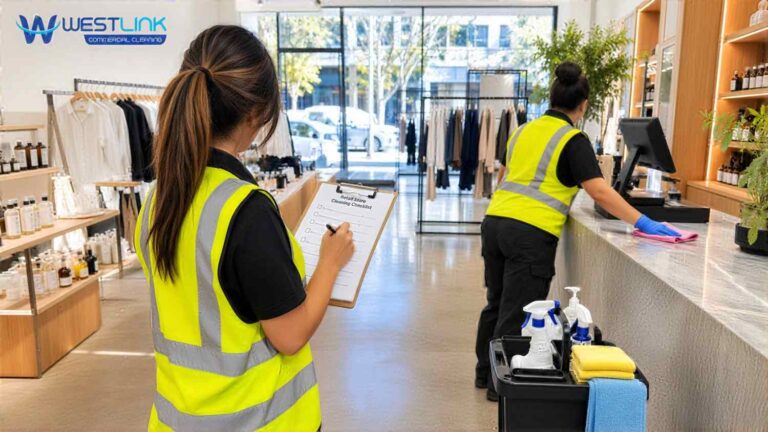
A retail store cleaning checklist for a Sydney shop covers daily surface cleaning, weekly detailed maintenance and monthly deep cleaning, and records the cleaning area, task, frequency, responsible employee and completion status. A complete checklist names every customer-facing area, staff facility, piece of equipment, task frequency and safety inspection. Daily cleaning runs before opening, during trading hours and after closing. Weekly cleaning removes accumulated dust and treats localised stains. Monthly cleaning removes built-up grime from hard-to-reach surfaces. Cleaning frequencies follow workplace risk, and NSW work health and safety duties govern every cleaning procedure.
What is a retail store cleaning checklist?
A retail store cleaning checklist is a written schedule that assigns each cleaning task of a shop to a frequency, an employee and a completion record. A Sydney store manager uses the checklist to keep shopfronts, sales floors, fitting rooms, checkout counters and stockrooms clean throughout trading hours. The checklist also shows which tasks were missed and who owns each task.
What should a retail store cleaning checklist include?
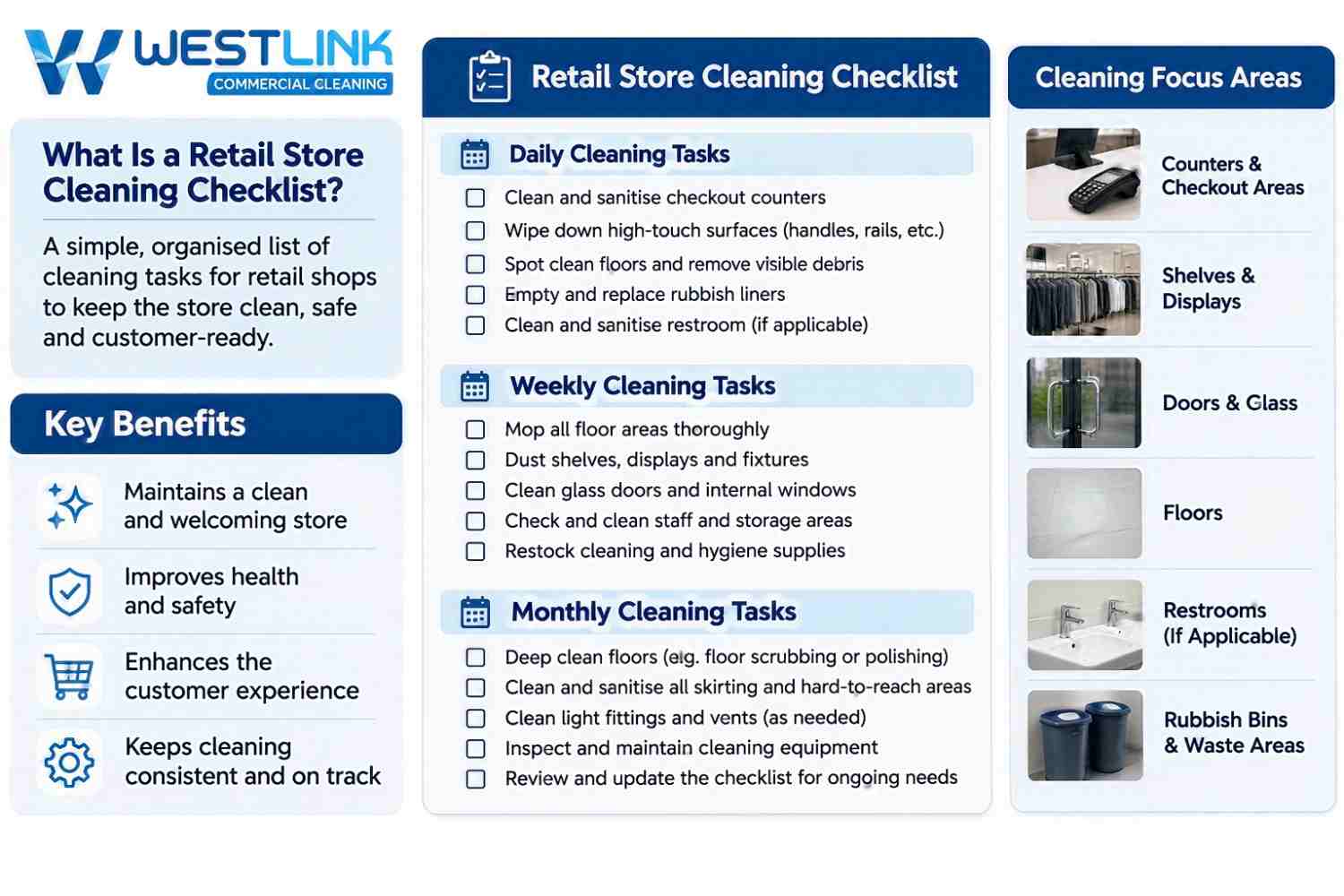
A retail store cleaning checklist should include every customer-facing area, staff facility, piece of cleaning equipment, task frequency and safety inspection. Each task needs one assigned employee and one method of recording completion.
| Cleaning area | Main cleaning tasks | Recommended frequency |
| Shopfront and entrance | Clean glass, door handles and entrance mats | Daily |
| Sales floor | Sweep, vacuum, mop and remove spills | Daily |
| Checkout counter | Wipe counters and compatible payment equipment. | Daily and as needed |
| Display shelves | Dust shelves, fixtures and product display surfaces | Daily spot cleaning; weekly detailed cleaning |
| Fitting rooms | Clean mirrors, floors, benches and handles | Daily and during trading |
| Stockroom | Remove packaging, clear aisles and clean floors. | Daily inspection; weekly cleaning |
| Staffroom and toilets | Clean fixtures, bins, sinks and frequently touched surfaces | Daily or more often as needed |
| Floors and carpets | Scrub in detail and apply suitable deep cleaning | Monthly or according to condition |
| High-level fixtures | Remove accessible dust from vents, corners and fittings. | Monthly or as needed |
These frequencies are risk-based starting points. Foot traffic, floor materials, trading hours, weather and the type of merchandise sold change the right frequency for each shop. A busy Sydney CBD shop may need extra entrance and floor cleaning during peak shopping periods.
What are the daily cleaning tasks in a retail store?
The daily cleaning tasks of a retail store are completed before opening, during trading hours and after closing. These tasks remove visible dirt, address immediate hazards and prepare the premises for customers.
What should staff clean before opening?
Pre-opening cleaning prepares the entrance, sales areas and customer facilities before the first shoppers arrive.
The pre-opening tasks are listed below:
- Inspect the shop entrance for rubbish, moisture and floor hazards.
- Remove fingerprints from entrance glass and door handles.
- Check entrance mats for dirt, damage or movement.
- Sweep or vacuum the sales floor.
- Damp mop suitable for hard floors and allow the floors to dry.
- Wipe checkout counters and customer service desks.
- Clean EFTPOS terminals and POS touchscreens according to the manufacturer’s instructions.
- Remove dust and visible marks from display counters.
- Check fitting room mirrors, benches and floors.
- Empty rubbish bins and replace liners where necessary.
- Inspect toilets and replenish soap, toilet paper and hand-drying supplies.
- Keep stockroom aisles and emergency exits unobstructed.
The store manager confirms that floors are dry, customer areas are presentable and essential cleaning tasks are complete before opening.
What should staff clean during trading hours?
Cleaning during trading hours targets spills, frequently touched surfaces, rubbish build-up and customer-used facilities.
The trading-hours tasks are listed below:
- Remove spills promptly and isolate the affected area until the floor is safe.
- Inspect high-traffic entrance areas for tracked-in dirt and water.
- Spot-clean visible fingerprints from glass and display surfaces.
- Wipe shopping baskets and trolley handles as needed.
- Monitor fitting rooms for litter, marks and misplaced merchandise.
- Check toilets and restock consumables when required.
- Empty bins before the bins overflow.
- Remove packaging and debris from customer walkways.
- Keep cleaning tools, cables and supplies away from shoppers.
- Report damaged flooring and persistent slip hazards.
In Sydney’s wet-weather periods, water enters shops on footwear, umbrellas and shopping trolleys. Stores should increase entrance inspections and lay suitable matting to reduce the risk of slippery floors.
What should staff clean after closing?
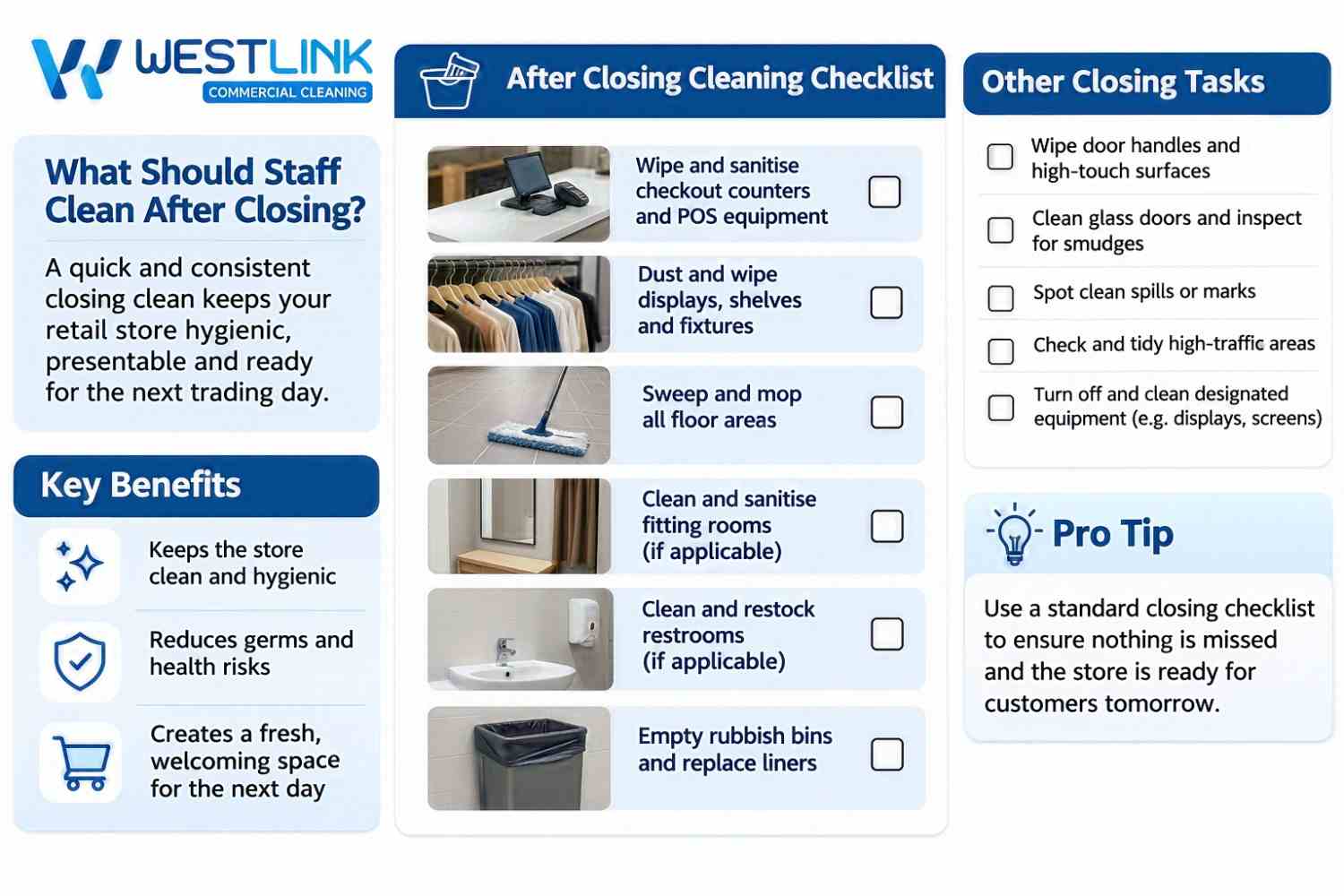
End-of-day cleaning removes the dirt and waste of the trading day and prepares the store for the next day.
The after-closing tasks are listed below:
- Vacuum carpets and sweep accessible floor areas.
- Mop suitable hard floors with the recommended cleaning solution.
- Clean checkout counters, service desks and frequently touched fixtures.
- Remove fingerprints from mirrors and accessible glass surfaces.
- Clean fitting room floors, seats and garment return areas.
- Wipe staffroom tables and kitchenette benchtops.
- Clean toilets, sinks, taps and other washroom fixtures.
- Empty waste and recycling bins.
- Remove loose cardboard and packaging from stockrooms.
- Clean and store reusable cleaning equipment.
- Replenish cleaning supplies for the next shift.
- Record completed tasks and report outstanding issues.
The closing supervisor checks the completed daily checklist and records tasks that need follow-up.
What does a weekly retail store cleaning checklist cover?
A weekly retail store cleaning checklist covers the detailed tasks that daily cleaning does not reach. Weekly cleaning removes accumulated dust, treats localised stains and maintains fixtures in less accessible areas.
| Retail area | Weekly cleaning task |
| Display shelves | Remove products where appropriate and dust shelf surfaces. |
| Display cabinets | Clean accessible glass, frames and interior surfaces |
| Sales floor | Scrub floor edges and clean beneath movable fixtures. |
| Fitting rooms | Detail-clean hooks, benches, partitions and mirror edges |
| Mannequins | Dust surfaces with materials suited to their finishes |
| Shopfront | Clean door frames, tracks and accessible glass |
| Skirting boards | Wipe away accumulated dirt and dust. |
| Carpets | Treat suitable localised stains |
| Customer seating | Vacuum upholstery and accessible crevices |
| Stockroom | Clean shelving, receiving benches and storage walkways |
| Staff facilities | Clean appliance exteriors and suitable kitchen equipment |
| Waste storage | Wash bins and clean accessible surrounding surfaces. |
| Cleaning equipment | Inspect vacuum components, mop heads and reusable tools. |
How should weekly cleaning be scheduled?
Weekly cleaning should be divided across quieter trading periods or scheduled after hours to limit disruption to customers. A Sydney clothing boutique, for example, can clean display shelves on Monday, detail-clean fitting rooms on Wednesday and complete stockroom housekeeping on Friday. The store manager verifies completion at the end of each week and records any maintenance issues found during cleaning.
What does a monthly retail store deep cleaning checklist cover?
A monthly retail store deep cleaning checklist covers built-up grime, hard-to-reach surfaces and periodic maintenance needs. Monthly tasks generally need extra time, specialised equipment or access outside trading hours.
The monthly tasks are listed below:
- Deep-clean suitable hard-floor surfaces with a suitable scrubber.
- Inspect tiles and clean dirty grout lines where required.
- Assess carpets for extraction cleaning or another approved treatment.
- Remove dust from safely accessible high-level surfaces.
- Clean accessible air vent covers and grilles without interfering with building systems.
- Detail-clean display cabinets and removable display components.
- Clean internal wall marks and skirting boards.
- Clean stockroom floors and accessible shelving thoroughly.
- Deep-clean waste storage areas and bins.
- Inspect upholstery and arrange suitable cleaning if needed.
- Check cleaning equipment for wear, damage and maintenance needs.
- Review the cleaning supply inventory.
- Complete a retail cleaning inspection and record corrective actions.
Not every surface needs deep cleaning every month. Carpet extraction, floor polishing, stone restoration and specialist window cleaning follow the material’s condition, the manufacturer’s guidance and the level of use.
When is professional deep cleaning necessary?
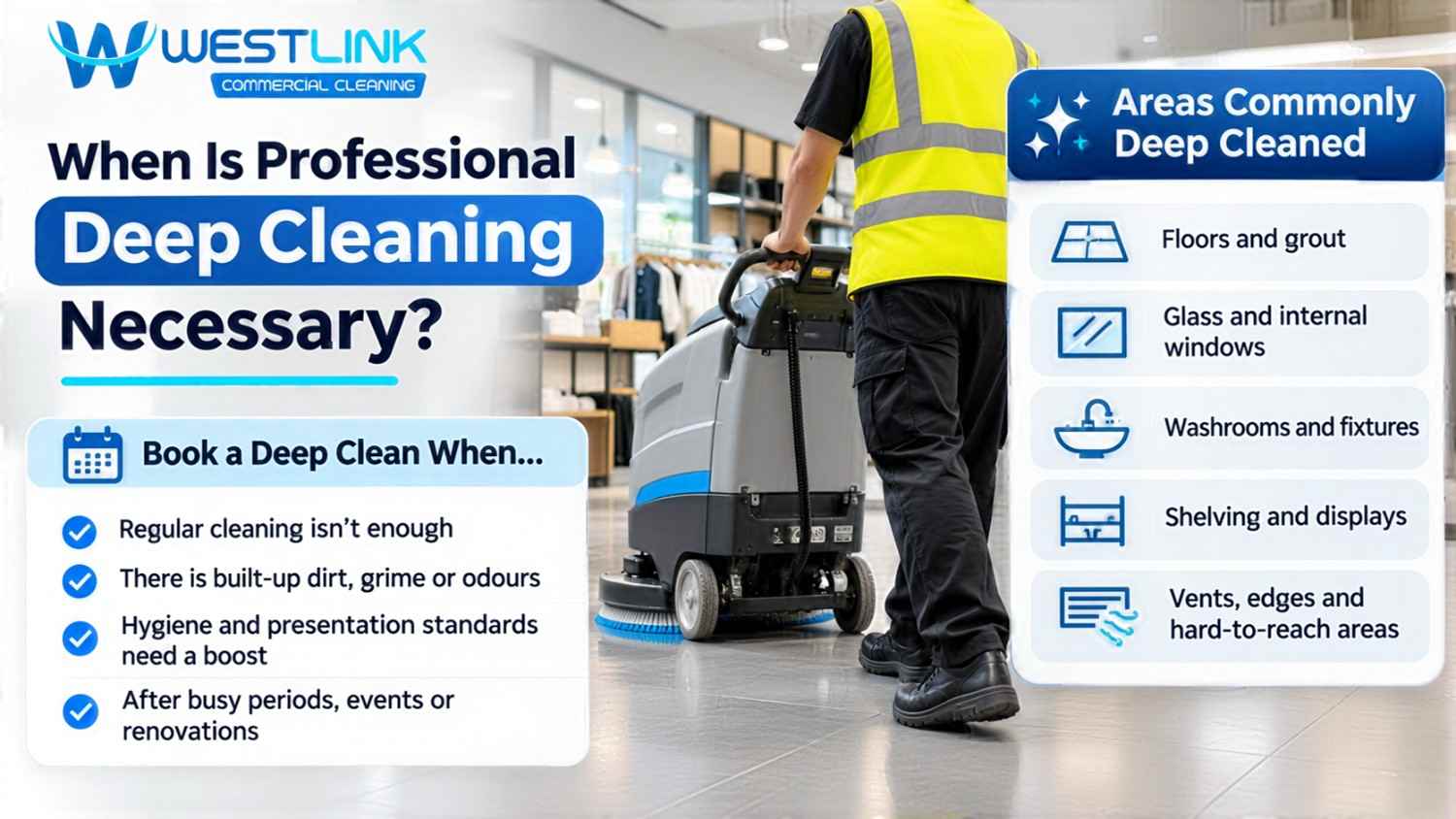
Professional retail deep cleaning is appropriate when a shop needs machine floor scrubbing, specialist carpet treatment, high-access glass cleaning or floor restoration. Professional deep cleaning also suits the periods after major sales events, store refurbishments, seasonal promotions and heavy customer traffic. Westlink Commercial Cleaning provides commercial floor cleaning and commercial carpet cleaning for these tasks.
What does a retail clothing store’s daily cleaning checklist add?
A retail clothing store’s daily cleaning checklist adds tasks for fitting rooms, garment displays, mirrors and fabric-sensitive surfaces. Clothing shops need close attention to lint, dust and fitting room presentation because customers handle merchandise and share changing areas.
| Area | Cleaning task | Frequency |
| Fitting rooms | Vacuum floors and remove litter. | Daily and as needed |
| Fitting room mirrors | Remove fingerprints and visible smudges. | Daily |
| Benches and hooks | Wipe frequently touched surfaces. | Daily |
| Garment return racks | Remove debris and check cleanliness. | Daily |
| Display tables | Dust around folded merchandise. | Daily |
| Mannequins | Remove surface dust with suitable methods. | Weekly |
| Clothing rails | Wipe accessible rails without applying chemicals to garments | Weekly |
| Upholstered seating | Vacuum lint and loose debris | Weekly |
| Display platforms | Clean underneath movable stands. | Weekly |
| Stockroom | Remove packaging waste and keep textile stock protected. | Daily inspection |
Staff should never spray cleaning chemicals directly onto garments, leather accessories, jewellery or delicate merchandise. Staff should use surface-compatible products and cover stock before cleaning nearby fixtures.
What does a printable retail store cleaning checklist template look like?
A printable retail store cleaning checklist template gives a Sydney shop manager a reusable format for tracking cleaning duties, with one checklist page and a separate exception log. The manager copies the template into a document or spreadsheet, adds store-specific tasks and prints the pages for daily staff use.
The header fields of the checklist page are listed below:
- Store name: __________________________
- Location: __________________________
- Cleaning date: __________________________
- Assigned employee: __________________________
The task rows of the checklist page are shown below.
| Cleaning task | Frequency | Assigned to | Time completed | Pass / Fail / N/A |
| Inspect the entrance and shopfront. | Daily | ______ | ______ | ______ |
| Clean doors and high-touch surfaces | Daily | ______ | ______ | ______ |
| Sweep or vacuum the sales floor. | Daily | ______ | ______ | ______ |
| Mop suitable hard floors. | Daily | ______ | ______ | ______ |
| Clean checkout and service counters | Daily | ______ | ______ | ______ |
| Clean fitting rooms, if applicable | Daily | ______ | ______ | ______ |
| Clean toilets and replenish supplies. | Daily | ______ | ______ | ______ |
| Empty bins and separate recycling | Daily | ______ | ______ | ______ |
| Dust shelving and fixtures | Weekly | ______ | ______ | ______ |
| Detail-clean floor edges | Weekly | ______ | ______ | ______ |
| Clean stockroom shelving | Weekly | ______ | ______ | ______ |
| Deep-clean suitable floors | Monthly | ______ | ______ | ______ |
| Clean accessible high-level surfaces. | Monthly | ______ | ______ | ______ |
| Complete cleaning quality inspection | Monthly | ______ | ______ | ______ |
The sign-off fields of the checklist page are listed below:
- Employee initials: __________________________
- Supervisor verification (signature and time): __________________________
The exception log records every hazard, missed task and failed check, so the checklist page stays uncluttered. The log layout is shown below.
| Date | Location | Hazard or missed task | Corrective action | Deadline | Assigned to | Closed |
| ______ | ______ | ______ | ______ | ______ | ______ | ☐ |
| ______ | ______ | ______ | ______ | ______ | ______ | ☐ |
| ______ | ______ | ______ | ______ | ______ | ______ | ☐ |
Stores that want these tasks completed to a schedule can request a retail cleaning quote for a Sydney store.
How do you create a retail store cleaning checklist PDF?
To create a retail store cleaning checklist PDF, copy the template into Microsoft Word or Google Docs, customise the tasks and export the file as a PDF. A printable daily checklist for retail employees keeps the opening, trading-hours and closing duties on separate pages or in clearly labelled sections.
What cleaning equipment does a retail store need?
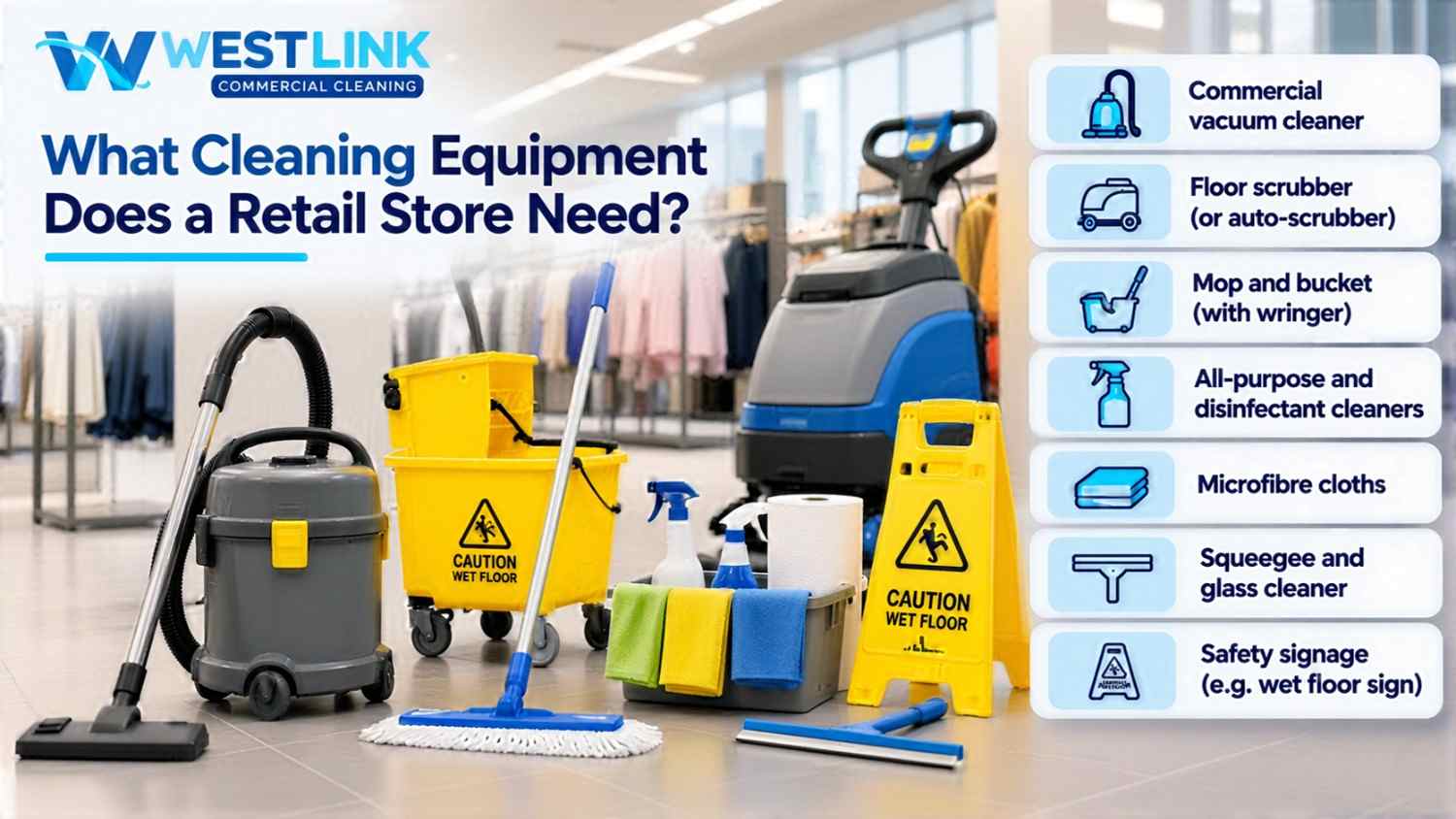
Most retail stores need a commercial vacuum cleaner, microfibre cloths, a suitable mop system, surface-compatible cleaning products, waste bags and wet-floor warning signs.
| Equipment | Primary use |
| Commercial vacuum cleaner | Carpet and suitable floor cleaning |
| Microfibre cloths | Dusting counters, shelves and fixtures |
| Flat mop or microfibre mop | Cleaning suitable hard floors |
| Neutral-pH floor cleaner | Maintaining compatible floor surfaces |
| Glass cleaner | Cleaning suitable glass and mirrors |
| Approved disinfectant | Disinfecting suitable surfaces when required |
| Colour-coded cloths | Separating toilet cleaning from other cleaning areas |
| Protective gloves | Controlling exposure where the task or product requires gloves |
| Wet-floor signs | Warning people about temporary floor hazards |
| Labelled chemical containers | Supporting safe identification and storage |
Store staff select cleaning products by surface material, manufacturer instructions and workplace risk assessments.
What is the difference between cleaning, sanitising and disinfecting?
Cleaning removes dirt and residues, sanitising reduces microorganisms to an acceptable level, and disinfecting targets microorganisms with a suitable product and the required contact time. Cleaning always comes first, because dirt reduces the effect of sanitisers and disinfectants. A Food Standards The Australia-New Zealand guide sets the same order for food businesses.
Not every checkout or display surface needs disinfecting every day. The table below shows the usual approach for five situations, and the workplace risk assessment has the final say.
| Situation | Usual approach | Note |
| Routine dust and soil on shelves, counters and floors | Detergent cleaning | Disinfection is not required on every surface every day. |
| Toilets, sinks and washroom fixtures | Cleaning, then disinfecting | Follow the product label, contact time and SDS. |
| Frequently touched surfaces, such as door handles and EFTPOS terminals | Cleaning, with disinfecting where the risk assessment calls for it | Follow the manufacturer’s instructions for payment equipment. |
| Spills of blood or body fluids | Cleaning and disinfecting under the workplace procedure | Wear the required protective equipment |
| Food-contact surfaces and equipment in food retail | Cleaning, then sanitising | Food Standards Code requirements apply. |
What cleaning methods suit each retail floor surface?
The right cleaning method for a retail floor depends on the surface material, and the manufacturer’s specification overrides general advice. The table below lists the routine method and the main caution for five common retail floor surfaces.
| Floor surface | Routine method | Main caution |
| Ceramic tile | Sweep, then damp-mop with a neutral-pH cleaner; clean dirty grout lines. | Wet tile is slippery, so place wet-floor signs and stay within the manufacturer’s chemical limits. |
| Vinyl | Sweep, then damp-mop with a neutral-pH cleaner. | Excess water at seams and abrasive pads can damage vinyl. |
| Polished concrete | Dust-mop, then damp-mop with a neutral-pH cleaner. | Harsh or acidic products can dull or etch the sealer. |
| Laminate | Sweep, then use a well-wrung damp mop. | Excess water can swell seams and edges |
| Carpet | Vacuum daily and treat spots promptly. | Over-wetting leaves moisture behind, so follow the manufacturer’s guidance for extraction. |
How often should Sydney retail stores be cleaned?
Sydney retail stores should complete routine cleaning every trading day, detailed cleaning at least weekly where needed, and periodic deep cleaning according to site conditions. These frequencies are a risk-based starting point and not a universal legal cleaning timetable.
Cleaning frequency should increase under the conditions listed below:
- Heavy customer foot traffic during weekends and sales events.
- Wet weather that carries water and dirt to the entrance.
- Frequent product handling or heavy use of fitting rooms.
- Visible dust, spills, stains or overflowing waste bins.
- Food preparation or other activities with extra hygiene requirements.
A boutique in Surry Hills, a high-traffic tenancy in the Sydney CBD and a large shop in Parramatta have different floor-cleaning needs. Store managers should assess actual conditions and avoid applying identical intervals to every location.
What are the retail cleaning safety requirements in Sydney and NSW?
Retail cleaning in NSW must be managed under the work health and safety duties in the Work Health and Safety Act 2011 and the Work Health and Safety Regulation 2025. SafeWork NSW administers both instruments. The legislation sets duties to manage risks and does not set a daily, weekly or monthly cleaning timetable for shops.
Cleaning procedures should address the foreseeable hazards of slippery floors, chemical exposure, electrical equipment, manual handling and obstructed walkways.
How do staff prevent slips, trips and falls?
Staff prevent slips, trips and falls by isolating spills, placing warning signs, choosing suitable floor-cleaning methods and keeping customers away from unsafe surfaces. SafeWork NSW describes slips, trips and falls on the same level as the most common cause of serious workplace injuries in NSW after hazardous manual tasks. The same page lists regular floor cleaning and maintenance with appropriate products among the controls. Cleaning cables, buckets and equipment must never block shopping aisles or emergency exits.
How do staff handle cleaning chemicals safely?
Staff handle cleaning chemicals safely by following product labels, the relevant Safety Data Sheets (SDS) and workplace procedures. Staff must not mix cleaning chemicals unless the manufacturer confirms compatibility. Staff wear the required protective equipment and store products securely in labelled containers.
What additional rules apply to food retail stores?
Food retailers carry obligations beyond general retail housekeeping. Standard 3.2.2 of the Australia New Zealand Food Standards Code requires food businesses to keep premises, fixtures and equipment clean and sanitary. Standard 3.2.2A adds food safety management tools for food service, catering and retail businesses that handle unpackaged, potentially hazardous, ready-to-eat food. The NSW Food Authority explains which businesses Standard 3.2.2A covers.
A cleaning checklist for a grocery store, supermarket or food retail outlet should match the business’s food-handling activities and the applicable food safety requirements.
Who is responsible for retail store cleaning?
Responsibility for retail store cleaning is divided between employees, the store manager, the cleaning supervisor and external contractors according to the cleaning scope.
| Role | Responsibility |
| Retail employees | Complete assigned routine tasks and report spills. |
| Store manager | Allocate duties and check cleaning records. |
| Cleaning supervisor | Inspect cleaning quality and address missed tasks |
| Professional cleaning contractor | Complete agreed cleaning and maintenance activities |
| Store or facilities management | Coordinate maintenance and applicable shared-area responsibilities |
For shopping centre tenancies, the retail lease and the centre management requirements can set responsibility for common areas, shared toilets, loading areas and external frontage. When a tenancy ends, the lease sets the make-good cleaning standard, and the commercial end-of-lease cleaning checklist lists the tasks.
How can store managers monitor cleaning quality?
Store managers monitor cleaning quality through completed task records, routine inspections, employee feedback and the exception log.
A practical cleaning inspection confirms the points listed below:
- Scheduled tasks were completed.
- Floors and frequently touched surfaces are visibly clean.
- Toilet and staff facilities hold sufficient supplies.
- Cleaning chemicals and equipment are stored safely.
- Open exceptions have an owner, a corrective action and a deadline.
The exception log records the date, location, issue, corrective action, deadline and owner, so the manager sees recurring problems and stops addressing the same missed task repeatedly.
When should Sydney shops hire professional retail cleaners?
Sydney shops should hire professional retail cleaners when staff cleaning cannot cover the store’s size, operating hours, floor types or specialist maintenance needs. Retail store cleaning services in Sydney include scheduled shop cleaning and periodic deep cleaning, and a contractor can take on after-hours floor care and detailed fixture cleaning.
Before engaging a cleaning company, the store manager confirms the cleaning scope, service frequency, equipment requirements, safety procedures, access arrangements and inspection process. The agreed schedule separates daily maintenance from weekly detailing and periodic specialist work. To compare scopes, request a retail cleaning scope and schedule for your Sydney store.
Questions about retail store cleaning checklists
Questions about retail store cleaning checklists cover staff and contractor roles, supervisor sign-off, missed tasks, specialist floor cleaning and store-specific customisation.
How do you divide retail cleaning between staff and contractors?
Staff handle spill response, trading-hours checks and daily surface tasks, and contractors handle after-hours floor care, machine scrubbing and periodic deep cleaning. The agreed cleaning scope states which tasks belong to which party.
What should a cleaning supervisor sign off on?
A cleaning supervisor signs off on completed tasks, visibly clean floors and frequently touched surfaces, restocked supplies, safely stored chemicals and equipment, and open exceptions with an owner. The supervisor adds a signature and a time to the checklist page.
How should missed cleaning tasks be recorded?
Missed cleaning tasks are recorded in the exception log with the date, location, task, corrective action, deadline and owner. The owner ticks the closed box when the corrective action is complete.
When does a shop need specialist floor cleaning?
A shop needs specialist floor cleaning when the floor needs machine scrubbing, polishing, restoration or carpet extraction that routine mopping and vacuuming cannot deliver. The floor material, the manufacturer’s guidance and the level of use set the timing.
Can I use the same cleaning checklist for every retail store?
No, one cleaning checklist does not suit every retail store, because each shop needs tasks that match the shop’s merchandise and activities. Clothing stores need fitting rooms and garment display tasks, and food retailers need extra cleaning and sanitising procedures.
Retail store cleaning checklist: next steps
The next step is to copy the template, add the store-specific tasks, assign one employee to each row and set a weekly supervisor review of the exception log. Daily, weekly and monthly tasks then run from one schedule that matches the shop’s layout, customer traffic, surface materials and NSW safety obligations.