A retail cleaning standard operating procedure (SOP) tells store staff what to clean, when to clean it, which methods to use, and who must verify the results. It covers opening preparation, cleaning during trading hours, closing routines, spill response, and shift handovers.
Effective retail store cleaning procedures also distinguish routine housekeeping from hazardous cleaning tasks that require trained personnel. For store managers, this means assigning responsibilities, defining acceptable cleaning standards, and keeping unresolved safety issues visible until they are addressed.
This guide provides a practical retail cleaning SOP for Australian stores, including shift checklists, spill escalation instructions, cleaning frequencies, supervisor inspection standards, and adaptable handover records.
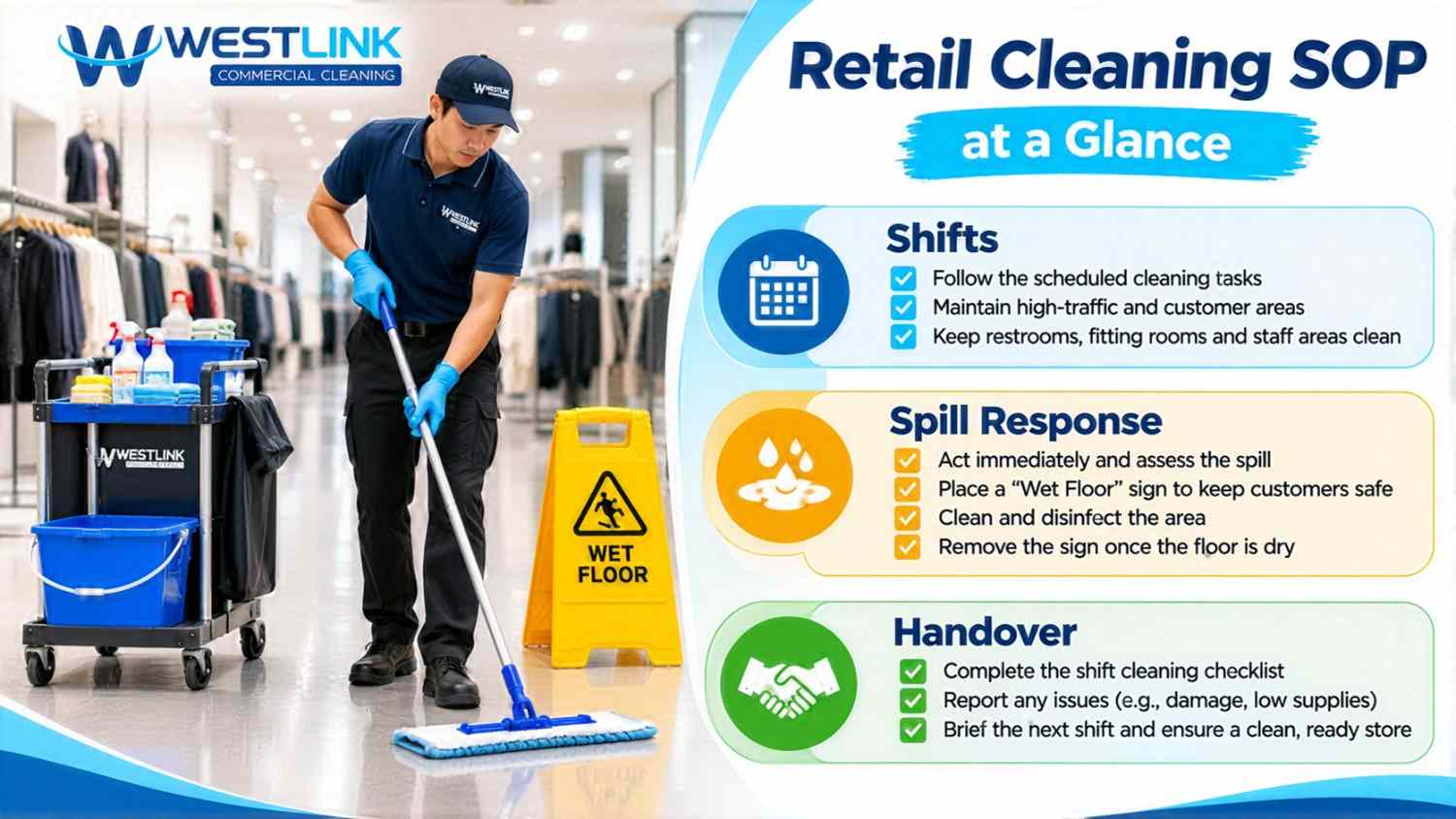
Retail Cleaning SOP at a Glance
A retail cleaning SOP organises cleaning work into scheduled tasks, immediate hazard responses, and documented supervisory checks.
| Cleaning stage | Main responsibility | Required outcome |
| Opening shift | Inspect customer areas, remove debris, and replenish supplies. | Store ready for customers |
| Mid-shift | Inspect high-traffic zones, respond to spills, and maintain hygiene. | Safe trading conditions |
| Closing shift | Complete scheduled cleaning, remove waste, secure equipment | Store prepared for the next trading day |
| Spill response | Restrict access, assess hazards, and arrange authorised cleanup | Hazard controlled before reopening |
| Shift handover | Record incomplete work, hazards, owners, and deadlines. | Incoming staff understand outstanding responsibilities. |
| Supervisor inspection | Check cleanliness, safety, and task completion. | Work accepted or corrective action assigned |
Key operating principle: A completed cleaning task, an inspected area, and a resolved hazard are three different statuses. Each must be recorded accurately.
What Must a Retail Store Cleaning SOP Include?
A retail store cleaning SOP is a controlled operational document that establishes cleaning methods, employee responsibilities, safety requirements, and verification procedures.
Unlike an informal list of chores, the SOP tells employees how to perform tasks safely and what to do when normal cleaning procedures cannot be followed.
Retail Cleaning SOP Document Control
Every retail cleaning SOP should identify its current approved version so employees can distinguish valid instructions from outdated procedures.
| Document field | Example or required entry |
| SOP title | Retail Store Cleaning Procedures |
| Document ID | RET-CLN-001 (illustrative) |
| Version | 1.0 |
| Document owner | Store manager |
| Approved by | Authorised manager |
| Effective date | Enter the approved start date. |
| Next review date | Enter the scheduled review date. |
| Applicable areas | Sales floor, fitting rooms, checkout, amenities, stockroom |
| Associated records | Cleaning checklists, spill logs, handover forms, inspection registers |
| Related procedures | Hazardous chemicals, incident reporting, emergency response |
The store manager should approve the procedure before implementation and arrange a review when cleaning equipment, chemicals, store layouts, safety risks, or staffing arrangements change.
What Is the Difference Between a Cleaning SOP and a Checklist?
A cleaning SOP explains how work must be performed, while a cleaning checklist records whether individual activities have been carried out.
For example:
- SOP instruction: Restrict customer access before wet mopping, follow the approved floor-cleaning method, and verify the surface is safe before reopening.
- Checklist entry: Entrance floor cleaned — completed at 8:15 am by the assigned employee.
- Supervisor inspection: Entrance dry, mat secure, and walkway unobstructed — accepted at 8:20 am.
The SOP governs the process. The checklist documents task completion. The inspection confirms whether the required outcome has been achieved.
Who Is Responsible for Retail Store Cleaning?
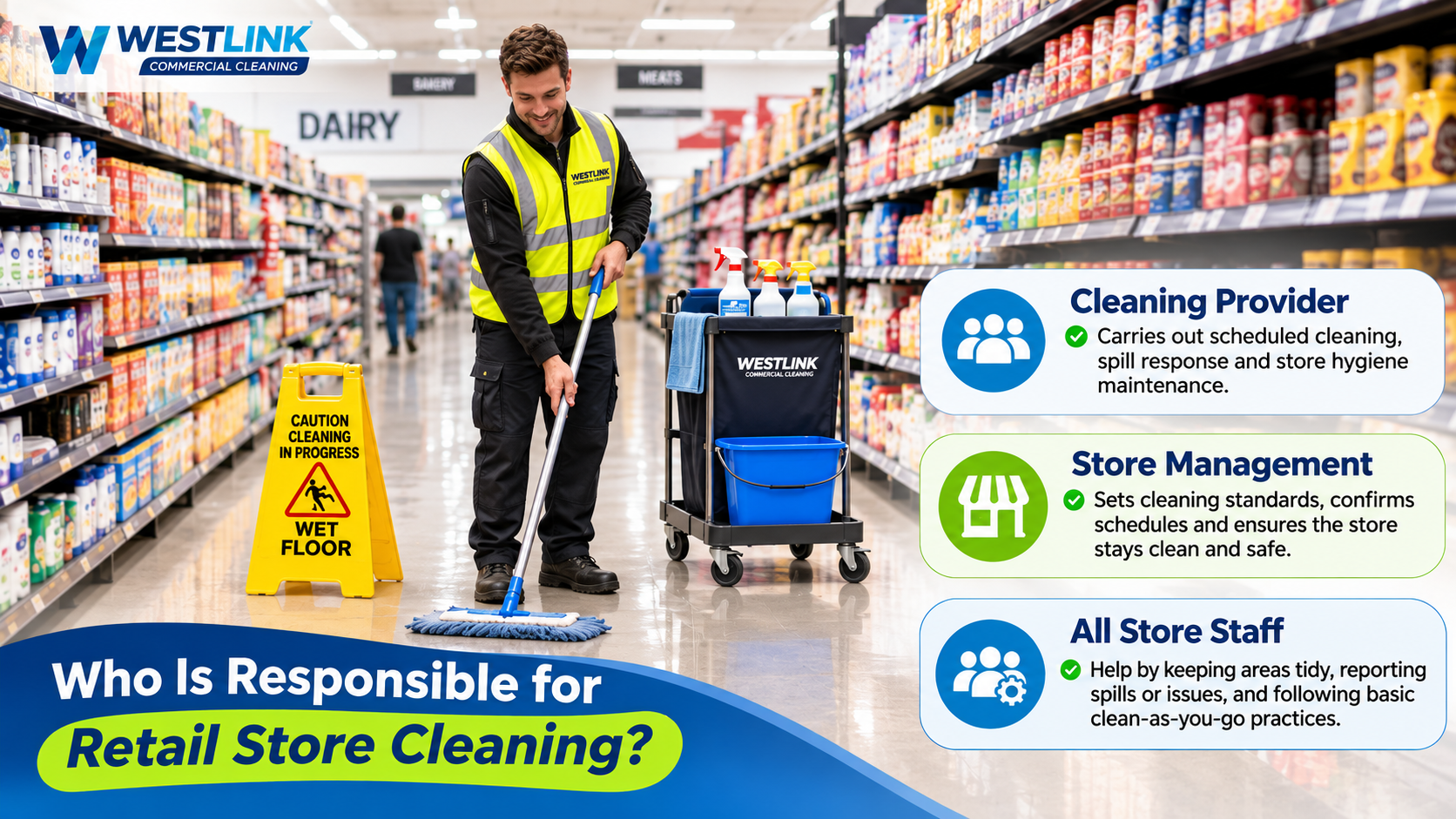
Retail cleaning responsibilities should be allocated according to employee training, cleaning risks, available equipment, and any contracted cleaning scope.
Store staff usually manage everyday presentation and immediate hazard reporting, while professional cleaning personnel may undertake scheduled deep cleaning, specialist floor care, and other agreed services.
Retail Cleaning Responsibility Matrix
| Cleaning activity | Store employees | Cleaning contractor | Shift supervisor |
| Identify and report hazards. | Report immediately. | Report when discovered. | Coordinate response |
| Clean small, non-hazardous spills | If trained and authorised | If within agreed scope | Verify when required. |
| Reset fitting rooms | Usually assigned | If contracted | Check presentation. |
| Clean checkout counters | Usually assigned | If contracted | Verify approved methods. |
| Perform scheduled floor deep cleaning. | Only if trained and equipped | If contracted | Inspect results |
| Handle unknown hazardous substances. | Isolate and escalate | Only if specifically qualified and authorised | Activate appropriate response. |
| Maintain shift cleaning records. | Update records. | Record contracted work | Review outstanding tasks. |
| Complete specialist cleaning | Only where authorised records. | If within scope and competent | Confirm requirements. |
This is an example responsibility allocation, not a mandatory staffing structure.
When Should Retail Stores Use Professional Cleaning Contractors?
Retail stores should consider professional cleaning support when tasks require specialist equipment, trained personnel, substantial cleaning time, or work outside normal employee duties.
Examples include machine floor scrubbing, carpet extraction, high-level window cleaning, periodic deep cleaning, and extensive after-hours cleaning.
A written contractor scope of works should identify cleaning zones, frequency, approved work methods, access arrangements, exclusions, inspection criteria, and reporting responsibilities.
For Sydney businesses, Westlink Commercial Cleaning‘s retail store cleaning services provide an option for discussing scheduled cleaning and specialist work.
Outsourcing cleaning does not remove the store operator’s responsibility to coordinate workplace safety and communicate site hazards with contractors.
Retail Store Cleaning Procedures for Opening, Mid-Shift and Closing
Retail cleaning procedures should follow the store’s operating cycle so employees prepare the premises before opening, manage contamination during trading, and restore cleanliness after closing.
Each shift should have assigned tasks, documented completion, and a process for escalating outstanding hazards.
Opening Shift Cleaning Checklist
Opening cleaning prepares the retail store for customer entry by identifying hazards and confirming that essential customer-facing areas meet the required standard.
Employees should complete the following activities before opening affected areas:
- Inspect entrances and walkways. Identify water, loose packaging, damaged mats, obstacles, and overnight debris.
- Clean floors. Sweep, vacuum, or spot-clean using equipment suitable for the floor finish.
- Check entrance mats. Confirm mats lie flat, remain stable, and do not obstruct access.
- Clean checkout surfaces. Remove visible dirt and use approved products on counters and shared touchpoints.
- Inspect displays and fitting rooms. Remove rubbish, tags, and other debris without disturbing merchandise.
- Check customer amenities. Inspect toilets, handwashing facilities, and consumable supplies.
- Prepare cleaning equipment. Confirm approved chemicals, cloths, warning signs, and spill kits are available.
- Complete the opening inspection. Record outstanding issues and obtain supervisor approval.
The opening supervisor should prevent customer access to areas with uncontrolled hazards, even if the rest of the store is ready for trading.
Mid-Shift Cleaning Routine
Mid-shift cleaning maintains safe shopping conditions while customers, employees, deliveries, and merchandise movements create new cleaning requirements.
Scheduled checks should focus on entrances, checkout queues, fitting rooms, restrooms, and other high-use areas.
Employees should:
- Inspect floors for liquids, packaging, loose objects, and trip hazards.
- Restrict access and respond to identified spills according to the spill response SOP.
- Spot-clean counters, display fixtures, glass, and other visibly soiled surfaces.
- Inspect fitting rooms and remove discarded packaging, hangers, or tags.
- Check restrooms and replenish essential supplies.
- Empty waste bins before rubbish obstructs access or creates hygiene concerns.
- Monitor tracked-in rainwater and dirt at entrances.
- Record cleaning tasks and report defects requiring maintenance.
Scheduled cleaning must not delay immediate hazard control. Employees should address a newly discovered slip or trip hazard when it occurs instead of waiting for the next cleaning round.
Closing Shift Cleaning Checklist
Closing cleaning restores the store after trading and prepares facilities, equipment, and records for the next shift.
The closing routine should include:
- Conduct a final walkthrough of customer-facing and back-of-house areas.
- Remove loose debris from floors, aisles, and display spaces.
- Vacuum, sweep, or mop assigned areas using approved methods.
- Clean checkout counters, fixtures, mirrors, and fitting-room surfaces.
- Complete scheduled restroom and staff-area cleaning.
- Remove waste and place it in designated disposal or collection areas.
- Clean reusable tools and separate contaminated materials for appropriate laundering or disposal.
- Inspect equipment for defects and remove unsafe equipment from service.
- Return cleaning chemicals to approved storage locations.
- Record incomplete tasks and transfer outstanding issues through the handover process.
Closing staff should not remove barriers from floors that remain wet or unsafe. Those areas must remain controlled until they can be verified as safe.
Where contractors complete overnight cleaning, the store should separately document access arrangements, alarm procedures, completion records, and morning acceptance checks. Shopping centre rules can vary by site.
Retail Store Cleaning Schedule by Area and Risk Level
Retail cleaning frequency should be based on contamination risk, pedestrian traffic, weather conditions, surface characteristics, and the consequences of a missed task.
The same timetable will not suit every boutique, supermarket, department store, or shopping centre tenancy.
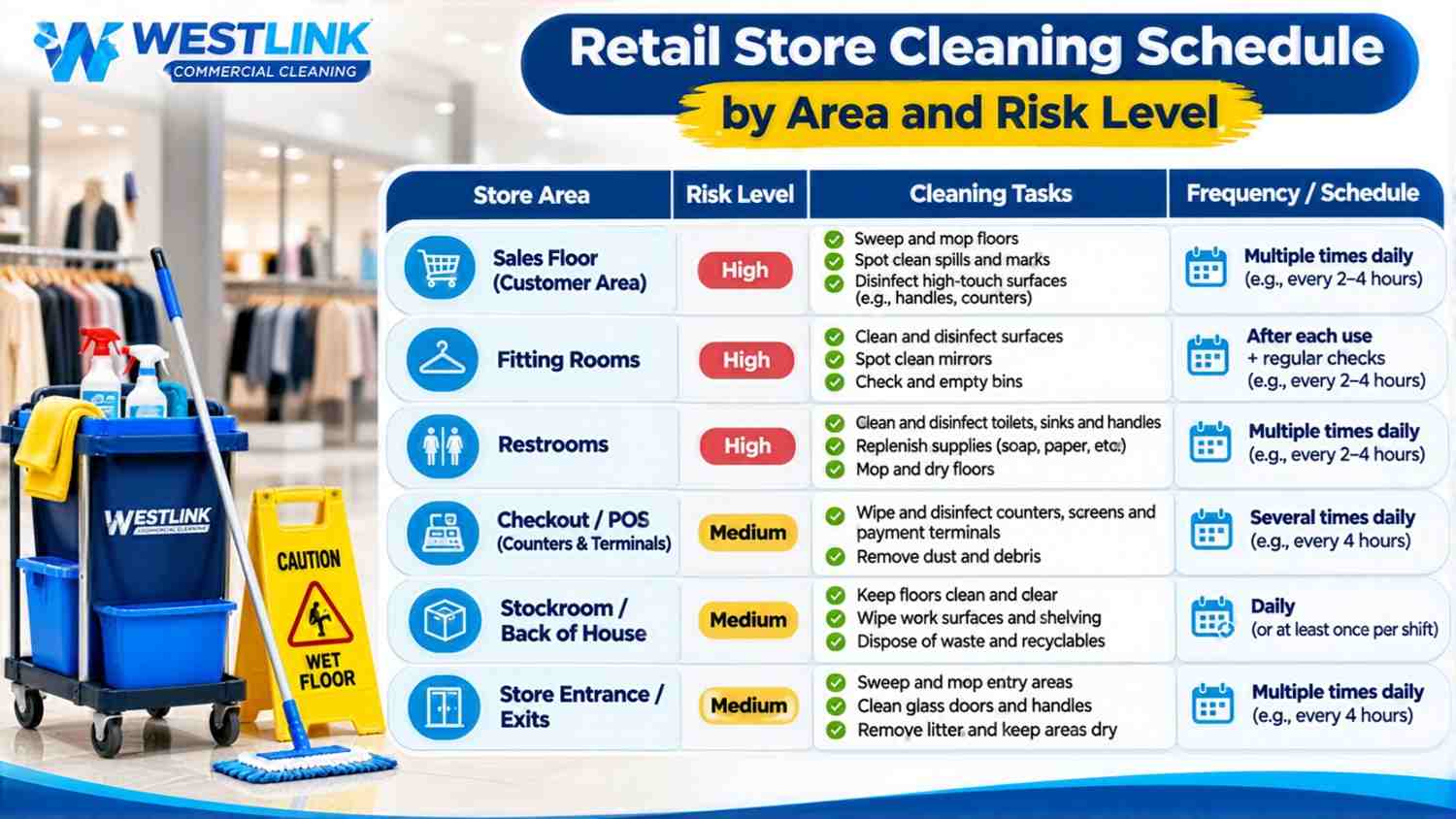
Example Retail Cleaning Frequency Schedule
| Store area | Suggested routine | Additional action trigger |
| Entrance | Opening, scheduled rounds, closing | Rainwater, dirt, debris, unstable mats |
| Sales floor | Regular inspection and daily cleaning | Spills, damaged packaging, obstacles |
| Checkout | Opening and scheduled cleaning | Visible residue or contamination |
| Fitting rooms | Scheduled checks and closing reset | Discarded tags, rubbish, spills |
| Restrooms | Risk-based checks throughout trading | Contamination, odours, missing supplies |
| Stockroom | Daily housekeeping checks | Packaging build-up, leaks, blocked routes |
| Staff breakroom | After use and scheduled cleaning | Food residue, overflowing bins |
| Display fixtures | Scheduled dusting | Visible dust or product contamination |
| Loading and receiving area | Before and after relevant activities | Spills, broken cartons, traffic hazards |
These frequencies are examples for planning, not universal legal requirements.
How Should Managers Set Inspection Frequency?
Managers should assess how frequently a hazard may develop and how quickly staff need to identify it.
For example, a store entrance exposed to heavy rain and continuous foot traffic requires closer monitoring than a locked stockroom with limited daily access.
A practical risk-based assessment should consider:
- Exposure: How many employees and customers use the area?
- Contamination likelihood: How often do liquids, rubbish, or other hazards appear?
- Potential consequence: What injury or operational disruption could result?
- Available controls: Can the hazard be prevented through mats, flooring improvements, equipment changes, or work practices?
Managers can start with an appropriate inspection schedule, review actual observations, and increase or reduce the frequency where justified by the risk assessment.
How Should Cleaning Change During Wet Weather?
Wet weather cleaning should prioritise moisture control at entrances and other locations where rainwater may be carried onto indoor floors.
Store staff should inspect entrance mats, remove tracked-in water, monitor slippery surfaces, and maintain suitable barriers during cleaning.
Managers should also investigate persistent moisture entering the store. More frequent mopping alone may not be an adequate long-term solution if drainage, flooring, or entrance design contributes to the hazard.
WorkSafe Queensland recommends cleaning methods that preserve floor slip resistance and suitable measures to keep people away from wet areas.
Retail Spill Response SOP: Isolation, Cleanup, Escalation and Reopening
A retail spill response SOP establishes how employees recognise contamination, restrict access, determine whether cleanup is authorised, and restore the affected area safely.
The response depends on the substance, spill size, location, exposure risk, and employee competence.
Retail Spill Response Decision Flow
- Spill discovered
Warn nearby people and restrict access where safe.
↓
- Assess the substance and hazards without unnecessary exposure.
Can the substance be identified safely? Is the spill manageable? Is the employee trained, equipped, and authorised to clean it?
If YES:
- Select the approved cleaning method and PPE.
- Remove the spill using suitable equipment.
- Dispose of contaminated materials appropriately.
- Clean and dry the affected surface.
- Inspect the area before reopening.
- Record the incident where required.
If NO or UNCERTAIN:
- Do not attempt cleanup.
- Maintain access restrictions where safe.
- Notify the supervisor immediately.
- Activate the relevant hazardous-material, biological-contamination, electrical, or emergency procedure.
- Reopen only after authorised personnel confirm the area is safe.
An unknown or dangerous spill must never be treated as ordinary housekeeping simply because it is small.
How Should Employees Respond to Common Retail Spills?
| Spill type | Initial control | Cleanup or escalation |
| Water or non-hazardous beverage | Restrict access and warn customers. | Trained staff can use approved absorbent and drying methods. |
| Food debris | Prevent access to the affected floor. | Collect debris safely and remove remaining residue. |
| Oil or grease | Isolate the slippery surface. | Use an approved method compatible with the flooring. |
| Broken glass or damaged merchandise | Establish a safe exclusion area. | Trained personnel use appropriate collection tools and disposal containers. |
| Unknown chemical | Prevent contact and access | Escalate; do not attempt identification through direct exposure. |
| Bodily fluids | Isolate the area. | Follow the applicable biological contamination and exposure-control procedure. |
| Large or uncontrolled spill | Restrict entry where safe | Activate specialist or emergency response arrangements. |
Employees should not use bare hands to collect broken glass or attempt to neutralise unidentified chemicals.
When Must a Spill Be Escalated?
A spill requires escalation when ordinary cleaning procedures cannot control the hazard safely.
Examples include unidentified chemicals, substantial hazardous releases, dangerous fumes, exposed electrical equipment, significant biological contamination, or a spill beyond the training and equipment available.
The employee who discovers the problem should warn others, report it, and maintain safe access controls where possible.
Reporting the hazard does not make the area safe. The person authorised to reopen the area must verify that the hazard has been controlled.
If an incident causes a serious injury, dangerous incident, or other potentially notifiable event, management must assess its reporting and site-preservation duties under applicable NSW WHS requirements.
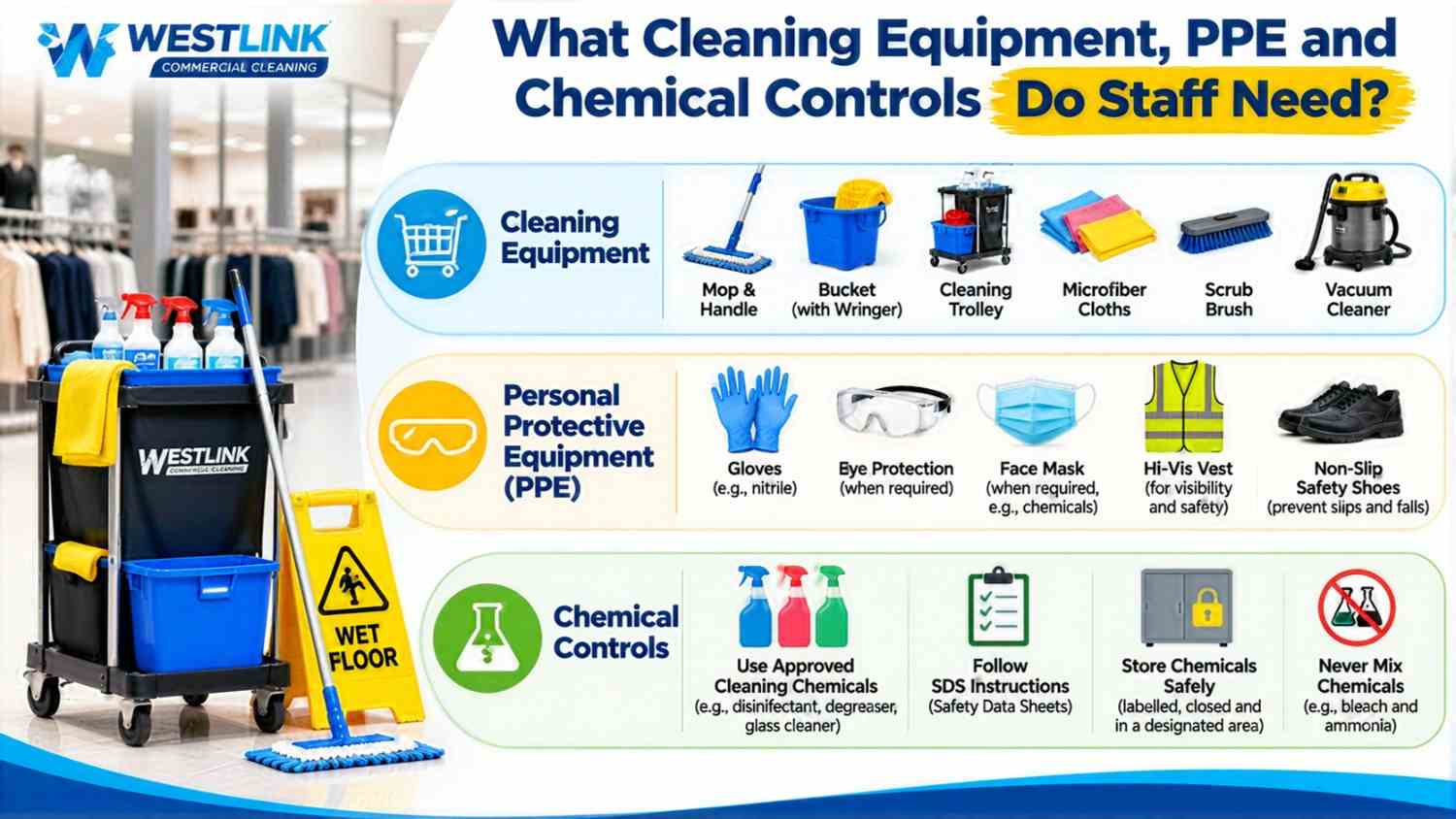
What Cleaning Equipment, PPE and Chemical Controls Do Staff Need?
Retail cleaning equipment must be suitable for the surface, contamination type, and assigned task.
Common equipment includes microfiber cloths, flat mops, buckets, suitable vacuum cleaners, non-abrasive pads, absorbent materials, warning signs, and cleaning trolleys.
Task-specific PPE may include suitable gloves, eye protection, protective clothing, and slip-resistant footwear.
Chemical Handling Requirements
Staff should follow approved product labels, Safety Data Sheets (SDS), manufacturer instructions, and workplace procedures.
Employees must:
- Use cleaning chemicals only for approved purposes.
- Follow instructions for dilution, application, and required contact time.
- Avoid mixing incompatible chemicals.
- Keep containers correctly labelled.
- Store products securely and separate incompatible substances.
- Use appropriate PPE and ventilation.
- Report damaged containers, leaks, and suspected exposure.
SafeWork NSW provides guidance on hazardous chemical risk management, chemical information, and workplace precautions.
How Can Stores Prevent Cross-Contamination?
Cross-contamination occurs when cleaning tools or materials transfer contaminants from one surface or area to another.
Stores should assign different cleaning equipment to different hygiene zones where necessary.
For example, cloths used for restroom fixtures should not be used on checkout counters, product displays, or food-contact surfaces.
Employees should also:
- Replace or launder reusable cloths according to the approved procedure.
- Store clean and contaminated equipment separately.
- Avoid placing used cleaning equipment on merchandise or food-preparation surfaces.
- Clean and dry reusable tools before storage.
- Dispose of single-use materials appropriately.
Colour-coded cloths can make equipment separation easier, but staff must be trained to follow the chosen colour system.
What Should Staff Do When Cleaning Equipment Malfunctions?
Employees should stop using equipment that becomes unsafe and report the defect to the supervisor.
Damaged electrical cables, leaking equipment, unstable machinery, and defective cleaning tools should be removed from service until assessed and repaired by competent personnel.
The handover log should identify the equipment, defect, affected cleaning tasks, and corrective action owner.
Do Different Types of Retail Stores Need Different Cleaning Procedures?
Retail stores should adapt their cleaning SOPs to the products they sell, surfaces they maintain, and operational hazards they encounter.
A clothing boutique and a supermarket may share the same basic shift structure but require different cleaning methods and hygiene controls.
| Retail environment | Additional cleaning considerations |
| Clothing stores | Fitting-room debris, mirrors, textile lint, display presentation |
| Supermarkets and food retailers | Food residue, food-contact sanitising, refrigerated-area spills, produce debris |
| Electronics stores | Surface-compatible products and restrictions around powered equipment |
| Pharmacies | Separation of routine housekeeping from regulated product or clinical-area procedures |
| Furniture showrooms | Upholstery care, surface compatibility, large display areas |
| Shopping centre tenancies | Coordination with common-area cleaning, centre access requirements, and reporting boundaries |
What Are the Cleaning Requirements for Food Retail Areas?
Food retailers may need separate food safety procedures in addition to routine retail housekeeping.
Food Standards Australia New Zealand explains that cleaning removes dirt and food residues, while sanitising reduces microorganisms to a safe level when performed correctly.
Food-contact equipment and surfaces must meet the applicable requirements of the Australia New Zealand Food Standards Code, including Standard 3.2.2.
For businesses covered by Standard 3.2.2A, additional food safety management and evidence requirements may apply.
Stores should therefore avoid treating ordinary display-shelf cleaning, food-contact sanitising, and disinfection as interchangeable tasks.
How Should Stockrooms and Loading Docks Be Cleaned?
Stockroom and loading dock cleaning should prioritise unobstructed access, packaging waste control, leak identification, and separation from moving equipment.
Employees should remove loose cardboard, plastic wrap, and other debris using approved procedures.
Cleaning should be coordinated with pallet movements, forklifts, delivery vehicles, and other activities that could expose staff to collision or manual-handling hazards.
Unsafe spills, damaged stock, leaking containers, and blocked emergency routes require prompt escalation.
How Should Retail Cleaning Tasks Be Handed Over Between Shifts?
A retail cleaning handover transfers responsibility for incomplete tasks, unresolved hazards, equipment problems, and pending corrective actions from one shift to another.
The outgoing shift must record the issue clearly, while the incoming employee acknowledges the assigned responsibility.
Five-Step Cleaning Handover Procedure
Step 1: Update the cleaning checklist.
Record completed activities, unfinished work, and any tasks requiring reinspection.
Step 2: Identify outstanding hazards.
Document affected locations, current access controls, and required escalation.
Step 3: Assign responsibility.
The supervisor identifies who must complete each outstanding task and establishes its priority.
Step 4: Obtain incoming acknowledgement.
The incoming employee confirms receipt of the handover information.
Step 5: Verify closure.
The supervisor checks that the corrective action has been completed and records the final status.
Safety-critical issues should not simply be transferred as ordinary unfinished cleaning work. Immediate controls and escalation remain necessary.
Example Retail Cleaning Handover Log
The following is a fictional example showing how a retail store might record an outstanding cleaning issue.
| Field | Illustrative entry |
| Date | Example: 12 November 2026 |
| Store area | Front entrance |
| Outgoing shift | Morning |
| Issue | Water tracked through entry doors. |
| Immediate control | The affected section is restricted with warning signs and barriers. |
| Cleaning status | Initial water removal completed. |
| Outstanding action | Reinspect floor condition and entrance mat |
| Assigned owner | Incoming shift supervisor |
| Priority | High |
| Deadline | Before reopening the affected section |
| Incoming acknowledgement | Recorded at shift change |
| Final verification | Pending until completed |
The task should remain open until the floor condition has been verified and reopening is authorised.
What Information Should Be Recorded in Every Handover?
A standard handover form should include:
- Store, department, date, and shift.
- Outgoing and incoming employee names.
- Completed and incomplete cleaning activities.
- Outstanding hazards and access restrictions.
- Equipment defects and supply shortages.
- Required corrective actions.
- Assigned task owners and deadlines.
- Incoming staff acknowledgement.
- Supervisor verification and closure time.
Digital forms may provide timestamps and a clearer record of outstanding actions, but a properly managed paper log can serve the same basic operational purpose.
How Should Supervisors Inspect Retail Cleaning Quality?
Supervisors should verify cleaning outcomes against observable acceptance criteria rather than relying only on employee checklist completion.
An inspection should establish whether the cleaning task meets the store’s documented standard and whether the area can be used safely.
Retail Cleaning Inspection Standards
| Area | Acceptable condition | Failure requiring action |
| Entrance | Floor safe for access, mat stable, walkway clear | Uncontrolled water, raised mat, obstruction |
| Sales floor | No visible spills, loose debris, or uncontrolled trip hazards | Liquid, packaging, or obstructed aisle |
| Checkout | No visible residue; approved cleaning performed. | Sticky surfaces or unsuitable chemical use |
| Fitting rooms | Floors clear, benches clean, and mirrors meet presentation standards. | Pins, tags, rubbish, visible marks |
| Restrooms | Fixtures cleaned and required supplies available | Uncontrolled contamination or missing essentials |
| Stockroom | Pedestrian routes and designated waste areas clear | Packaging blocking aisles or emergency access |
These are example acceptance standards. Individual stores may require more detailed inspection criteria.
What Happens When Cleaning Fails Inspection?
A failed cleaning inspection should trigger a documented corrective action.
The supervisor should:
- Identify the specific cleaning defect.
- Assess whether the condition creates an immediate hazard.
- Apply temporary access controls where necessary.
- Assign the corrective task to an appropriate employee or contractor.
- Record the priority and completion deadline.
- Reinspect the affected area.
- Close the issue only after satisfactory verification.
Repeated failures should prompt investigation of the underlying cause.
For example, recurring water accumulation at an entrance may indicate inadequate mat coverage, poor drainage, or unsuitable flooring rather than insufficient staff effort.
How Can Managers Measure Cleaning SOP Performance?
Managers can use operational records to monitor whether cleaning procedures are completed and effective.
Useful performance indicators include:
| Indicator | inspected.What it measures |
| Cleaning completion rate | Percentage of scheduled tasks recorded as complete |
| Inspection pass rate | Percentage of checked areas meeting defined standards |
| Spill response time | Time from notification to the beginning of appropriate hazard response |
| Outstanding task backlog | Number of unresolved cleaning actions |
| Corrective action closure rate | Percentage of issues resolved within assigned deadlines |
| Handover completion rate | Percentage of required handovers documented and acknowledged |
These figures should be interpreted alongside actual inspection results and incident records. A high checklist completion rate does not necessarily indicate effective cleaning.
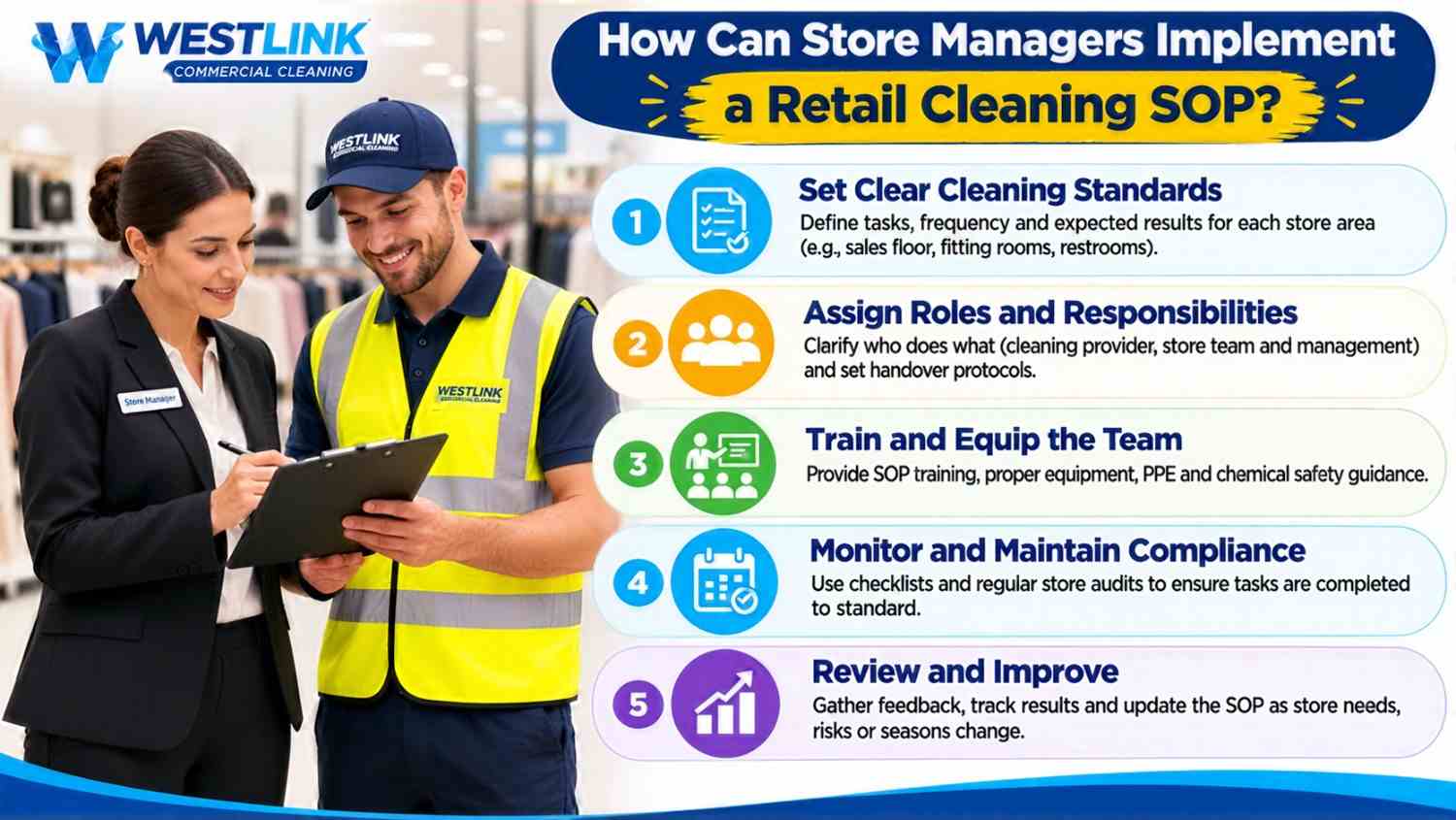
How Can Store Managers Implement a Retail Cleaning SOP?
Store managers should introduce the cleaning SOP through a documented rollout that includes risk assessment, responsibilities, staff training, and performance review.
Step 1: Assess the Retail Environment
Identify cleaning zones, customer traffic patterns, flooring materials, waste sources, spill risks, and specialist cleaning needs.
Step 2: Create the Cleaning Schedule
Assign cleaning methods and frequencies to each area according to its risk and operational importance.
Step 3: Confirm Staff and Contractor Responsibilities
Identify which tasks employees can perform safely and which require trained personnel, professional equipment, or a contracted service.
Step 4: Establish Hazard Escalation Rules
Explain when staff must isolate an area, stop cleaning, report an incident, or seek specialist assistance.
Step 5: Train Employees
Demonstrate the required cleaning methods, safe equipment use, chemical precautions, spill procedures, and recordkeeping.
Step 6: Introduce Completion and Inspection Records
Use shift checklists, handover forms, and inspection registers to distinguish completed tasks from verified outcomes.
Step 7: Review and Improve the Procedure
Review cleaning records, incidents, recurring defects, staffing changes, and store conditions.
Update the SOP when necessary and ensure employees receive the revised instructions.
Retail Cleaning SOP Templates for Store Staff
The following sample forms can be copied and adapted into a store’s cleaning manual or digital checklist system.
Template 1: Daily Retail Shift Cleaning Checklist
Store: ____________________
Date: ____________________
Shift: Opening / Mid-shift / Closing
Assigned employee: ____________________
| Task | Complete | Issue / action required |
| Entrance and mats inspected | ☐ | |
| The salesperson inspected. inspected. The floor was checked. | ☐ | |
| Checkout surfaces cleaned | ☐ | |
| Fitting rooms inspected | ☐ | |
| Restrooms inspected | ☐ | |
| Waste bins checked | ☐ | |
| Stockroom hazards checked | ☐ | |
| Cleaning supplies checked. | ☐ | |
| Spills and hazards reported | ☐ | |
| Outstanding tasks recorded | ☐ |
Employee completion time: ____________________
Supervisor verification: ____________________
Outstanding actions: ____________________
Template 2: Retail Spill Incident Record
Date and time discovered: ____________________
Location: ____________________
Substance identified: Yes / No
Description: ____________________
Immediate controls applied: ____________________
Employee or response personnel: ____________________
Cleanup method or escalation: ____________________
Area safe for reopening: Yes / No / Pending
Authorised verification: ____________________
Incident reference: ____________________
Template 3: Retail Shift Handover Form
Outgoing employee: ____________________
Incoming employee: ____________________
Shift date and time: ____________________
| Outstanding task or hazard | Current control | Assigned owner | Deadline | Status |
Outgoing acknowledgement: ____________________
Incoming acknowledgement: ____________________
Supervisor approval: ____________________
These examples are starting templates. Before operational use, stores should align them with actual job responsibilities, workplace safety procedures, record retention requirements, and applicable regulations.
Australian Retail Cleaning and Workplace Safety Guidance
Australian retail cleaning procedures should reflect the workplace’s applicable work health and safety duties, rather than relying on a generic checklist as proof of compliance.
Resources:
- SafeWork NSW — Retail Trade: Retail workplace hazards and safety considerations.
- SafeWork NSW — Chemical Spills Safety Alert: Hazardous chemical spill planning, training, and protective measures.
- Safe Work Australia — Slips, Trips and Falls: Hazard identification and risk management guidance.
- WorkSafe Queensland — Cleaning: Floor cleaning methods, slip resistance, barriers, and warning signs.
- Food Standards Australia New Zealand — Cleaning and Sanitising: Cleaning and sanitising requirements for applicable food businesses.
Frequently Asked Questions
Can Retail Employees Clean Spills Without Specialist Training?
Retail employees may clean small, identifiable, non-hazardous spills when they have appropriate instruction, equipment, and authorisation. Unknown substances, hazardous chemicals, or complex contamination require further assessment and potentially specialist assistance.
What Should Staff Do If They Cannot Identify a Spill?
Staff should prevent access where safe, avoid direct contact, notify the supervisor, and follow the applicable emergency or hazardous-substance procedure. Cleanup should not begin until the hazard has been assessed and suitable personnel are authorised to respond.
Who Signs Off a Retail Cleaning Checklist?
The assigned employee records task completion, while the designated supervisor verifies work according to the store’s inspection requirements. Employee sign-off and supervisor acceptance should be recorded separately when both are required.
What Happens If Cleaning Is Not Completed Before Shift Change?
The outgoing employee records the unfinished activity, the supervisor assigns the next responsible person, and the incoming employee acknowledges the handover. Any associated safety hazard must remain controlled and be escalated immediately where necessary. The task remains open until the required work and verification are completed.
Should Supermarkets Use the Same SOP as Clothing Stores?
Supermarkets and clothing stores can follow a similar opening, mid-shift, and closing structure, but their cleaning procedures should differ where operational risks require it. Food retailers may need specific food-contact sanitising and food safety controls, while fashion stores typically place greater emphasis on fitting rooms, mirrors, textile debris, and merchandise presentation.
How Often Should Retail Cleaning SOPs Be Reviewed?
Retail cleaning SOPs should be reviewed at the store’s approved interval and when significant changes occur. Triggers may include new cleaning chemicals, changed equipment, altered store layouts, incidents, repeated inspection failures, or updated legal requirements.
How Do Managers Know Whether Their Retail Cleaning SOP Is Effective?
Managers should compare cleaning records with physical inspections, incident reports, customer complaints, and unresolved corrective actions. Consistent completion records and satisfactory inspection results provide better evidence of effectiveness than checklists alone.
Need Professional Retail Cleaning Support in Sydney?
A retail cleaning SOP should clearly identify the tasks store employees can manage and the activities requiring trained cleaning personnel or specialist equipment.
Westlink Commercial Cleaning provides retail cleaning services for Sydney shops, boutiques, showrooms, supermarkets, and other commercial retail premises.
Store operators can discuss cleaning zones, service frequencies, after-hours scheduling, floor care, and the allocation of responsibilities between employees and contractors.
Request a retail cleaning quote to discuss an appropriate cleaning scope for your premises.
Conclusion
A retail cleaning SOP gives store employees clear instructions for opening preparation, trading-hours cleaning, closing tasks, spill response, and shift handovers.
Effective retail store cleaning procedures combine risk-based schedules, clearly assigned responsibilities, approved work methods, and observable inspection standards. They also ensure that hazardous situations are escalated rather than handled as ordinary cleaning tasks.
Store managers should adapt the procedures and templates in this guide to their retail environment, train employees on their responsibilities, and maintain reliable records of completed work and outstanding actions.
A consistent cleaning programme is one that staff can follow, supervisors can verify, and management can improve when risks or operating conditions change.