What Is End-of-Lease Cleaning? Guide for Commercial Premises
End-of-lease cleaning is the detailed cleaning a business tenant arranges before handing premises back at the end of a commercial lease, so the condition at handover matches what the lease requires. How far that clean has to go is not decided by industry custom or by what the last tenant did. It is decided by the wording of your lease and by whatever condition benchmark that lease points to.
This guide explains what a commercial end-of-lease clean covers zone by zone, where cleaning stops and a make-good obligation begins, what business tenants in Sydney are typically responsible for at handover, and how to get the scope agreed in writing before the final inspection. It is written for business premises office suites, retail tenancies, warehouses, clinics and hospitality venues. It is not a guide to residential tenancies, which run under different legislation and a different security arrangement.
If you already know what the clean involves and simply need it scoped and priced, our commercial end-of-lease cleaning services page is the faster route. If you are not yet sure what your lease obliges you to do, start here.
What End-of-Lease Cleaning Means for Commercial Premises
An end-of-lease clean is a one-off clean of the whole tenancy, carried out after the premises are emptied and before the keys, swipes and access cards go back. It is also called a handover clean, a final clean or end-of-tenancy cleaning. All three describe the same job.
Two things separate it from the cleaning a business already pays for. The first is the standard. Routine commercial cleaning keeps premises presentable while people are working in them, which means it is repeated, partial and scheduled around occupancy. A handover clean is measured once, against a fixed condition, by someone whose job is to find what was missed. The second is the trigger. Routine cleaning happens because a service contract says so. A handover clean happens because a lease clause says so, and the wording of that clause, not the cleaner, sets the finish line.
That second point is the practical one. Two businesses vacating identical office suites on the same floor can owe materially different obligations, because one lease asks for the premises to be left clean and tidy, and the other ties the handover to a schedule of condition recorded five years earlier.
End of Lease, End of Tenancy, Vacate, Bond and Make Good: the Terms Explained for Business Premises
These terms get used interchangeably in quotes and in conversation, and two of them are not interchangeable at all. Mixing up cleaning and make good is the most expensive misunderstanding available to a commercial tenant, because one is a cleaning cost and the other can include building work.
| Term | What it means for business premises | Do not confuse it with |
| End-of-lease cleaning | The final clean of the tenancy before handover. What this page is about. | Make good, which may include far more than cleaning. |
| End-of-tenancy cleaning | The same service under different wording. Common in property-management language. | Nothing; it is a straight synonym. |
| Final clean / handover clean | Trade shorthand for the same job. You will see both on quotes. | A builder’s clean, which happens after construction work. |
| Vacate clean / bond clean | Australian wording that almost always signals a residential tenancy and a rental bond. | A commercial handover, which is governed by the lease and secured differently. |
| Make good | A contractual obligation to return the premises to a condition set by the lease. The NSW Small Business Commissioner’s Retail Tenancy Guide defines it as the obligation to return premises to the condition they were first built in, the condition at the start of the lease, or another condition specified in the lease and notes it may include re-painting or restoring partitions. | Cleaning. Cleaning is often part of make good; make good is rarely only cleaning. |
| Defit / strip-out | Physical removal of fit-out: partitions, joinery, cabling, signage, and sometimes services back to capped points. | Cleaning. This is construction work. |
| Builder’s clean / shopfit handover clean | Removal of construction dust and residue after a fit-out, usually before a business opens. | An end-of-lease clean, which happens when a business leaves. |
| Routine commercial cleaning | Scheduled cleaning during occupancy, under a service contract. | A clean handover, which is one-off and inspected. |
| Bank guarantee / security deposit | The security a commercial landlord commonly holds. The Retail Tenancy Guide lists security payments as a cash bond, a third-party guarantee or a bank guarantee. | A residential rental bond, which is a different instrument under different legislation. |
| Schedule of condition / condition report | The record of what the premises looked like at a point in time, usually lease commencement. It is the benchmark a handover is judged against. | The final inspection, which is the event where that benchmark gets applied. |
| Fair wear and tear | Deterioration from ordinary use over the term. Leases commonly exclude it from the tenant’s obligations. | Damage or neglect, neither of which is excluded. |
| Broom clean | A phrase that appears in some leases to describe a minimum standard. It has no single fixed technical definition, so what it means in practice depends on the lease and on what the parties agree. | A fully commercial handover is clean, which is usually a higher standard. |
The short version: if your lease only requires the premises to be left clean, you need a handover clean. If it contains a make good clause, cleaning is one part of a larger obligation that may also involve removing your fit-out and reinstating what was underneath it. We explain that boundary in detail in make good and end of lease cleaning.
What Business Tenants Are Typically Responsible For at Handover
Your obligations come from your lease, not from a general rule about commercial premises. That sounds like a disclaimer, and it is not; it is the single most useful thing to understand before you scope a handover clean, because it tells you where to look for the answer. The chain below is how that obligation usually works in practice.
- The lease clause sets the obligation. Look for the clauses dealing with the condition of the premises at the end of the term, yield-up or redelivery, and make good. Between them, they define what state the premises must be in when you leave.
- A condition benchmark defines “how clean”. Many commercial leases refer back to a schedule of condition, a condition report or a dilapidation report prepared at the start of the term. The NSW Small Business Commissioner’s guide recommends carrying out an inspection or condition report before taking possession, precisely so this benchmark exists.
- Fair wear and tear is usually carved out. Leases commonly exclude deterioration from ordinary use. That distinction matters at handover: a worn carpet in a walkway and a stained carpet are treated differently.
- Fit-out obligations sit alongside cleaning. The Retail Tenancy Guide advises agreeing in writing, in the lease where possible, which fit-out items can stay, which must be removed, and how the premises will be made good. If those questions were settled when you signed, your handover is far simpler.
- A property or building manager inspects. In practice, this is the person who decides whether the condition has been met. What they check is a subject in its own right, and we cover it separately.
- Security is released or claimed against. A commercial landlord commonly holds a bank guarantee, a security deposit or a cash bond. If make good is not carried out, the Retail Tenancy Guide notes that a lessee will normally be liable for the lessor’s costs of doing it.
Retail leases and general commercial leases are not the same.
In New South Wales, retail leases fall under the Retail Leases Act 1994 (NSW), which adds disclosure requirements and refers disputes to the NSW Small Business Commissioner for mediation. A general commercial lease for a warehouse, a standalone office building, or most industrial premises is not covered by that Act and is governed largely by the lease itself. If you do not know which regime your premises fall under, that is worth establishing before you negotiate anything about handover.
This page describes general obligations under NSW commercial leases and is not legal advice. Read your own lease, and for a retail tenancy, start with the NSW Small Business Commissioner’s Retail Tenancy Guide. If the make-good wording is unclear or the sums involved are significant, get advice before you commit to a scope.
Why the Handover Clean Matters Commercially
Your security is exposed until the handover is accepted.
A commercial landlord typically holds a bank guarantee, a security deposit or a cash bond against the tenant’s obligations. Cleaning that does not meet the required condition is one of the simpler, better-documented reasons for a landlord to seek costs, because the evidence is photographic and the remedy has an invoice attached to it.
The lease clause is enforceable whether or not you read it.
An obligation you did not notice is still an obligation. The common pattern is a tenant who budgets for a clean, then discovers at the final inspection that the lease also required carpets to be professionally cleaned or signage removed and the substrate made good.
A failed handover has a time cost as well as a cleaning cost.
If the premises are not accepted, the work has to be redone, re-inspected and rebooked, and that can run past the date your lease ends. Where a tenant remains in occupation past the term, the lease will usually deal with that as holdover, generally on a monthly basis, with rent continuing to run. Check your own lease for how holdover is handled, because the terms vary. The point is simply that a handover which slips is rarely only a cleaning problem.
You may need the same landlord or agent again.
Commercial property in Sydney is a smaller world than it looks. The property manager inspecting your outgoing premises may well be the reference point for your next tenancy application.
What a Commercial End-of-Lease Clean Covers
Scope varies with premises type and with what the lease requires, but the structure of the work is consistent: the tenancy is emptied, then cleaned zone by zone from the top of each space down, then checked against the scope before handover. The zones below are the ones that appear on most commercial handovers. For a printable, zone-by-zone version you can work through on site, use our commercial end of lease cleaning checklist.
Common areas: reception, corridors, lift lobbies and stairwells
These are the first things an inspector sees and the easiest to under-clean, because they are circulation space rather than workspace. Work top to bottom so that dust and debris fall onto surfaces not yet cleaned.
- Dust high surfaces first: ledges, door frames, cable trays, vents, light fittings and the tops of partitions and cupboards.
- Clean walls and high-touch points: scuff marks, door handles, push plates, switch plates, intercoms and access readers.
- Remove cobwebs from ceiling junctions, corners, behind doors and above door closers.
- Clean internal glass: entry doors, sidelights, glazed partitions and reception screens, checking for streaks at an angle to the light.
- Finish with floors: vacuum carpet, including edges and under where furniture stood, then mop or machine-clean hard floors.
Then walk each area once more from the doorway, at standing height and in the light the inspector will use. Most missed work is found in that second look rather than during the clean itself.
Staff kitchens and kitchenettes
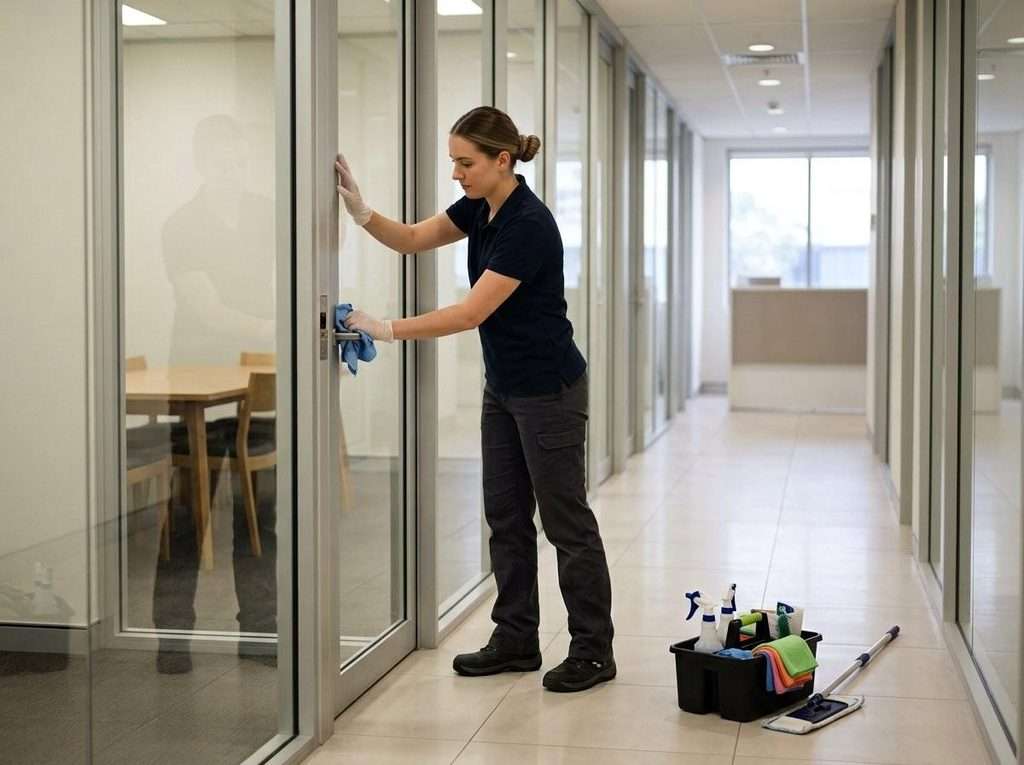
Kitchen areas fail inspections more often than any other zone in an office, because grease is cumulative, invisible from a distance and obvious under a hand.
- Benchtops, splashbacks and the wall behind any bench-top appliance.
- Cupboards and drawers, inside and out, emptied first, including runners and handles.
- Sink, tapware and drain, with mineral marks removed rather than wiped over.
- Appliances that remain with the premises: fridge, dishwasher, microwave, urn or boiling-water unit, including seals and filters.
- Floor, including the gap beside and behind the cabinetry where spills collect.
A commercial kitchen in a food business is a different job with different standards, equipment and frequencies. If you are vacating a hospitality venue, see commercial kitchen cleaning rather than treating it as a kitchenette.
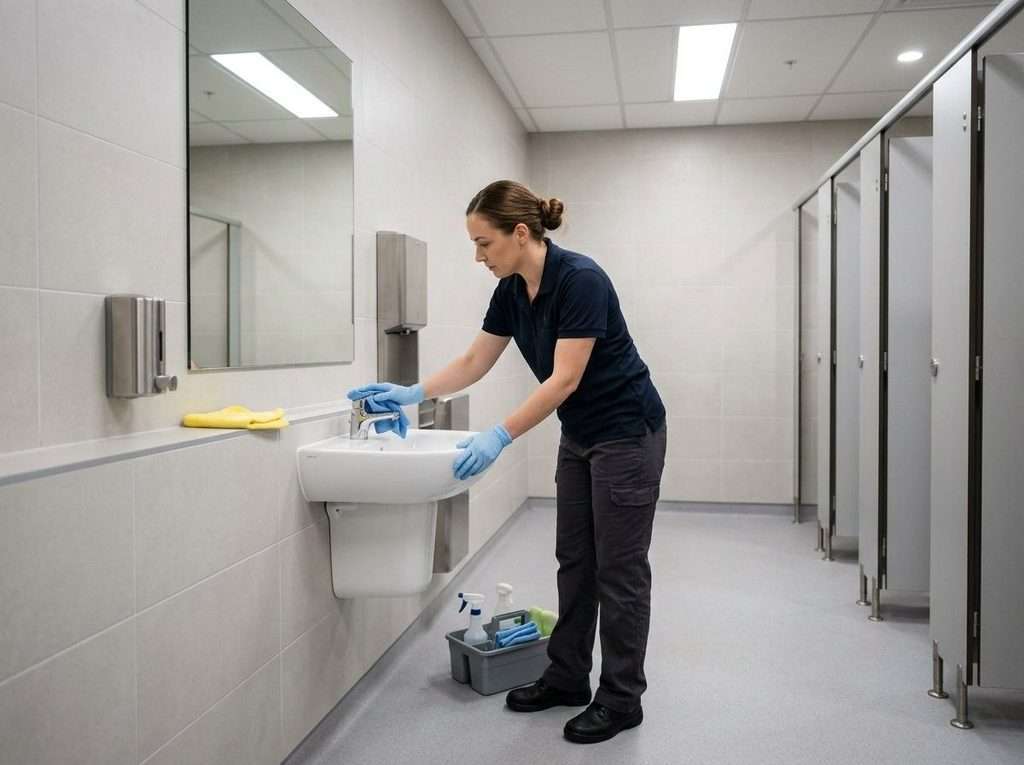
Washrooms and amenities
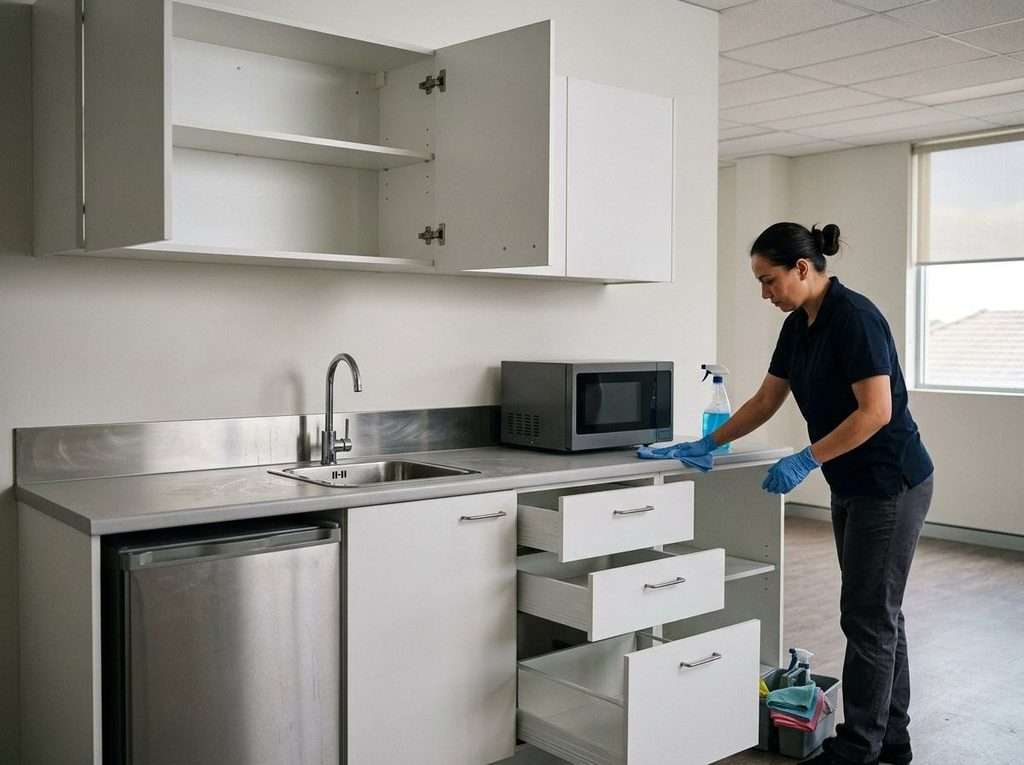
Amenities are inspected closely because the standard is hygiene rather than appearance, and shortcuts show.
- Pans, cisterns, urinals and the fixings and floor around them.
- Cubicle partitions, doors, latches and the tops of partitions.
- Hand basins, tapware, mirrors, hand dryers and dispensers.
- Consumable dispensers emptied or restocked as the scope requires, and bins emptied and sanitised.
- Tiled surfaces and grout, floor wastes and drains.
- End-of-trip facilities where the tenancy has them: showers, lockers, benches and drying areas.
Workstations, meeting rooms and fitout surfaces
This is the zone with no residential equivalent, and it is where a handover clean is visibly different from a domestic one.
- Workstations and desks once removed or emptied, including cable trays, floor boxes and the underside of desk returns.
- Workstation screens and fabric partitions, vacuumed or spot-cleaned according to the material.
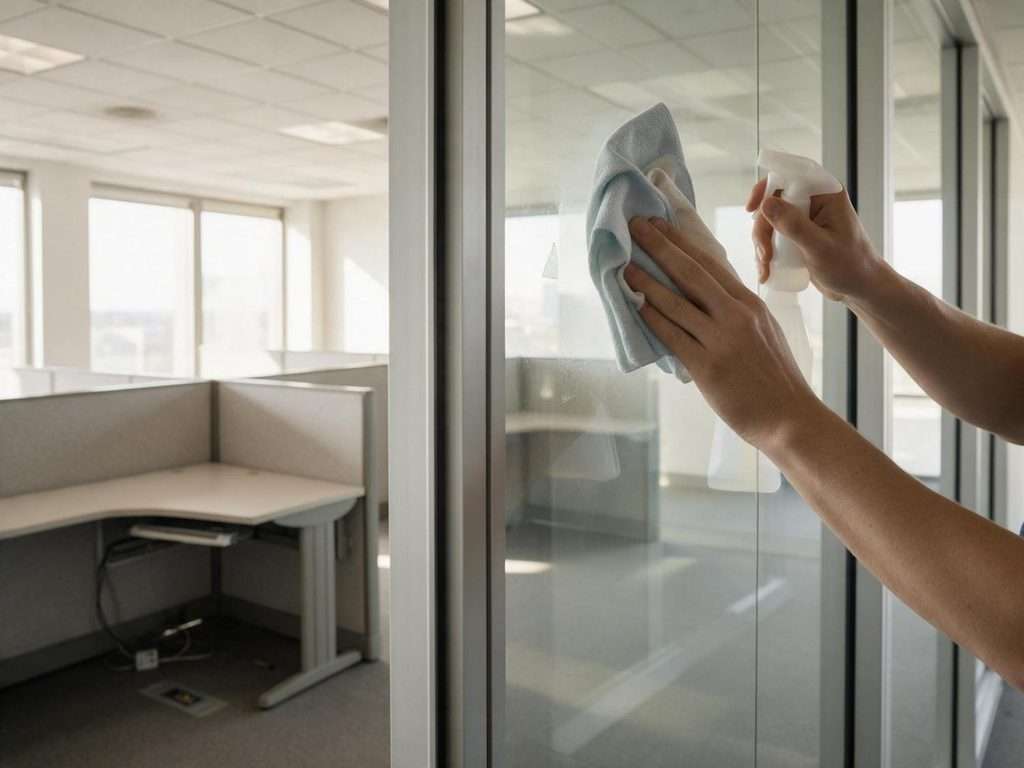
- Glazed partitions and meeting-room glass on both faces, plus frames and door furniture.
- Joinery, storage units, lockers and shelving, inside and out.
- Whiteboards, pinboards and the wall behind them.
- Marks and adhesive residue left by removed signage, decals, wall graphics and cable clips.
That last item is worth flagging early. Removing signage is usually straightforward; what is left behind is adhesive, paint shadow, and fixing holes can cross from cleaning into make good, and the two are quoted by different trades.
Confirm These as Scope, Not Assumptions
Most handover disputes we see described are not disagreements about quality. They are in disagreement about what was included. The items on the right below are the ones most often assumed by tenants and excluded by quotes.
| Usually part of a commercial handover clean | Confirm explicitly before you accept a quote. |
| Common areas, offices and circulation space | Carpet extraction or steam cleaning, where the lease requires it |
| Staff kitchen or kitchenette | External glass and any window above ground level needing access equipment |
| Washrooms and amenities | Waste and rubbish removal, including bulk waste left after a defit |
| Internal glass and partitions | E-waste and secure document destruction |
| Hard floors: mop or machine clean | Hard-floor stripping and resealing, as distinct from cleaning |
| Dusting, high surfaces and vents | Loading docks, back-of-house, yards and external areas |
| Fixtures and fittings that stay with the premises | Adhesive and paint residue after signage removal |
| A final check against the agreed scope | Anything requiring a licensed trade, which is make good, not cleaning |
Carpets are the most common of these. Many commercial leases require professional carpet cleaning at the end of the term as a specific obligation rather than as part of a general clean, so it is worth checking the clause rather than assuming. Our guide to end-of-lease carpet cleaning for commercial premises covers methods, traffic zones and what property managers look for. External windows raise a different question: responsibility for them is not always the tenant’s, which we cover in who is responsible for cleaning outside windows.
Cleaning In-House vs Engaging a Commercial Contractor
Some businesses can complete a handover clean with their own staff or their existing cleaning contractor. Whether yours can depends on six practical constraints, not on effort.
| Consideration | In-house or existing routine contractor | Specialist handover contractor |
| Access hours | Usually limited to normal hours, which may not suit an empty tenancy or a building with restricted access | Typically scheduled around the handover date, including outside business hours where the building permits |
| Site induction and WHS | Your staff may not hold the inductions a building requires for contractor work. | Induction and site-rule compliance is part of the engagement |
| Insurance | Check whether your policies cover staff performing this work, particularly at height or with machinery. | Public liability and workers’ compensation should be confirmed in writing before work starts |
| E.quipment | Domestic or light commercial equipment is rarely enough for carpet extraction, hard-floor machines or height access. | Plant is matched to the scope; specialist work may still be subcontracted. |
| Scale | Workable for a small suite emptied in good condition | Better suited to multi-zone tenancies, warehouses and tight handover windows |
| Documentation | Rarely produced, which leaves you without evidence at inspection | A written scope and photographic evidence where agreed gives you something to point at. |
In-house is a reasonable choice when the tenancy is small, the fit-out is simple, the premises are already in good condition, and the lease asks only that they be left clean. It becomes a poor choice when the lease specifies professional cleaning of particular elements, when the building imposes contractor requirements, or when the handover date leaves no room to redo work.
How Much Does Commercial End-of-Lease Cleaning Cost in Sydney?
There is no single rate, because a handover clean is priced against a scope rather than against a floor area alone. Five factors do most of the work in a quote:
- Size and zone count. Size and layout of the tenancy, including how many separate zones it contains.
- Condition. Condition at the point the premises are emptied, which is usually a bigger variable than size.
- Access and hours. Whether work must run after hours, at weekends, or around lift and dock bookings.
- Add-ons. Carpet extraction, external glass, hard-floor treatment and waste removal are commonly priced separately.
- Timing. A compressed handover window costs more than a planned one because it constrains crew size and scheduling.
The most useful thing you can do before comparing quotes is to fix the scope first. Two quotes for “an end-of-lease clean” are not comparable; two quotes against the same written scope are.
How Long Does a Commercial End-of-Lease Clean Take?
Duration depends on far more than floor area, which is why a quote should state a schedule rather than an hourly estimate. These are the factors that move it:
| Factor | Why it changes the schedule |
| Floor area and number of zones | A single open floor cleans faster per square metre than the same area split into offices, meeting rooms and amenities. |
| Condition at handover | Accumulated grease, adhesive residue and neglected amenities take disproportionately longer than general soil |
| Whether the tenancy is fully emptied | Cleaning around remaining furniture or stock means returning, which is the most common cause of overrun. |
| Access hours | After-hours and weekend work may be required by the building and may need to be booked in advance. |
| Lift and dock bookings | Equipment and waste movement in a multi-storey building depends on a booked service lift. |
| Site induction lead time | Some buildings require inductions or approved-contractor status before anyone starts. |
| Security escorts and alarms | Out-of-hours access may need an escort, an alarm isolation or a temporary access card. |
| Staged handover | Handing back floor by floor takes longer in total than a single handover but protects the deadline. |
| Drying time | Carpet extraction needs drying time before the inspection; build it into the schedule, not around it. |
The scheduling point that matters most: book the clean to finish with time before the inspection, not on the same day. If something is flagged, you want the room to fix it while you still hold access.
Planning a Commercial Handover Clean: What Goes Wrong, and How to Avoid It
Five failure points account for most handover problems. Each has a straightforward preventive action.
- Booking the clean for the handover date itself. If anything is flagged, there is no time to fix it. Instead: schedule the clean to complete two to three days before the inspection, and keep access until the handover is accepted.
- Scoping from a walkthrough instead of from the lease. A cleaner quoting on what they can see will not know the lease requires carpets professionally cleaned or signage substrate made good. Instead: read the yield-up and make-good clauses first, then brief the scope from them.
- Cleaning before the tenancy is fully emptied. Furniture, stock and cabling left in place mean a second visit and a second charge. Instead: sequence removalists, defit and cleaning in that order, with a clear day between each.
- Assuming back-of-house is out of scope. Loading docks, yards, storerooms, plant cupboards and bin areas are part of the tenancy and are inspected. Instead: walk the full demise, including the areas nobody uses, and list them in the scope.
- Leaving no evidence of what was done. Without a scope and a record, a dispute becomes one recollection against another. Instead, agree on the scope in writing, and take dated photographs of each zone at completion.
If something is flagged at the final inspection
The property manager will normally identify the specific items and the standard expected. From there the sequence is practical: confirm in writing what has been raised, check each item against the scope that was agreed upon and against the lease obligation, and establish who is addressing it and by when. Items that fall inside the agreed cleaning scope are handled under that agreement; items that turn out to be make good, damage or repair are a different obligation and usually a different trade.
Frequently Asked Questions
Is end of lease cleaning the same as make good for a commercial lease?
No. End-of-lease cleaning is the final clean of the premises. Make good is a contractual obligation to return the premises to a condition set by the lease, which the NSW Small Business Commissioner notes may extend to removing fit-out, repainting or restoring partitions. Cleaning is frequently one component of make good, but make good is rarely satisfied by cleaning alone.
Is “end of tenancy commercial cleaning” a different service?
No, it is the same service under different wording. End of tenancy cleaning, handover cleaning and final cleaning all describe the clean carried out before commercial premises are handed back. Use whichever term your lease or property manager uses so that everyone is scoping the same job.
Does a commercial lease require professional cleaning, or can our own staff do it?
It depends on the clause. Some leases require only that the premises be left clean, which your own staff may be able to achieve. Others specify professional cleaning of particular elements; carpets are the common example in which case a receipt or report may be expected at handover. Read the yield-up and make-good clauses before deciding.
Do commercial carpets have to be professionally cleaned at the end of a lease?
Often, but not always, and the answer is in your lease rather than in general practice. Where a lease specifies professional carpet cleaning, doing it in-house will not discharge the obligation even if the result looks the same. Our guide to end-of-lease carpet cleaning for commercial premises covers methods and what is checked at handover.
Who is responsible for cleaning the external windows at handover?
That depends on the lease and, in a multi-tenanted building, on what the landlord handles as part of building services. External and high-level glass also raises access-equipment and safety-planning questions that internal glass does not, so treat it as a scope item to confirm rather than assume. We look at this in terms of who is responsible for cleaning outside windows.
What happens if the property manager is not satisfied at the final inspection?
They will usually list the specific items and the standard expected. Confirm that list in writing, check each item against the agreed cleaning scope and against your lease obligation, and agree on who addresses it and by when. Keeping access until the handover is accepted is what makes this manageable, which is why the clean should be scheduled ahead of the inspection rather than on the same day.
Your Next Step: Get the Scope Agreed in Writing
The single action that prevents most handover problems costs nothing and takes an afternoon.
- Read the yield-up, condition and make-good clauses in your lease, and find the schedule of condition if one exists. Note anything that names a specific cleaning requirement.
- Write the scope down zone by zone, including back-of-house, and mark each item as either included or to be confirmed.
- Send that scope to your property manager before the clean, and ask whether anything is missing from their perspective. It is a short email, and it moves the disagreement to a point where it is still cheap to resolve.
- Quote against that scope, not against a walkthrough, and book the work to finish before the inspection, not on the day.
If you would like that scope priced for premises in Sydney, our commercial end-of-lease cleaning services page sets out what we cover and how to request a quote. Bring the lease clause with you; it makes the conversation much shorter.