How to choose retail cleaners in Sydney comes down to 12 questions that separate documented providers from confident sales pitches. The checklist below covers experience, registration, insurance, staffing, screening, scheduling, security, quality, shift cover, equipment, pricing and contract terms. It suits shop owners, store managers, shopping centre tenants and multi-store operators.
How do you choose retail cleaners in Sydney?
Ask every provider the same 12 questions, tick an item only when the provider shows written evidence, and compare at least three providers against one written scope: floor area, trading hours, cleaning frequency, access arrangements and task list. Westlink Commercial Cleaning offers retail store cleaning in Sydney, and the same checklist applies to it and to every other provider on your shortlist. Run the checks in two stages: confirm the mandatory items first, then score the rest.
What is on the 12-question retail cleaner checklist?
Each question has an ask, an evidence item and a warning sign.
1. Do the cleaners have experience with stores like yours?
Retail experience shows in a plan written for your store type, not a generic office routine.
- Ask: Which store types do you clean now, such as boutiques, supermarkets, pharmacies, showrooms or centre tenancies, and which tasks apply to mine?
- Evidence: Two references from comparable sites and a sample plan listing your areas. A retail store cleaning checklist helps you draft the scope.
Watch for a plan that assumes fitting rooms or checkouts you do not have, or omits ones you do.
2. Is the business registered, and which entity signs the contract?
An Australian Business Number (ABN) identifies a legal entity, which may trade under a different business name.
- Ask: Which entity signs the contract and holds the insurance, and who is my account manager?
- Evidence: An active ABN confirmed on ABN Lookup, with the legal name, trading name, quote, contract and insurance certificates consistent.
Watch for: Entity names that differ between documents with no explanation. An ABN alone does not prove competence or insurance.
3. Which insurance policies are current?
Public liability insurance matters most in customer-facing stores. Workers’ compensation applies once a contractor’s wages pass the NSW exemption threshold.
- Ask: What is the sum insured and expiry date for public liability? Do you hold workers’ compensation or claim an exemption, and why? Does the cover meet my lease or centre minimums?
- Evidence: Certificates of currency, plus policy conditions and exclusions where needed.
Watch for: An unexplained exemption claim. NSW employers paying $7,500 or less in annual wages, with no apprentice or trainee, may be exempt, but a contractor with a regular crew would normally exceed that. A certificate does not confirm every activity or subcontractor is covered.
4. Who will actually do the cleaning?
Employees and approved subcontractors can both work, provided someone stays accountable for pay, training, supervision and safety.
- Ask: Are the cleaners employees, contractors or labour-hire workers? Do you subcontract any work, and do I approve it first? How do you meet the Cleaning Services Award 2020?
- Evidence: Written subcontracting terms and a statement of who supervises the work.
Watch for unexplained subcontracting or a price too low to cover award wages. The Fair Work Ombudsman explains that the award covers employers and employees in contract cleaning, not independent contractors, and lists underpayment and sham contracting among its compliance concerns.
5. How are cleaners screened and trained?
Screening needs vary with your risk and site rules, so ask for the policy rather than copies of personal records.
- Ask: Which checks do staff pass before attending my store? How recent must they be, and what training and site induction do they receive?
- Evidence: A written screening policy, written confirmation that the assigned cleaners have been checked, and induction records.
Watch for: Vague assurances such as “all our staff are checked” with no policy behind them.
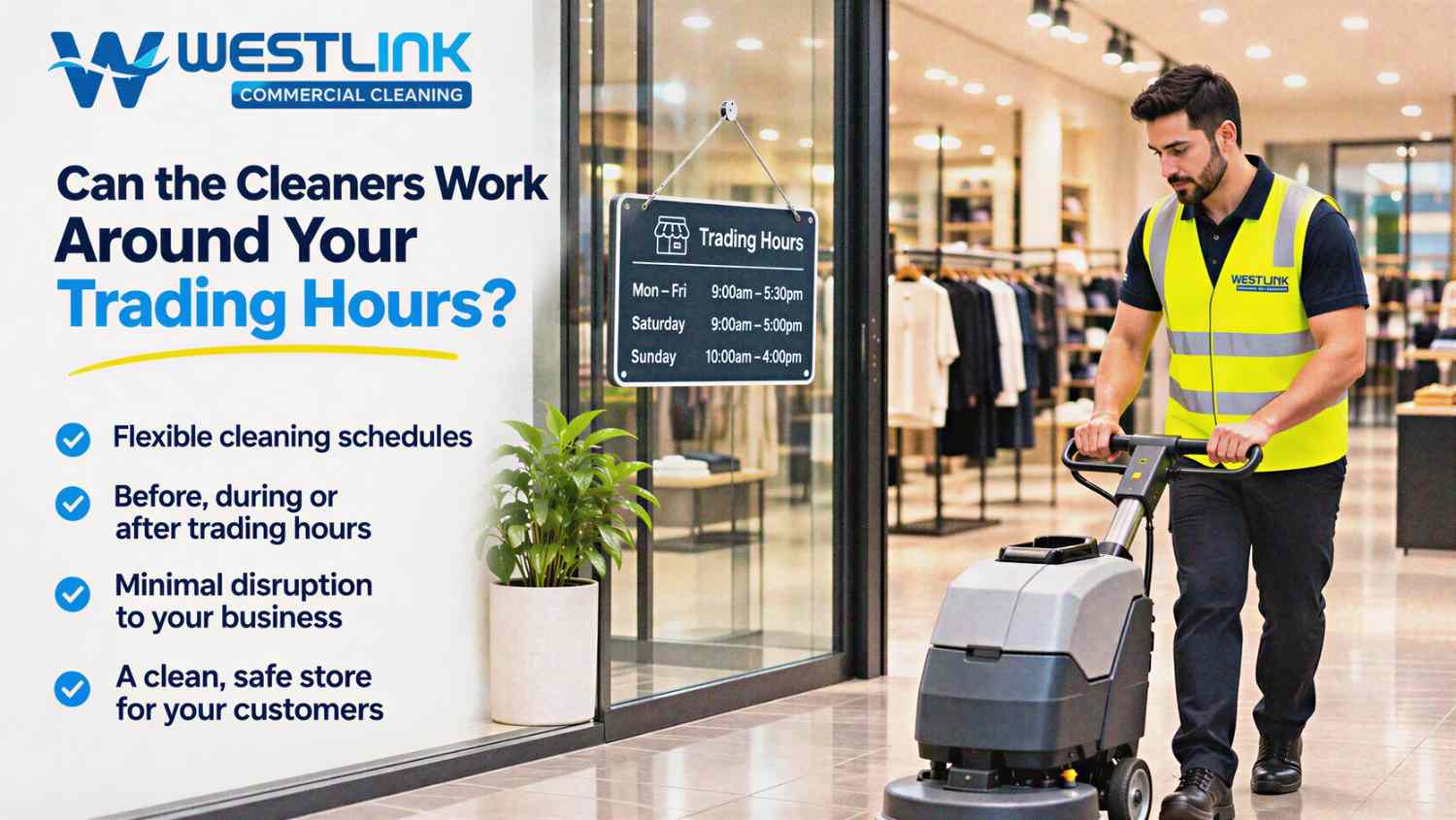
6. Can the cleaners work around your trading hours?
Availability should match what your contract needs: pre-opening, after closing, overnight, weekends or public holidays.
- Ask: Which windows do you cover, and how fast can you attend an urgent spill? How will you handle Christmas peaks?
- Evidence: A written schedule, with weekend and public holiday rates shown in the quote.
Watch for: Out-of-hours rates missing from the quote.
7. How are keys, alarms and site access managed?
A standalone shop and a shopping centre tenancy have different requirements, and the centre’s tenant handbook and contractor rules take precedence.
- Ask: How are keys issued, stored and returned, who holds the alarm code, and do you complete centre contractor inductions?
- Evidence: A written access procedure, attendance records, a confidentiality agreement if needed, and induction records for centre sites.
Watch for: Shared keys or alarm codes with no log.
8. How is cleaning quality measured?
A checklist shows what should happen. Inspection results and corrective actions show what did.
- Ask: Who inspects the store, how often, and which measures do you track, such as shift completion, inspection pass rates, complaint response times and repeat defects?
- Evidence: A sample inspection report, service level agreement (SLA) targets agreed with you, and a record of how defects are corrected.
Watch for: “We trust our cleaners” as the only control.
9. What happens when a cleaner misses a shift or you complain?
Both contingency staffing and a complaint path matter.
- Ask: How quickly does a relief cleaner attend, and who handles complaints and re-cleans?
- Evidence: A written contingency arrangement, a named escalation contact and response times. A retail cleaning SOP shows what spill response and handover can look like.
Watch for: No named escalation contact.
10. Who supplies equipment and manages chemical safety?
Supply responsibility should be written down, and Safety Data Sheets (SDS) alone do not show a working chemical safety system.
- Ask: Does the price include equipment, products and consumables? How do you label, store, dilute and register chemicals, train staff and respond to spills? Which methods suit my floor types?
- Evidence: Safe work procedures, a chemical register where required, SDS, protective equipment and training records, aligned with the Work Health and Safety (WHS) Act 2011 and Work Health and Safety Regulation 2025 that SafeWork NSW administers.
Watch for unlabelled chemicals or no colour-coded equipment to prevent cross-contamination.
11. How is the price built?
Hourly and fixed-price quotes can both be fair when scope, inclusions and exclusions are clear.
- Ask: Will you assess the store before quoting? What is excluded or charged extra, such as carpet extraction, high-level dusting, consumables or out-of-hours work?
- Evidence: A written quote issued after a site assessment, showing GST, inclusions and exclusions.
Watch for: A quote with no scope of work or no list of additional charges.
12. What do the contract terms say?
Longer terms and early termination charges can be reasonable when they are proportionate, so judge notice, renewal, price changes and termination rights together.
- Ask: Is a month-to-month or no-lock-in option available? How are price increases, scope changes and repeated service failures handled, and is there a cure period?
- Evidence: A contract with subcontracting, insurance, confidentiality, notice and termination clauses. The ACCC explains that unfair contract term rules can protect small businesses signing standard form contracts.
Watch for: Automatic renewals combined with heavy exit fees.
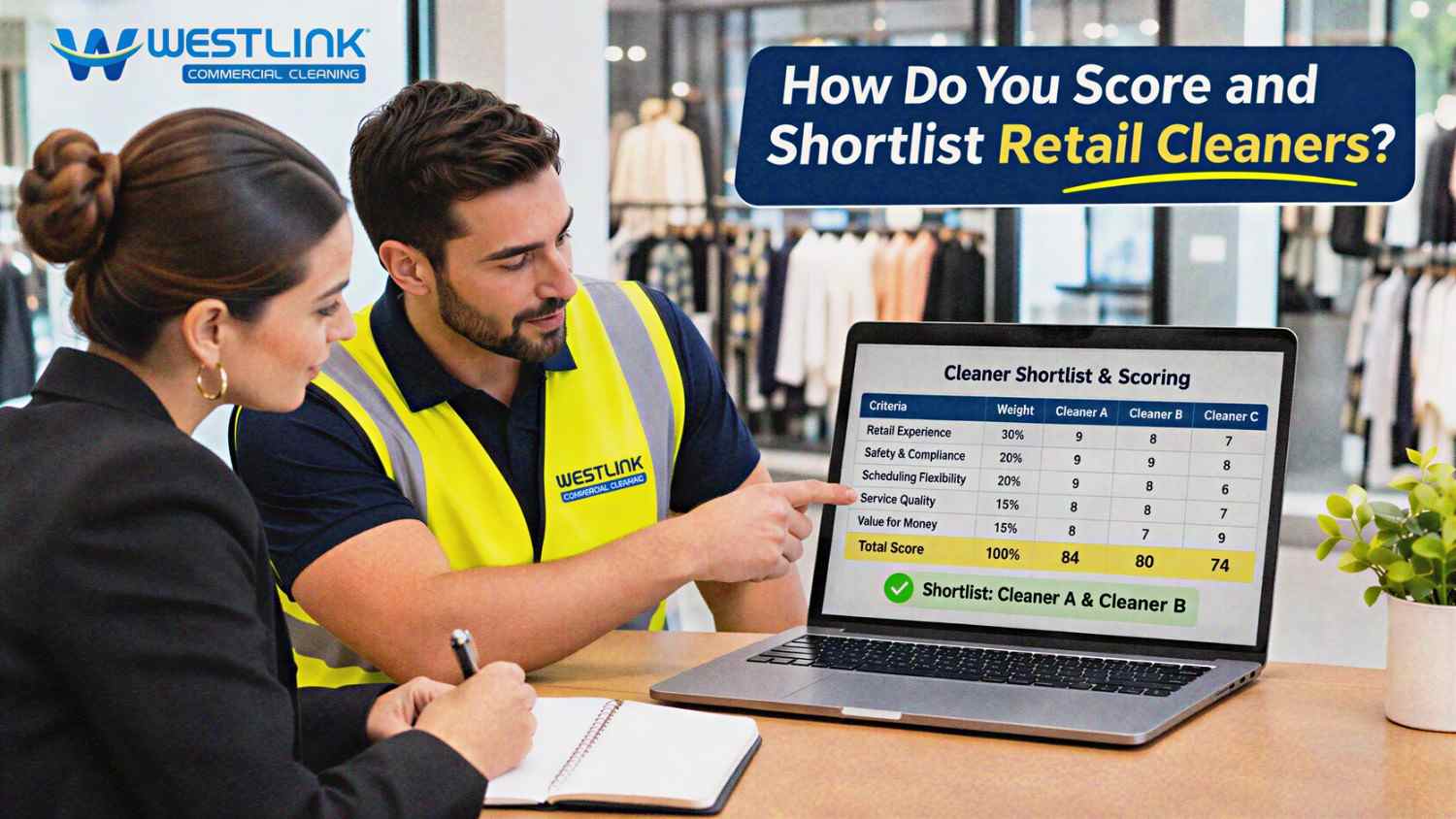
How do you score and shortlist retail cleaners?
Stage one is pass or fail: confirm identity, applicable insurance, lawful workforce arrangements, safety procedures and any site security requirements (questions 2 to 5, 7 and 10). Stage two scores the remaining items from 0 (no evidence) to 5 (documented evidence), weighted to your risk. Quality measurement, retail experience and scheduling often deserve heavier weights, but the weights are your judgement, not an industry standard. Compare quotes only on identical scope, because a cheaper quote that omits consumables or glass cleaning can cost more over a year.
How does Westlink answer these 12 questions?
Put Westlink Commercial Cleaning through the same checklist. Its retail store cleaning page states that it carries public liability and workers’ compensation insurance on every job, uses police-checked crews, offers free site assessments, uses colour-coded equipment, keeps SDS documentation for its products and offers month-to-month arrangements without lock-in. It also states that it cleans before opening, after closing, overnight and on weekends, and reports centrally for multi-site retailers.
Ask Westlink for the certificates, screening policy, sample inspection report and contract terms behind each statement, as you would for any provider. Then request a retail cleaning site assessment with your written scope and compare the answers.